Thursday, 20 April 2017

Thirteen Reasons Why - Jay Asher

'I'm listening to someone give up. Someone I knew, someone I liked. I'm listening. But still, I'm too late.'
This cover put me off this book for
a while because I thought it looked
a little childish and I expected the
same from the story itself.

Heyo!

As you might know, I was supposed to be studying reading other stuff, but the hype is high and I had bought this earlier... So I thought I'd read a bit of it. And I ended up reading all of it over three days of mostly doing other things. It was very gripping, one could say.

The premise of this book is this: High school student Clay Jensen receives a package of tapes, and finds out they were a suicide note of such by his crush, Hannah Baker, who committed suicide two weeks prior. These tapes tell the story of the thirteen reasons and thirteen people who drove her to kill herself, and Clay received them because he's one of them. (The notes in the book tell me this is a pun on the Baker's Dozen, which I found quite funny)

The style works quite well; Hannah's voice on the tapes is in italics, Clay's thoughts in normal text. It's all woven quite tightly together, and it works. Clay follows in Hannah's footprints along the places she talks about, offering some of his knowledge to fill in the gaps. I think this might also work quite well as an audio book, provided whoever read Hannah's parts was very good at what she does.

In a way, this book is a horrible read. All of the horrible things that have happened to Hannah, I've heard them all before. These things happen to people, because we are careless and can never think enough about the consequences of our actions and words on others. In its heart, Hannah made these tapes not because she blames these people, but because she wants them to know how even smaller actions can destroy you. She even acknowledges that this decision was ultimately hers and hers alone, even if the actions of others made her think of it.

I didn't think I would like this since I don't really agree with suicide as an option, but I thought the situation was handled quite delicately here. It didn't preach or claim to tell anyone else's story. Regardless, I would never recommend this to anyone who's had problems with depression or suicidal thoughts or anything. This isn't a helpful book in that way. What I didn't like about this book was that some story points didn't really come across that clearly, and I would have wanted to know more.

The ending, I thought, was quite clever and nice. I really liked that. I also liked how all the different stories were quite different. I also liked Clay, even though he was a bit flat. Like Nick in The Great Gatsby, he was an onlooker of sorts, and everything happened around him, not necessarily to him. That's all cool though. This story isn't about Clay, but about Hannah.

Through the tapes, the book handles with many difficult subjects for teenagers, like drinking, relationships, depression, bullying... It was sobering in how real it felt - I didn't leave that time all that long ago, after all.

All in all, I'd give this a 3.5/5, rounded up. It was an easy read in a way, and succeeded in what it set out to do.

For the Helmet 2017 reading challenge I put this in category 19: A "one day story" book! (This does have like a three page epilogue from a different day but I thought it's still good enough... If I read a better one this year, I might change that!)

I think I'll check out at least the first episode of the Netflix original show based on this and let you know my thoughts later under this post. I'm very curious.

Thoughts on the TV show (Edit from 22th April)

I admit - this thing looks pretty
cool. Better than the book cover,
anyway!
So I watched that pilot like I said I would. And while I can say that I totally would have enjoyed it had I not read the book previously (this thing heavily relies on the mystery of who did what to Hannah), it's a bit drawn out. Of course it would be, considering that in the book Clay listens to all the tapes in one night - to me this even made sense, considering he felt like he should do it as quickly as possible. In the Netflix series however, it's a 'monster of the week' type of thing, with each side of the tape - one story - given a whopping 50 minutes. If the book has 336 pages (it does, by the way. I checked!), it would be around 25 pages per tape. So you can imagine how drawn out this thing feels to me, in comparison.

There's all this added drama. From what the first episode gives me, Hannah's parents are filing a lawsuit against school (why?), everyone who has had the tapes before tries to contact Clay, and Clay has to ask people about obvious things which in the book were treated like just that - obvious. Also, Clay is some crusader vigilante who has decided to bring Hannah justice.

Also, from my brief online reading, this thing ends on some cliffhangers so they're planning a second season? Now why in the world would they do that? I thought the book ended really gracefully and a second season, well, if this was drawn out already... On the bright side, however, what's on the tapes seems to be very faithful to the book. There have been a lot of direct quotes spoken by Hannah, and I appreciate that.

Having watched this one episode and pretending like I watched the whole show, I'm starting to believe that most of the problems people have with this thing are actually added just for extra drama. That's a shame, and I find myself thinking that if you're on the fence about this, please just read the book instead. Except if you're depressed! It's not a happy story when someone's died.

Never mind all that. More importantly, why did I think Hannah was a blonde? I have real problems recreating characters in my mind from their descriptions, it seems. I just make up whatever I want instead. Welp.

Wednesday, 12 April 2017

Carry On - Rainbow Rowell

'You have to pretend like you get an endgame. You have to carry on like you will; otherwise, you can't carry on at all.'
I think it turned out really pretty! (Though after reading it I
should have maybe gone for darker tones...)

I bought this book from Glasgow on the prettiest spring day last year purely based on the fact that you could colour it in yourself and I thought that was the coolest thing ever! (Also, it's signed by the author, which helped...) So last week I decided to get to it and actually colour it in and then read it. That's pretty much the whole story. I've not read Fangirl or Eleanor & Park but this was so good I definitely will, both of those.

I feel like this is one of those books where knowledge adds to the pain and you're better off knowing as little as possible. (Though if you've read Fangirl first you definitely know something I didn't) So I'll not tell you much of the plot but maybe hopefully enough so that you'll want to read it!

Simon Snow is The Chosen One - the one that will save the Magickal World. However, he's not able to control his magic, and everything else in his life is currently a bit of a mess as well. His girlfriend breaks up with him, and maybe they were never really in love anyway. The Insidious Humdrum is out to kill him, lobbing all sorts of monsters at him, and his horrible roommate is gone, probably also plotting his demise.

Blank book and mismatched woolly socks
The book is clearly inspired by Harry Potter, but I think it's in a very tasteful and inspired way. (Though some people seem to disagree, and that's okay too!) It has "all of this happened in our previous years" sort of recaps sometimes, and skips straight to their last year at Watford School of Magicks. Don't get me wrong, I'm sure it would've been cool to read about Simon Snow, from the Normal World, learn about the magickal realm at the age of 11... but that would have been a bit too on the nose. This book is very meta, but at least it doesn't pretend that it's not the case.

The take on magic itself is also really interesting. They use words, but they're words that become more powerful the more they're used. Like nursery rhymes, which are mentioned as some of the most powerful spells, because they're forever stuck in your brain. Or sayings, lyrics, metaphors, that sort of a thing. They're very innovative and fun, and they're bolded and in italics in the book so you can always tell easily when someone's using their magic. I had to wonder how you'd make that work in an audiobook, since it's not like these words are always yelled or boomed or stuff, either.

I really liked how the Magickal World was portrayed with variety and depth, and the story managed to touch many different lives. It's also told through the eyes of many different people, which makes it even better. The only thing that doesn't get much coverage is the Normal World, but I think it's, like in Shadowmagic, an 'imagine your own life here' sort of a thing. It works just fine, since Normal isn't all that exciting in comparison anyway.

Work in progress!
I also liked all the characters for different reasons! I liked Simon because he was really caring and even though he was clearly important, he didn't try to make everything about himself. I liked Baz because he was misunderstood, but he didn't wear it like a cape. I liked Penny because she was helpful and smart and a really good friend. And Agatha because she was the most human out of all of them. I liked Ebb because I thought she was like Ilia from Twilight Princess. (too meta?) And even the characters who didn't get all that much page time all added to the experience, to the life and heart of the world.

This story is a very good portrayal of growth and what it's like to accept yourself even when it feels like you don't want to. It deals with a lot of important themes in a way that was surprisingly mature and not at all pointed. The romance (that's a thing) was cute and important but not overpowering. My main problem was probably with the ending - a lot of characters didn't find out things that I as the reader knew, and it bothered me because I was really hoping that all these loose strings would be tied up in a neat bundle in the end.

Also, did I mention that this book is very British? You guys know how I love that - it makes me feel at home. It's by an American author but regardless, she does a terrific job at showing the different places and mannerisms and the language. It might be a bit less posh British than Harry Potter and more... Northern, almost. It made me feel quite fuzzy and warm inside.

So anyway, easy 5/5, I really liked this but I see why some people haven't (it's that Harry Potter thing, they see plagiarism where I saw inspiration). I'm going to read Hän sanoi nimekseen Aleia (She said her name was Aleia) next, because my mum was really nice and bought it for me in Helsinki!!

For the Helmet 2017 reading challenge, I put this in category 6: A book with many storytellers!

Wednesday, 5 April 2017

Senlin Ascends - Josiah Bancroft

"“I still recall a line from that feckless Everyman’s guide. It said something like, ‘the Tower’s real trade is in whimsy, adventure, and romance.’ I cannot imagine a less accurate trio. Though, who in their right minds would’ve come if the editors had said, ‘the Tower’s true trade is in tyranny, dismemberment, and heartbreak?” - Every Man’s Tower, One Man’s Travails by T. Senlin"

Hello!
I think this cover looks amazing.

I started reading this book while in Brussels because Daniel was taking so long with The Unknown SoldiersSenlin Ascends has been getting a ton of hype lately, and for a change, I feel like it was every bit deserved. 

Thomas Senlin, a school headmaster, goes with his wife on a honeymoon to the prestigious Tower of Babel - a place for the cultured, the luxurious, the ones who need nothing more in life.

It all goes bad within minutes, as fate would have it. Senlin and Marya get separated in the market, and Senlin is left with their money and train tickets back home. He decides to climb to the third ringdom of the tower that reaches to the skies, and meet her at the Baths, where they were going to go.

Only the Tower isn't what he thought. It's full of criminals, corruption, dictators and straight-up torture. He meets what he believes to be friends, only can you trust anyone in a place where everyone is indebted, threatened and alone?

The writing and the characters are both incredibly strong in this book. Senlin is very intelligent and capable of sharp wits and analysis, and everyone he meets feels like a person even before you find the burden they might be carrying. I loved most of the characters in this, but also the way they were all so different and in the Tower for their own reasons. My favourite was probably Edith, though I will tell you nothing about her because you shouldn't know too much. Even as I say this, I liked all of the characters and their backstories a lot. Senlin himself has a tremendous amount of character growth and it still feels believable and not like an awkward level up.

The setting is also excellent, not necessarily 100% real but something I can still imagine, with an old-school steampunk vibe but with added bits of intrigue from everywhere. It felt East more than West, but in a believable way. The different ringdoms of the Tower are very creative and different from one another, but the book never forgets about the ones it's already gone through. That's really cool. Each chapter also open with a quote from a book, at first from "Everyman's Guide", which is Senlin's trusty guidebook from the beginning. Later it becomes "Every Man's Tower", which Senlin writes himself. These quotes are often witty and sometimes downright ironic, and they're a lot of fun to read.

Senlin Ascends is the first in a four-book series, the last two not being out yet. I think I'll give it some time before reading part two, but at the same time I am so excited to do it! Meanwhile, I recommend this so much!! Please read it!! It's amazing and I want everyone to get this sort of experience of a great book that feels fresh and engaging. While writing this review, I bought physical copies of this one and Arm of the Sphinx, the sequel, on Amazon. Whoops. How did that happen.

All in all, a strong 5/5 because I wouldn't even dream of trying to change anything in this amazing little masterpiece. I'm definitely in love.

For the Helmet 2017 reading challenge I put this in category 2: A book discussed in book blogs!

Friday, 31 March 2017

Paras mahdollinen maailma - Riikka Pulkkinen

'Elämästä paljon suurempi osa kuin uskallamme itsellemme myöntää on unta.'

'A much bigger part of life than we dare admit to ourself is a dream.'

Hello again!

This is the other book my mum bought me for Christmas - maybe it's because the main character's father has a stroke or maybe because the book is quite heavily about the Berlin Wall. Maybe it's because she's read books by Riikka Pulkkinen before and I haven't yet. Anyway!

Aurelia was born on the day the Wall fell. Her father is dying in a hospital and she's not answering the calls from her mother. She's an actress and she has just landed a main role in a huge production about the Wall. Her father wanted to say something, before, and now it's too late. Her mother is trying to tell her, but maybe that's too late as well. There's also friends and sex and musings about being and overlapping stories of Berlin and pain and loss and love. In that order. Most of the story is told through Aurelia's eyes, some is through her mom's messages to her, and some is from the past of the director of the play.

The writing is very prose-like, maybe even overly poetic. It goes on and on and on and twists and turns and it's really quite interesting but at the same time you're secretly hoping that maybe just maybe it could stop sometime soon.

The weather has been lovely so most of this
was read outside! (Bought a raspberry
chocolate muffin from Starbucks even
though I shouldn't have because that's
what spring is for!)
A lot of the characters were very well established, which is one of the biggest compliments I can bestow upon this. I liked Aurelia, even though sometimes she got annoying. Sometimes she supposedly could read other people's thoughts and every time she did, they were supposedly thinking of how amazing she herself was. Kind of like seeing a really hot guy and believing that their current thought is that you are a goddess; self-centered and not even realistic. Her friends were nice even though they weren't that prominent, but whatever she had once had with her ex-boyfriend Niklas didn't end up feeling like anything to me. The eccentric director was very interesting, and I think his story ended up being the one that was the most captivating to me. Seija was also incredibly cool, see the following:

'Jos Seijasta on jotain sanottava, hänestä voi sanoa tämän: hän on ihminen joka kantaa käsilaukussaan voiveistä. Koskaan ei tiedä milloin mieli alkaa tehdä juustoa tai kokonaista kakkua, josta leikata palasia.'

'If one had to say something about Seija, it could be this: she is a person who carries a butter knife in her purse. You never know when you start to crave cheese or a whole cake, out of which to cut pieces.' 

Role model, definitely.

On the other hand, I didn't like Aurelia's (dying) father at all, because in the flashbacks from her mum's point of view, he didn't come across all that nice. And this was through the eyes of the woman who loved him. Weird.

This is where I finished the book!
The plot, while captivating at first, kind of fell flat when I learned that there's really nothing more, and the last hundred pages (almost a third of the book) didn't really introduce anything new. Even the twists felt like I already knew, and maybe I did. It was cool to see and hear about what it's (presumably) like to be an actress in a theatre production and I could have definitely read more of that too. Additionally, while all the Berlin imagery and theme was really cool in a way, it was also way too convenient to feel any kind of realistic. In a more light-hearted book I'd definitely let that slide but when a book wants to be taken this seriously, it feels a bit off.

Overall a solid 3.5 though I'll have to round down to a three, since it's not quite a four for me. Will read her other works and hopefully I'll like the plots better then. From what I understand, a lot of people liked those better than this, so that's good to know.

For the Helmet 2017 reading challenge I put this in category 45: A book about a Finnish woman! Kinda self-explanatory, I suppose.

Friday, 24 March 2017

Shadowmagic - John Lenahan

"Fergal and I looked at each other like naughty schoolboys. When she was out of earshot, we both let out a very quiet yeehaa in defiance."


Shadowmagic was apparently a big part of J's childhood so he wanted me to read it for The Bookclub. And while I loathe to admit he ever does something right, it was a very good read (and very underrated, since if you search for it, Google comes back with "Did you mean shadow magic?"). It's available as a free audiobook read by the author, who's very, very excited about what he does and does it extremely well. There's also Kindle and paperback version so there's literally no reason you shouldn't read it (unless you really hate fantasy or teenagers or both for some reason).

Conor is an 18-year old living with his father and doing whatever teenagers do until he gets pulled into a magical land of Tir na Nog, where he's a prince and everyone wants to kill him because of an old prophecy. The book is heavily laden with Irish mythology, which was very refreshing and interesting to read about. Conor is also a very point of view -character for the reader, taking all of the magical things as a curiosity and cracking jokes about them every chance he gets. The description isn't very heavy since Conor seems a bit harebrained and doesn't really care about the finer details, which I suppose is fair enough.

There's some things I didn't really like all that much, one of them being the lack of female characters. There's literally only Conor's love interest, his mum (you don't want to know the first thing Conor says about his mum, trust me) and aunt, and I don't think that's near enough. Also, sometimes Conor is too immature to be likeable, too defiant to be relatable. While I understand his purpose as a POV character, I feel like sometimes it would have been better if he could just once do whatever he's told without questioning everything. Quite a few of the plot twists also come across as expected (as an audiobook, there's a cliffhanger at the end of each 15-ish minute long chapter), but the ones I didn't expect really kinda managed to blow me away. Conor didn't spend near enough time in The Real World for us to establish his life or personality there, but that might have been an "imagine your life here" type of gimmick. Still, I'm hoping the next two books will open that up for me a bit more.

Also, most of the characters didn't really get much of a personality. While Conor got some well-needed character growth during the book, both of his parents remained very distant. The love interest Esa (note: Conor also has a real-world girlfriend he doesn't seem to care much for) was mostly just a sort of badass love interest who didn't do much but be around so Conor could pine over her. There were a couple of others I already forgot. Fergal however, whom Conor befriends quite near the beginning, was amazing. That's all I'll say on this.  

All in all though, Shadowmagic was a really fun read. Lighthearted and warm and the kind of book that will take you on a grand adventure with the characters. I'm perfectly willing to overlook my less glaring complaints (although please give me female characters) and give it a solid 4/5.

For the Helmet 2017 reading challenge I put this in category 11: a Book by an acknowledged professional! This because John Lenahan is famous as an illusionist and (wikipedia tells me) was the first person in 85 years to be expelled from The Magic Circle (which I didn't even know existed). The more you know!

Friday, 17 March 2017

Band of Brothers on Steroids - Unknown Soldiers


(This is a guest entry of sorts written by Daniel since I feel like as a Finnish classics, his thoughts on this one may be more intriguing than mine :) )

The inaugural premise of this book leaves a curious impression on the reader, it is introduced in a way which paves the emotional wave awaiting the reader; this is followed by brutal, desperate situations that you share with the soldiers whom you have come to know and love.

After reading this moderately long book, I have a sense of loss; one of the most memorable aspects of this novel is the connection that you gain with the characters. One can confidently compare this connection to the relationships seen between the soldiers in the HBO miniseries Band of Brothers. This connection does not necessarily stem from the bonding between each character but rather from the delicate descriptions and intricate stories belonging to each of the characters. Some characters I abhorred and some I highly enjoyed; but whether I hated or loved I still cared for them. I will purposefully avoid any information relating to spoilers but it was quite an exciting/traumatising ordeal following each character; that is all I will say on this.

Unknown Soldiers was translated from Finnish to English by Liesl Yamaguchi. I therefore cannot give a judgement of the novel through how the author intended it to be but for what I read I gained a sense of pride, courage and how brutal war can be. It is all too common these days for war to be glamorised in Hollywood by a single soldier, cemented in mud, blood and usually an American flag as he simultaneously eradicates numerous people with a single bullet. The beauty of Unknown Soldiers is its raw, in-depth, realistic cruelty and violence. Nothing is glamourized and it feels like the most realistic account of war I have read; this expresses the quality of the book as, it is fictional.  I have never read or watched anything similar to this, it was frightening to imagine and is definitely the closest I wish to be to a war zone.

I am a very lucky individual to have Finnish girlfriend, due to this my knowledge of Finnish history is much greater than the average non-Finnish person. This novel appropriately articulates a sense of pride and understanding from a Finnish perspective. It discusses the topic of war from a point of view that doesn’t necessarily fall under the term ‘slander’ but rather understanding. I believe my former, non-Finnish experienced self would sympathise with the characters and opinions of the book. It is not a lecture about the diplomatic decisions circulating around the ethics of war, but it highlights upon the peoples war and why ‘dancing with the devil’ might be the way to go.

On the most part, the translation was very good but sometimes the sentences did not flow as well as they could, they all made sense but seemed to stem from a verbally spoken point of view, rather from a written piece of literature.

The plot of this novel was very simple. I am very glad it is not complex and full of crazy side plots that are so very common these days. It shadows a battalion of soldiers from the completion of their training until the end of a four year long war (1941 – 1945). This is based upon the continuation war of Finland; I would recommend you read upon this war, as from an Englishman’s point of view I found this rather interesting. The simplicity and elegance of the plot did not drag, even when the book lead us through the standard lives of soldiers on the front line. There is an eloquent assortment of surprise and normality, which gives a steady and exciting pace of the novel.

An interesting point is that this book is based upon a war, yet it is entirely fictional. Some of the characters are vaguely based upon real life individuals but none of the battles actually took place. The author participated in the war and started writing the first half while at war. For myself, part of the enchantment of this book is its ability to describe and articulate situations that could be real. Instead of replicating something real, it produces a passage of text purely from abstracted imagination of events, in essence this book is more detailed than a text that stems from a real battle as little details are not missed.

The characters in this book exceeded in captivating my interest, as their development was profound. Similar to real life you get individuals who stagnate in a pitiful array of arrogance, some who have always been what they are or what they want to be and those who desire is to excel in every way manageable. The range of characters I this book satisfy these characteristics in the best way possible as you can see and feel how the war wears them down and turns them into someone new.


Unknown Soldiers was given to me as a present; gifted as a prized collective of Finnish literature and read simultaneously across four countries with my beloved girlfriend. I was pleasantly surprised with its direct, ruthless expression of war and the progression of how men can develop into inhumane machines but still hold humanity to their heart. It takes you through a relinquished journey, from childish wishes, adult impersonations to absolute abandonment; this is truly a novel that should be seated upon the greats of war related books.

PS. I love the cover.

Sunday, 26 February 2017

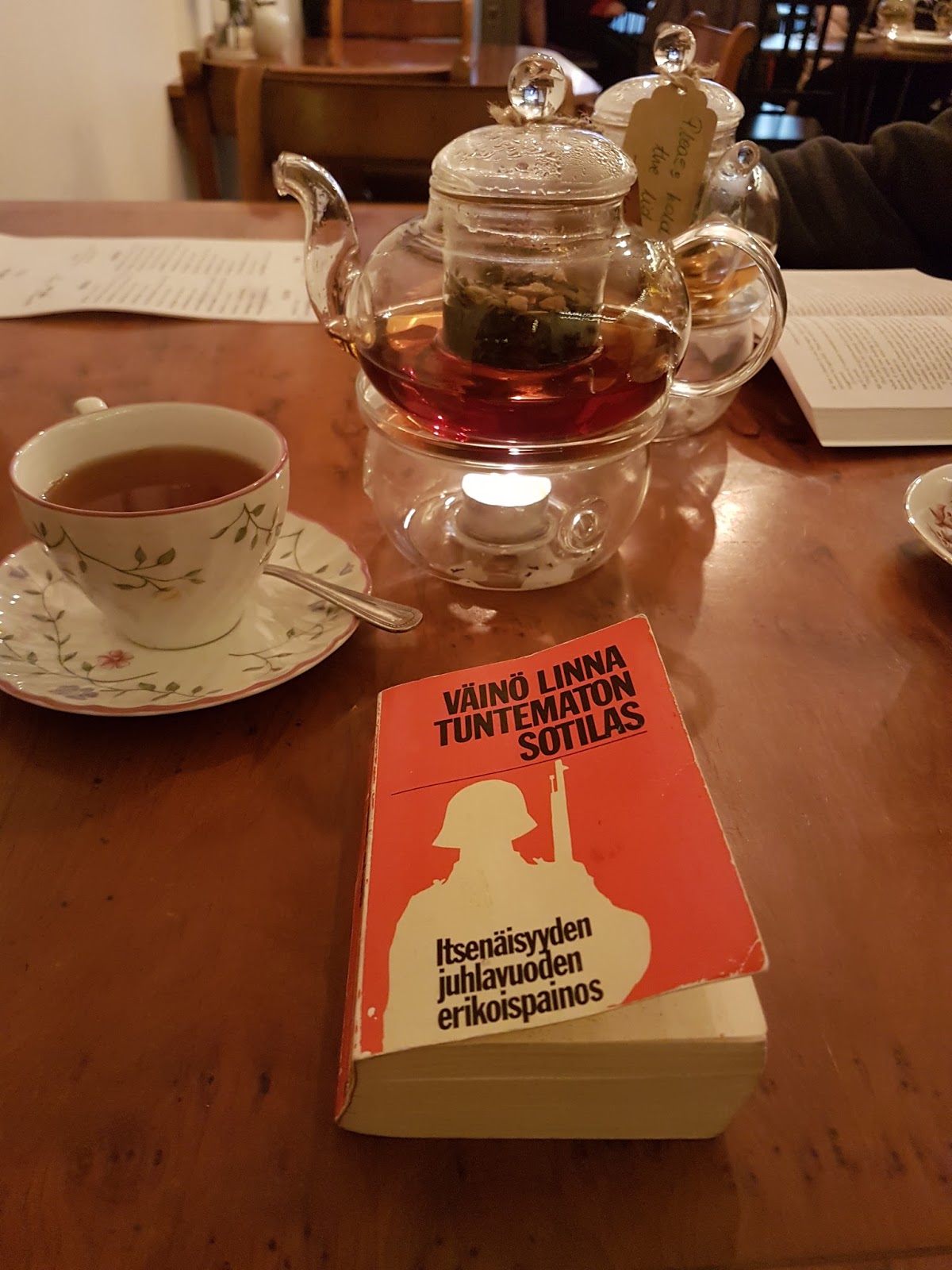
Tuntematon sotilas - Väinö Linna


Started this book on our way to Helsinki
halfway through January.
'Ei tarvittu kuria, ei isänmaata, ei kunniaa eikä 
velvollisuudentuntoa. Noita kaikkia mahtavampi käskijä ruoski heitä eteenpäin. Kuolema.'

'They needed no discipline, no fatherland, no glory and no sense of duty. A commander stronger than all of those lashed them onwards. Death.'

Here's my main(?) Finnish book for the 100-year anniversary - four hundred-ish pages of a pure classic of the Continuation War of 1941-1944. I bought my boyfriend an English copy for Christmas and convinced him to buddy read it with me. I asked him to write about his thoughts too so I'll link that here after it's done 😀 (edit: here you go!) There's so much I want to say about this, so bear with me for a long review!

As mentioned, Tuntematon sotilas (The Unknown Soldiers) is about the Continuation War between Finland and the Soviet Union, from point of view of the Finnish soldiers on the battlefield. Historical background is that the author, Väinö Linna, actually served in the war and wrote the book - fictional as it is - based more or less on his own experiences. You must admit that's pretty cool. By the way, we lost this war in a crude, horrible manner that wasn't pretty and just kind of depressed everyone. You should know that - this is also a bitter tale of loss. That's beautiful.

'Heidän kärsimyksensä oli yksin heidän. Kaiken muun he olivat saaneet luovuttaa. Heiltä oli vaadittu viimeinenkin hiukkanen, mutta kärsimyksensä he saivat pitää itse. Se ei kelvannut kenellekään.'

'Their suffering was theirs alone. Everything else they had had to give up. From them had been demanded even the last speck, but their suffering they got to keep for themselves. It wasn't good enough for anyone.'

Critics didn't enjoy the book all that much when it originally came out in 1954 because of the non-idealistic way it portrays the war and the current (political) environment, but the standard people still really liked it. (Same thing happened to another Finnish masterpiece, Aleksis Kivi's Seitsemän veljestä (The Seven Brothers), almost a hundred years earlier)

Anyway, I've been a bit apprehensive about reading this, as it's written with a heavy dialect that's difficult to describe to someone who's not Finnish. It's like Glaswegian, but written, if you're not even from Scotland, I suppose. Also, it's lengthy. But it's one of those books that's just so satisfying to read that I didn't mind working my way through it slow and steady.

Tuntematon sotilas is a very, very good book and incredibly deserving of its place as a beloved Finnish classic. As far as war novels go, it's very honest and realistic - it doesn't portray the cause as purely noble and the soldiers aren't only delighted to serve in the efforts. They don't always die as heroes and they're not always even remembered. They don't fall down in slow motion and say their last words tearfully. Sometimes they're crude and they swear and hate their uppers and want to go home. They die quickly and ruthlessly and that sincerity, in my mind, is the best thing this book has to offer.

Of course, the quality doesn't stop there. The book also describes humanity in all its beauty - how ugly and broken it is, and how it can rise from its own ashes, if that's not too poetic for this book. It's also very down-to-earth and incredibly Finnish in what it does, and since I'm very patriotic, I really enjoyed that side of it. There's also many named characters - almost all of them soldiers, of course - but all of them manage to seem very human. They also have a huge variety of political and ideological natures and different personalities, which is really great. As a war novel would have it, most of them don't stay with you for very long, but they still stayed with me long after they were gone. Some of them I liked, some of them I hated. All of them mattered.

All in all, this book was incredible. I enjoyed it more than I've enjoyed 95% of everything I've ever read, and I feel a sense of loss now that it's over. It certainly benefits from knowing about the history but even if you know nothing, it won't leave you cold. It deserves its place in history and I really hope more people will choose to read it internationally with the new English translation.

'Hän hymähti pari kertaa katkerasti, ei niinkään paljon valtiollisesta vihasta kuin sen vuoksi, että hänen kengässään oli hiekkaa, eikä hän voinut jäädä poistamaan sitä, koska olisi jäänyt toisista liian kauas.'

'He sneered a couple of times bitterly, not so much from a governmental anger as it was because he had sand in his shoe, and he couldn't stay to remove it, because he would have been left too far behind from the others.'

Cool story: I bought my copy from an antiquarian in Hämeenlinna a couple of years ago while on an adventure with my father. The shop was very cool and the owner so nice I talked to him for nearly an hour and then felt compelled to buy this book I had been eyeing. As you can probably see, it's a pocket size one, but also an anniversary edition for 60 years of independence - 40 years ago. So I think it's really cool. It has sentimental value, and lots of it. For the past month it's also come on many adventures with me. Oh, and the antiquarian moved fully online only a couple of months later - a bit of a shame but I'm really glad I got the chance to visit!
This book took too many cups of tea
to even count and this tea shop is also
where I finished it.

For the Helmet 2017 reading challenge I put this in category 3: A Finnish classic!

PS. If you ever decide to read this in English somehow, pick up the new 2015 translation by Liesl Yamaguchi. The old 1955 translation is all sorts of wrong, with many changes that have no basis in, well, anything.

'―Viipuri vallattu, kähisi hän eteenpäin, huomaamatta muuttaa äänensävyään, niin että edelläkulkeva mies sai ilmoituksen vihan pakahduttamalla äänellä, ikään kuin pahinta, mitä Lehto tiesi maailmassa olevan, olisi ollut Viipurin valtaus.'

'―Viipuri has been taken, he croaked ahead, without noticing to change his tone of voice, so that the man walking in front of him got the announcement in a voice bursting with hatred, as if the worst thing which Lehto knew in the world had been Viipuri being taken.'

Friday, 24 February 2017

Harry Potter and the Goblet of Fire - J.K. Rowling

'Hermione was now teaching Krum to say her name properly. He kept calling her 'Ermion. 
"Her-mi-o-ne" she said, slowly and clearly.
"Herm-o-nini."
"Close enough," she said, catching Harry's eye and grinning.'

I picked this quote because that's how it goes with most of my university encounters. Close enough. It made me chuckle.

So, Harry Potter and the Goblet of Fire is my latest 'listening while walking to uni and back to make it a bit more productive' book, and as far as Harry Potters go, it's undoubtedly my favourite so far. (Though I still love Chamber of Secrets as a movie, nostalgia trip) At first it was a little intimidating at 21 hours, but it was a lot of walks well spent!

Kind of pointless mayhaps to summarise these plots but maybe my mum will read this or something, so here goes: Harry Potter goes back to Hogwarts for year another year of wizarding studies. This time the academic year is made all the more exciting by the Triwizard tournament. Only those over the age of 17 are supposed to be allowed entry into the dangerous tournament, but when someone enters Harry into it, he's forced to compete. And whoever it was obviously didn't do it as a favour.

This book was what I've been waiting for while reading these (and I might have mentioned this before, too); the book that'll make me go, so that's why everyone loves these books. Goblet of Fire was very interesting and well-written and just generally all around a very very good book. The tasks of the Triwizard tournament are exciting and just strange enough so that you don't really know what's going to happen next. Additionally, the side plots are interesting and serve the core of the book well. This world feels so alive, and more so with each addition to it (except Fantastic Beasts, I still don't really agree with that).

The tone of this book is darker than in the previous ones, and from what I understand it's the direction the works from here on will take. That's pretty exciting, as the more mature tone really did this work justice.

I don't know what else to say. This book is great. Read it if you haven't yet.

For the Helmet 2017 reading challenge I put this in category 29: A book's main character can do something which you would like to learn (magic, obviously!).

Thursday, 23 February 2017

Charisma - Jeanne Ryan

Hey!

This book was so dull it put me off writing about it for nearly two weeks after finishing it. That bad.

Charisma is from the same author as Nerve, which apparently isn't all that good. It is, however, a basis for a movie from last year that was pretty enjoyable on its own right. So when Charisma, with its colourful 'from the author of Nerve' cover (right there on the right) started popping up at Waterstones and the synopsis sounded interesting enough, I thought I could check if it's really that bad.

Well that was a mistake, clearly.

The idea of the book is this: Aislyn has suffered from crippling shyness all her life, and would do anything to be more outgoing, so that she could live her life. When the anything comes in the form of an experimental drug called Charisma, she jumps at the opportunity. For a moment, she has everything; fame, popularity, charm, love. Soon, however, she comes to discover that you can't have your cake and eat it too, as the side effects prove to be dangerous, even fatal.

There's also this side plot that's supposed to have you wondering whether gene therapy is ethical or not, but all I could think of was how Charisma tried to seem all smart and deep, without any of the work or thought that normally goes into being either of these things.

The execution of the whole books is one of the worst ones I can imagine. Just for the plot, I have dozens of ideas of making it more tolerable, even good. That doesn't even start to cover the dull writing style...

Aislyn as a character is quite plain with the whole 'too shy to live' thing, but after the side effects kick in (this is around 1/3 in so the idea itself isn't all too fleshed out), she becomes downright tolerable. You'd be surprised to learn just how much a person can whine and cry and complain after (briefly, sure) getting everything they've ever wanted. Also, my empathy was further reduced by her knowingly taking the drug, acknowledging it's experimental and there might be side effects and even signing a consent form(!!!). So I didn't really feel for her.

Her best friend's name I've already forgotten, but she was the opposite of Aislyn in nature; outgoing, happy, brave. She also abandoned Aislyn when she really needed her to hang out with her new boyfriend, so that was nice.

Aislyn also has a super dull boyfriend, John or Jack or something. He's basically there so that Aislyn could complain some more about maybe dying in the future, just when she's so happy (although all the complaining she did could have fooled me).

All in all, this was the dullest thing I've read in a while (I'm at university, too!). I think I should stick to less obviously bad books for a change.

For Helmet 2017 I put this in category 10: A book with a beautiful cover (mostly because that's the only compliment I can give this book...)

PS. Apparently I didn't pick up a single quote while reading this. Yes, that bad.

Saturday, 4 February 2017

In Order To Live - Yeonmi Park

'This is my story of the choices I made in order to live.'

This book was incredibly moving. Interesting, also. I obviously have very standard subpar knowledge of North Korea, the standard stuff most people know but rarely stop to think about. I know and acknowledge that life must be awful there, but it's not common I actually consider what this means for the people.

In Order To Live is the story of a young girl who at thirteen starts the most difficult journey to escape her North Korean home, Hyesan in the north near the Chinese border. Yeonmi Park tells a powerful, painful story about her own life that must have been difficult to get into paper or even remember, and I think she's incredibly brave to do so. She describes in a very honest manner how she felt and what happened to her, which is very humbling to read. She's what she never aimed to be, a role model and an ambassador, and a voice for her people.

The story is split into three parts; Yeonmi's time in North Korea, China and finally South Korea. The first one is obviously the longest and perhaps the hardest, but it doesn't get any easier even when you think it would. In the 1990s, the government in North Korea stopped being able to provide its citizens with food because they stopped receiving Soviet support. Yeonmi Park was born in 1993, so she's of the generation named after the black market, Jangmadang. These younger people may not quite share the blind faith their elders had for the government and their fearless leader, but they're far from free. In the book, Yeonmi describes how she believed that the leader could read her mind, and was always afraid to even think bad things of the country. These old habits die hard, especially considering all western media and entertainment is banned in North Korea, and even every school subject and songs and books are filled with propaganda.

Kudos to the Kindle edition for including
these photos like in the paperback, they
really bring this story to life.
The book is incredibly informative, considering it also tells a cohesive story. You can tell that since she fled North Korea, Yeonmi has really absorbed other cultures and stories, because the book clearly understands what parts of the culture are interesting to people outside of its reach. I learned so many curious and deeply worrying details about this undemocratic country through reading this book, yet I never felt like I was being lectured or straight-up taught anything. Yeonmi has also clearly learned a lot about critical thinking (a practice obviously forbidden in North Korea) since she fled, because she is able to say things about herself I would perhaps never be humble or brave enough to admit.

The story told in this book is raw and cruel and horrible, but it's also a story about humanity. The author has gone through the most terrible places and situations only to find that there is more to life than just surviving. There's also kindness and purity and good. I truly believe she's accomplished a lot if only by telling her story to people, but I also hope it's brought her some peace. She's only two years older than me today, and less and less so throughout the book to the beginning. I can't imagine going through what she has, but it is inspiring. I'm grateful that she has decided to share this story with us, and hopefully it will make a change in the world.

It's a bit odd to rate a story that's based on truth, but if not for the events themselves, then for the information, the thoughts and the bravery, I'd like to give this one a full five out of five. I don't see a reason not to recommend it unless you are a bit like my mum and feel the need to carry the sadness of the whole world on your shoulders. If you want to know what life and escape is like at least for some North Koreans today, this book is very interesting.

For the Helmet 2017 reading challenge I put this book in category 40: A book by a writer who comes from a different (from yours) culture.