Showing posts with label please read it. Show all posts

Friday, 2 March 2018

Gone With the Wind - Margaret Mitchell

'I'm tired of everlastingly being unnatural and never doing anything I want to do. I'm tired of acting like I don't eat more than a bird, and walking when I want to run and saying I feel faint after a waltz, when I could dance for two days and never get tired. I'm tired of saying, 'How wonderful you are!' to fool men who haven't got one-half of the sense I've got, and I'm tired of pretending I don't know anything, so men can tell me things and feel important while they're doing it.'

Hello!

Now that all my 2017 books are reviewed, here's the first book I read in 2018, from my Christmas break spent in Finland. I think I can safely say it's also the best book I will read this year. What a
terrible idea to get a jackpot on the first book!
I had the absolute pleasure to read mum's beautiful copies
from the 1970s!!
Anyway, the spoiler is that I really liked this book. My mum's been telling me to read it for a while now and I can only speculate why I haven't read it before. Well, to be honest, I think I know why. 
You see, Gone With the Wind clearly has a reputation of some sort. I've heard it being called one of the greatest love stories of all time and all that, and I think it's really downplaying the importance of this masterpiece. It is a love story, sure, and it is a great one. But it's also a story about war and misfortune and death and misery and unfairness and inequality and racism and patriarchy and a million of things that I find should be mentioned before it's just branded a romantic book for women.  Heck, Margaret Mitchell herself stated that the primary theme of this book is 'survival'. That's not really anything we should outright label as a women's silly little pastime.

The books had these lovely pictures from
the movie!!
'Life's under no obligation to give us what we expect. We take what we get and are thankful it's no worse than it is.'

Scarlett O'Hara is without a doubt one of the best-written characters I've met in any book. She's self-centered, spoiled and shallow in the beginning and she's still all of these things in the end, but the growth of her character is so well-written and believable. She's stubborn and she refuses to give up when her world turns to ash around her, unlike most of the other characters who just cling to the past. She's the most beautiful girl and she knows it, but she's also so sincere in just wanting to live her life having fun that she's hard to not like. She's also much more intelligent than she's allowed to be for a woman in her time, which I really enjoyed as well.

'After all, tomorrow is another day.'


All of the other characters are so good as well. There's Scarlett's crush Ashley, attractive and artistic and incredibly unsuited for Scarlett and probably so attractive to her because of it. The Tara household also has a black caretaker called Mammy, who's incredibly difficult not to like. Scarlett's sister-in-law Melanie is basically the kindest person ever and everything else Scarlett doesn't even
want to be but she still thinks the world of Scarlett, and Rhett Butler is a charming scoundrel who doesn't care to even try and gain the approval of the Southern nobles. He's also the only one not to fall for Scarlett's charm, and the two of these are the main romance of the book. I must say that it was impossible for me to not smile every time Rhett was around, because his character was so enjoyable to have around and such a great fit for Scarlett, insofar as anyone could be.
Melanie on the left and Rhett and Ashley on the right

Scarlett and Rhett's relationship is probably so memorable and iconic because it's not the standard love at first sight -kind. These two characters challenge each other and dance around each other constantly, and never quite settle into a comfortable relationship. In a way, even the aspect of this book that you should be able to take comfort in is a constant battle.

'No, my dear, I'm not in love with you, no more than you are with me, and if I were, you would be the last person I'd ever tell. God help the man who ever really loves you. You'd break his heart, my darling, cruel, destructive little cat who is so careless and confident she doesn't even trouble to sheathe her claws.'

The historical setting of this book is the American Civil War. What I knew about the war beforehand could be summed up in the following two points: 1) the South wanted to keep slaves and 2) the South lost. And while that's kind of the gist of it, this book made me understand how it was much more complicated and many-sided. Margaret Mitchell was from Atlanta, Georgia herself, and much of the historical aspects are based in her own experiences and the stories she heard. You could probably argue that the story takes sides, but to me it felt rather sincere about what it was trying to get across. This war is not part of my heritage, but I cared and weeped for the characters going through the hardships regardless, because it all felt so real.

So yes, 5/5, I loved it, I want to go back in time to not having read it but I also don't want to not have read it. Please read it and talk to me about it.

Thursday, 23 November 2017

The Handmaid's Tale - Margaret Atwood

"There is more than one kind of freedom," said Aunt Lydia. "Freedom to and freedom from. In the days of anarchy, it was freedom to. Now you are given freedom from. Don't underrate it."


Hello!

I've been meaning to read this book for a while because dystopias. On the other hand, I anticipated it being a depressing experience so I've not been in any hurry to do it... And yeah, it was pretty grim.

The Handmaid's Tale is another one of those always upsettingly current dystopian books like Brave New World and 1984 (The Handmaid's Tale was written in 1984, which Margaret Atwood said was 'corny'). It's set in a world in which women have been stripped of their autonomy, prohibited from reading, owning things, and 'freedom to'. Any sort of plot synopsis honestly feels like I'd be butchering this story, because there's so much depth to it that I could analyse it for hours and still be just at the tip of the iceberg. Here we go anyway.

Offred, the main character who never gets an actual name, is placed as a handmaid for a Commander to give him and his wife a child. She is of the unfortunate transfer period as the country that was the United States of America becomes the Republic of Gilead. She had a husband and a child and a life, so she's able to sharply contrast the current world order to the old and is unwilling to accept the change the way she should.

It's purposefully vague and somewhat out of order, and you find out about the world bit by bit. I thought it would annoy me at first, but after I got into it, I was so interested in finding out more, even if it was at a slower pace.

'It isn't running away they're afraid of. We wouldn't get far. It's those other escapes, the ones you can open in yourself, given a cutting edge.'

The book has a very heavily metafictional epilogue of sorts which I don't want to further spoil from you, but it's very interesting and intelligent. It was so metafictional that I thought the book had ended and I was listening to the afterword.

The actual afterword by Atwood on this book was also very enlightening. She says that she was inspired by her travels behind the Iron Curtain during the Cold War, and she was determined not to add any concepts, ideas or technology that did not already exist. It's set in the US because it's her way of retaliating against the 'it couldn't happen here' mentality of the people she told about her experiences. She also calls it an anti-prediction: if a story like this can be told in such a detail, then maybe we can make sure it won't become reality. I'm definitely on board with that.

All in all, The Handmaid's Tale is a very harrowing read, with kind of an open ending. It plays on human emotion and humans themselves, and I find I keep thinking about it almost every day, even now that I finished it some two weeks ago. When is it acceptable to start reading again a book you just finished?

I gave this a 5/5 without thinking about it much, because I'm not sure if a book has ever affected me quite so much. It's probably my favourite dystopia, and I read quite a lot of those. I'd recommend it without qualms to anyone and everyone, though I'm not sure how the reading experience would change if you were not a woman and inherently, Offred.

For the Helmet 2017 reading challenge I put this in category 12: A book about politics and politicians. Because at least in part, that's what this book is, among so many other things. Politics.

Saturday, 23 September 2017

A Game of Thrones - George R.R. Martin

'When the snows fall and the white winds blow, the lone wolf dies but the pack survives.'

Hello!


I was actually in a very, extremely fortunate position where I was able to read A Game of Thrones (the first book in the A Song of Ice and Fire series) this before watching the most popular TV show ever inspired by it. Because while this book was excellent, it was also very heavy, and I don't think I would've enjoyed it half as much if I had if I knew every death that was going to come before they did. And yes, a lot of people do die. And yes, they shook me pretty much every time. Even if you have watched the TV show, I still recommend the books, though. It's excellent writing.

Another thing I was in an extremely fortunate situation to do was meeting George R.R. Martin in Worldcon 75 in Helsinki this summer. For real! My hands were shaking for like an hour afterwards but I got an autograph and managed to string together like three comprehensible sentences in the process. Success! 

Future family heirloom etc.
 
Anyway, let's get down to business. I'm not actually interested in talking about this book in all that much length as I'm not that knowledgeable about everything, so take this more as my humble ramblings than some sophisticated High Fantasy Expect Analysis.

This book is from the point of view of nine different characters, and concerns three main plots that are intwined: The Wall, The Seven Kindgdoms, and that of the Dothraki. My favourite is probably the latter, but all of them are extremely good.

A lot of the characters in this book are very complex. There were many I disliked originally that later earned points and vice versa, and it helps that you get to see these people through their own eyes as well as someone else's. Actually, everything about this book and the world is very complex, but I don't suppose I need to tell anyone that. What can I actually say about this that hasn't already been said? In a work of a lesser quality it would probably feel crowded, but in this book I would definitely not have taken anyone out or put anyone else in.

This book was also quite dark. After I gave her a vague plot description, my mum (ever the humanitarian) asked me how I could read it, isn't it just too depressing? I'd say that in a work like this, while the balance is definitely on the darker side, it makes up for a lot when you get even a little spark of happiness. And I never felt actually depressed while reading this, because it had enough of those sparks to make it work. That being said, there's a lot of violence, sex and rape. Though I'd like to contest that the sex scenes in this are more tolerable than those in the show, because they're less graphic and often over very quick and not at all the focus of it.

Rape, though? I suppose it's a necessary evil rather than anything. It's never made to seem romantic or sexy, and it's clear that these people are doing awful things. It's hardly ever used as a plot device, which I also had to appreciate (few things are worse, to be honest). But yeah, I know some people don't like that, and I don't blame them. They didn't bother me though.

This book is full of really, really cool scenes and good quotes. Appreciated.

The language of this book is excellent. It's flowing and detailed, and no word seems to be there unnecessarily. Sometimes (oftentimes) I had to go back because I spaced out for just a few seconds but felt like I had missed something important. Sometimes that felt a little tedious, but the book was definitely worth the attention it demanded.

Also, did you want to hear about my favourite characters? No? Well, anyway, I loved Arya and Daenerys the most. And Bran. Can I just comment on how much it tells about the characters how they named their direwolves, by the way? Bran's is called Summer. Let that one sink in. Also, let's just say my favourite scenes had to do with Dany towards the end as well.

All in all, this book was so good and deserves all the love ever, but I do acknowledge that it's not for everyone. It really is a new staple to which I wish to hold any other high fantasy books I read after it, but at the same time I want us to talk about how it's really not always good to say 'this book is totally for fans of Game of Thrones!!' because...  well. You're just doing everyone a disservice there, mate.

For the Helmet 2017 Reading Challenge I put this in category 43: A book you have planned to read for a long time! Kinda obvious again, I assume.

I'll be reading the second part when I get around to it, but it's even longer than this one and I... think I need a moment to let this one settle in.

Sunday, 2 July 2017

We Should All Be Feminists - Chimamanda Ngozi Adichie

'Some people ask: 'Why the word feminist? Why not just say you are a believer in human rights, or something like that?' Because that would be a way of pretending that it was not women who have, for centuries, been excluded. It would be a way of denying that the problem of gender targets women.'


I picked this up, sat at the dinner table and read it. Granted, it's a TED Talk turned into an essay and in Finnish just shy of 50 pages, but I would've gladly read 50 more or even 150. The reason We Should All Be Feminists has been on my radar is that earlier this year, a copy of it was given to every 9th grader in Finland. I read the Finnish edition they were given ('Meidän kaikkien pitäisi olla feministejä'), and I think they're in good hands. This book works incredibly well as a conversation starter as well due to its short length and current message.

This essay is very personal. Adichie talks about her own experiences and doesn't make them into some sort of a universal truth that everyone should agree on, but also raises many sharp points about why, indeed, We Should All Be Feminists. She's from Nigeria and lives partly in the US herself, but even though our cultures are vastly different, her experiences still resonate with what I feel. I'm sure anyone who's a woman or doesn't hate women would agree.

I don't expect that giving this book to kids miraculously turns them into a full generation of acceptance and love, but I think if even one of them finds this book an eye-opener, it has done its work. It's a good size with reasonable sized text, and at least I found it a page-turner. If only they opened it.

I took a look yesterday into how that was taken in Finland, and some of it was pretty appalling. Middle-aged men calling out on Twitter how, direct quote: "Political propaganda is being forced upon our youth."  Really. If you think that equality of genders is dangerous propaganda, you should go back to the 1500s where you clearly belong. Also, it was very clear that no one who criticised this book had ever even touched it. It's horrible how just saying 'I'm a feminist' gets this sort of a reaction from people, and that's something Adichie talks about as well: how the word itself has become incredibly loaded and makes people imagine that you hate men, among many other things. 

If these people actually read the book, they would know feminism is not the opposite of misogynism, but the actual plea for equality of genders. And they might disagree with some of the things in this book, but at least they would know what they were talking about. Of course, if people were willing to educate themselves and admit to being wrong, this would be all too easy.

You can find the TED Talk here in its entirety and if you've not read this or watched it, well, I definitely recommend it. I wish everyone would, and then maybe we would have a slightly better world. 

'My own definition is a feminist is a man or a woman who says, yes, there's a problem with gender as it is today and we must fix it, we must do better. All of us, women and men, must do better.'

For the Helmet 2017 reading challenge I put this in category 4: A book inspiring wellness and wellbeing.

Wednesday, 12 April 2017

Carry On - Rainbow Rowell

'You have to pretend like you get an endgame. You have to carry on like you will; otherwise, you can't carry on at all.'
I think it turned out really pretty! (Though after reading it I
should have maybe gone for darker tones...)

I bought this book from Glasgow on the prettiest spring day last year purely based on the fact that you could colour it in yourself and I thought that was the coolest thing ever! (Also, it's signed by the author, which helped...) So last week I decided to get to it and actually colour it in and then read it. That's pretty much the whole story. I've not read Fangirl or Eleanor & Park but this was so good I definitely will, both of those.

I feel like this is one of those books where knowledge adds to the pain and you're better off knowing as little as possible. (Though if you've read Fangirl first you definitely know something I didn't) So I'll not tell you much of the plot but maybe hopefully enough so that you'll want to read it!

Simon Snow is The Chosen One - the one that will save the Magickal World. However, he's not able to control his magic, and everything else in his life is currently a bit of a mess as well. His girlfriend breaks up with him, and maybe they were never really in love anyway. The Insidious Humdrum is out to kill him, lobbing all sorts of monsters at him, and his horrible roommate is gone, probably also plotting his demise.

Blank book and mismatched woolly socks
The book is clearly inspired by Harry Potter, but I think it's in a very tasteful and inspired way. (Though some people seem to disagree, and that's okay too!) It has "all of this happened in our previous years" sort of recaps sometimes, and skips straight to their last year at Watford School of Magicks. Don't get me wrong, I'm sure it would've been cool to read about Simon Snow, from the Normal World, learn about the magickal realm at the age of 11... but that would have been a bit too on the nose. This book is very meta, but at least it doesn't pretend that it's not the case.

The take on magic itself is also really interesting. They use words, but they're words that become more powerful the more they're used. Like nursery rhymes, which are mentioned as some of the most powerful spells, because they're forever stuck in your brain. Or sayings, lyrics, metaphors, that sort of a thing. They're very innovative and fun, and they're bolded and in italics in the book so you can always tell easily when someone's using their magic. I had to wonder how you'd make that work in an audiobook, since it's not like these words are always yelled or boomed or stuff, either.

I really liked how the Magickal World was portrayed with variety and depth, and the story managed to touch many different lives. It's also told through the eyes of many different people, which makes it even better. The only thing that doesn't get much coverage is the Normal World, but I think it's, like in Shadowmagic, an 'imagine your own life here' sort of a thing. It works just fine, since Normal isn't all that exciting in comparison anyway.

Work in progress!
I also liked all the characters for different reasons! I liked Simon because he was really caring and even though he was clearly important, he didn't try to make everything about himself. I liked Baz because he was misunderstood, but he didn't wear it like a cape. I liked Penny because she was helpful and smart and a really good friend. And Agatha because she was the most human out of all of them. I liked Ebb because I thought she was like Ilia from Twilight Princess. (too meta?) And even the characters who didn't get all that much page time all added to the experience, to the life and heart of the world.

This story is a very good portrayal of growth and what it's like to accept yourself even when it feels like you don't want to. It deals with a lot of important themes in a way that was surprisingly mature and not at all pointed. The romance (that's a thing) was cute and important but not overpowering. My main problem was probably with the ending - a lot of characters didn't find out things that I as the reader knew, and it bothered me because I was really hoping that all these loose strings would be tied up in a neat bundle in the end.

Also, did I mention that this book is very British? You guys know how I love that - it makes me feel at home. It's by an American author but regardless, she does a terrific job at showing the different places and mannerisms and the language. It might be a bit less posh British than Harry Potter and more... Northern, almost. It made me feel quite fuzzy and warm inside.

So anyway, easy 5/5, I really liked this but I see why some people haven't (it's that Harry Potter thing, they see plagiarism where I saw inspiration). I'm going to read Hän sanoi nimekseen Aleia (She said her name was Aleia) next, because my mum was really nice and bought it for me in Helsinki!!

For the Helmet 2017 reading challenge, I put this in category 6: A book with many storytellers!

Wednesday, 5 April 2017

Senlin Ascends - Josiah Bancroft

"“I still recall a line from that feckless Everyman’s guide. It said something like, ‘the Tower’s real trade is in whimsy, adventure, and romance.’ I cannot imagine a less accurate trio. Though, who in their right minds would’ve come if the editors had said, ‘the Tower’s true trade is in tyranny, dismemberment, and heartbreak?” - Every Man’s Tower, One Man’s Travails by T. Senlin"

Hello!
I think this cover looks amazing.

I started reading this book while in Brussels because Daniel was taking so long with The Unknown Soldiers. Senlin Ascends has been getting a ton of hype lately, and for a change, I feel like it was every bit deserved. 

Thomas Senlin, a school headmaster, goes with his wife on a honeymoon to the prestigious Tower of Babel - a place for the cultured, the luxurious, the ones who need nothing more in life.

It all goes bad within minutes, as fate would have it. Senlin and Marya get separated in the market, and Senlin is left with their money and train tickets back home. He decides to climb to the third ringdom of the tower that reaches to the skies, and meet her at the Baths, where they were going to go.

Only the Tower isn't what he thought. It's full of criminals, corruption, dictators and straight-up torture. He meets what he believes to be friends, only can you trust anyone in a place where everyone is indebted, threatened and alone?

The writing and the characters are both incredibly strong in this book. Senlin is very intelligent and capable of sharp wits and analysis, and everyone he meets feels like a person even before you find the burden they might be carrying. I loved most of the characters in this, but also the way they were all so different and in the Tower for their own reasons. My favourite was probably Edith, though I will tell you nothing about her because you shouldn't know too much. Even as I say this, I liked all of the characters and their backstories a lot. Senlin himself has a tremendous amount of character growth and it still feels believable and not like an awkward level up.

The setting is also excellent, not necessarily 100% real but something I can still imagine, with an old-school steampunk vibe but with added bits of intrigue from everywhere. It felt East more than West, but in a believable way. The different ringdoms of the Tower are very creative and different from one another, but the book never forgets about the ones it's already gone through. That's really cool. Each chapter also open with a quote from a book, at first from "Everyman's Guide", which is Senlin's trusty guidebook from the beginning. Later it becomes "Every Man's Tower", which Senlin writes himself. These quotes are often witty and sometimes downright ironic, and they're a lot of fun to read.

Senlin Ascends is the first in a four-book series, the last two not being out yet. I think I'll give it some time before reading part two, but at the same time I am so excited to do it! Meanwhile, I recommend this so much!! Please read it!! It's amazing and I want everyone to get this sort of experience of a great book that feels fresh and engaging. While writing this review, I bought physical copies of this one and Arm of the Sphinx, the sequel, on Amazon. Whoops. How did that happen.

All in all, a strong 5/5 because I wouldn't even dream of trying to change anything in this amazing little masterpiece. I'm definitely in love.

For the Helmet 2017 reading challenge I put this in category 2: A book discussed in book blogs!

Sunday, 26 February 2017

Tuntematon sotilas - Väinö Linna


Started this book on our way to Helsinki
halfway through January.
'Ei tarvittu kuria, ei isänmaata, ei kunniaa eikä 
velvollisuudentuntoa. Noita kaikkia mahtavampi käskijä ruoski heitä eteenpäin. Kuolema.'

'They needed no discipline, no fatherland, no glory and no sense of duty. A commander stronger than all of those lashed them onwards. Death.'

Here's my main(?) Finnish book for the 100-year anniversary - four hundred-ish pages of a pure classic of the Continuation War of 1941-1944. I bought my boyfriend an English copy for Christmas and convinced him to buddy read it with me. I asked him to write about his thoughts too so I'll link that here after it's done 😀 (edit: here you go!) There's so much I want to say about this, so bear with me for a long review!

As mentioned, Tuntematon sotilas (The Unknown Soldiers) is about the Continuation War between Finland and the Soviet Union, from point of view of the Finnish soldiers on the battlefield. Historical background is that the author, Väinö Linna, actually served in the war and wrote the book - fictional as it is - based more or less on his own experiences. You must admit that's pretty cool. By the way, we lost this war in a crude, horrible manner that wasn't pretty and just kind of depressed everyone. You should know that - this is also a bitter tale of loss. That's beautiful.

'Heidän kärsimyksensä oli yksin heidän. Kaiken muun he olivat saaneet luovuttaa. Heiltä oli vaadittu viimeinenkin hiukkanen, mutta kärsimyksensä he saivat pitää itse. Se ei kelvannut kenellekään.'

'Their suffering was theirs alone. Everything else they had had to give up. From them had been demanded even the last speck, but their suffering they got to keep for themselves. It wasn't good enough for anyone.'

Critics didn't enjoy the book all that much when it originally came out in 1954 because of the non-idealistic way it portrays the war and the current (political) environment, but the standard people still really liked it. (Same thing happened to another Finnish masterpiece, Aleksis Kivi's Seitsemän veljestä (The Seven Brothers), almost a hundred years earlier)

Anyway, I've been a bit apprehensive about reading this, as it's written with a heavy dialect that's difficult to describe to someone who's not Finnish. It's like Glaswegian, but written, if you're not even from Scotland, I suppose. Also, it's lengthy. But it's one of those books that's just so satisfying to read that I didn't mind working my way through it slow and steady.

Tuntematon sotilas is a very, very good book and incredibly deserving of its place as a beloved Finnish classic. As far as war novels go, it's very honest and realistic - it doesn't portray the cause as purely noble and the soldiers aren't only delighted to serve in the efforts. They don't always die as heroes and they're not always even remembered. They don't fall down in slow motion and say their last words tearfully. Sometimes they're crude and they swear and hate their uppers and want to go home. They die quickly and ruthlessly and that sincerity, in my mind, is the best thing this book has to offer.

Of course, the quality doesn't stop there. The book also describes humanity in all its beauty - how ugly and broken it is, and how it can rise from its own ashes, if that's not too poetic for this book. It's also very down-to-earth and incredibly Finnish in what it does, and since I'm very patriotic, I really enjoyed that side of it. There's also many named characters - almost all of them soldiers, of course - but all of them manage to seem very human. They also have a huge variety of political and ideological natures and different personalities, which is really great. As a war novel would have it, most of them don't stay with you for very long, but they still stayed with me long after they were gone. Some of them I liked, some of them I hated. All of them mattered.

All in all, this book was incredible. I enjoyed it more than I've enjoyed 95% of everything I've ever read, and I feel a sense of loss now that it's over. It certainly benefits from knowing about the history but even if you know nothing, it won't leave you cold. It deserves its place in history and I really hope more people will choose to read it internationally with the new English translation.

'Hän hymähti pari kertaa katkerasti, ei niinkään paljon valtiollisesta vihasta kuin sen vuoksi, että hänen kengässään oli hiekkaa, eikä hän voinut jäädä poistamaan sitä, koska olisi jäänyt toisista liian kauas.'

'He sneered a couple of times bitterly, not so much from a governmental anger as it was because he had sand in his shoe, and he couldn't stay to remove it, because he would have been left too far behind from the others.'

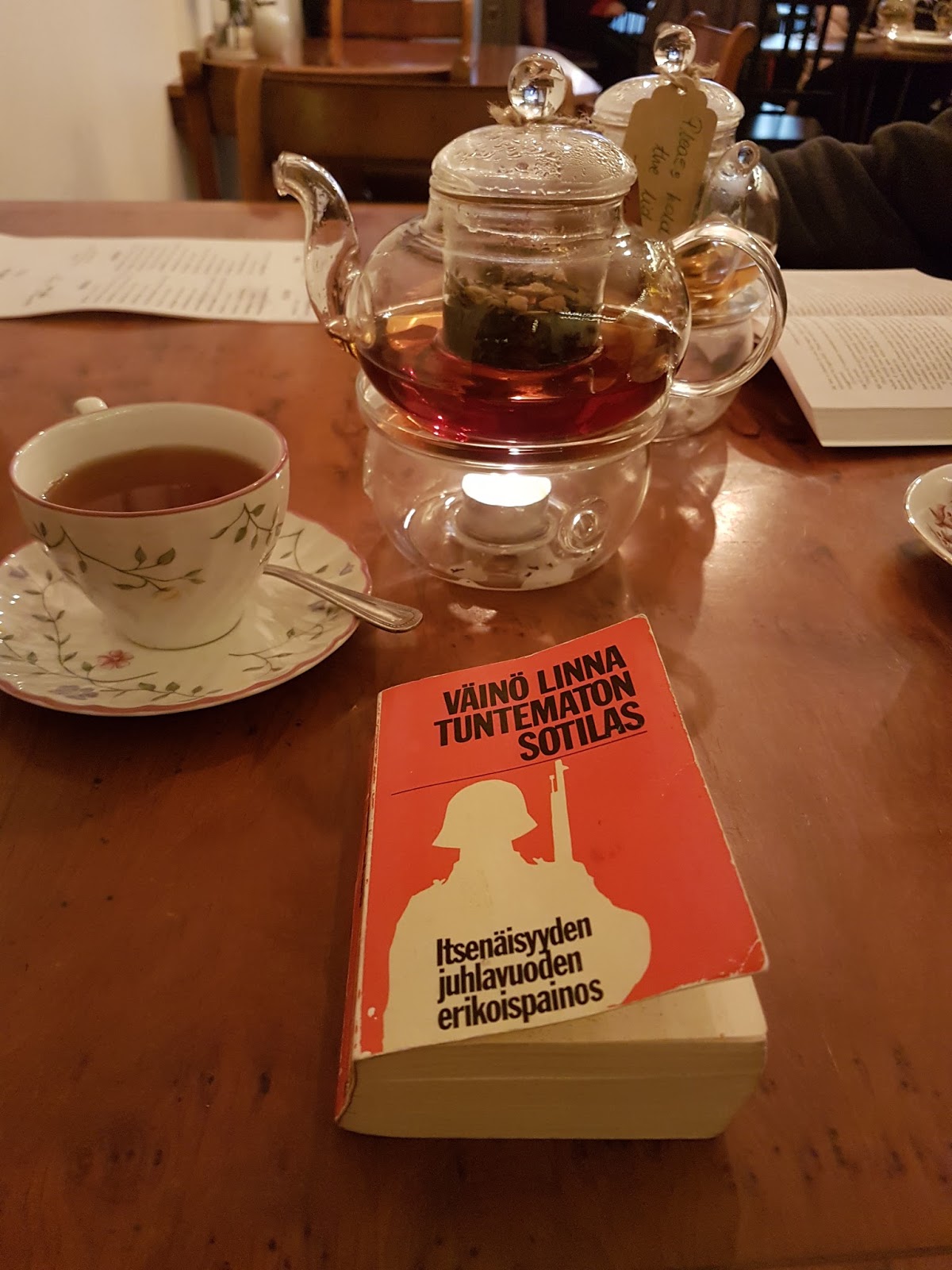
Cool story: I bought my copy from an antiquarian in Hämeenlinna a couple of years ago while on an adventure with my father. The shop was very cool and the owner so nice I talked to him for nearly an hour and then felt compelled to buy this book I had been eyeing. As you can probably see, it's a pocket size one, but also an anniversary edition for 60 years of independence - 40 years ago. So I think it's really cool. It has sentimental value, and lots of it. For the past month it's also come on many adventures with me. Oh, and the antiquarian moved fully online only a couple of months later - a bit of a shame but I'm really glad I got the chance to visit!
This book took too many cups of tea
to even count and this tea shop is also
where I finished it.

For the Helmet 2017 reading challenge I put this in category 3: A Finnish classic!

PS. If you ever decide to read this in English somehow, pick up the new 2015 translation by Liesl Yamaguchi. The old 1955 translation is all sorts of wrong, with many changes that have no basis in, well, anything.

'―Viipuri vallattu, kähisi hän eteenpäin, huomaamatta muuttaa äänensävyään, niin että edelläkulkeva mies sai ilmoituksen vihan pakahduttamalla äänellä, ikään kuin pahinta, mitä Lehto tiesi maailmassa olevan, olisi ollut Viipurin valtaus.'

'―Viipuri has been taken, he croaked ahead, without noticing to change his tone of voice, so that the man walking in front of him got the announcement in a voice bursting with hatred, as if the worst thing which Lehto knew in the world had been Viipuri being taken.'

Saturday, 4 February 2017

In Order To Live - Yeonmi Park

'This is my story of the choices I made in order to live.'

This book was incredibly moving. Interesting, also. I obviously have very standard subpar knowledge of North Korea, the standard stuff most people know but rarely stop to think about. I know and acknowledge that life must be awful there, but it's not common I actually consider what this means for the people.

In Order To Live is the story of a young girl who at thirteen starts the most difficult journey to escape her North Korean home, Hyesan in the north near the Chinese border. Yeonmi Park tells a powerful, painful story about her own life that must have been difficult to get into paper or even remember, and I think she's incredibly brave to do so. She describes in a very honest manner how she felt and what happened to her, which is very humbling to read. She's what she never aimed to be, a role model and an ambassador, and a voice for her people.

The story is split into three parts; Yeonmi's time in North Korea, China and finally South Korea. The first one is obviously the longest and perhaps the hardest, but it doesn't get any easier even when you think it would. In the 1990s, the government in North Korea stopped being able to provide its citizens with food because they stopped receiving Soviet support. Yeonmi Park was born in 1993, so she's of the generation named after the black market, Jangmadang. These younger people may not quite share the blind faith their elders had for the government and their fearless leader, but they're far from free. In the book, Yeonmi describes how she believed that the leader could read her mind, and was always afraid to even think bad things of the country. These old habits die hard, especially considering all western media and entertainment is banned in North Korea, and even every school subject and songs and books are filled with propaganda.

Kudos to the Kindle edition for including
these photos like in the paperback, they
really bring this story to life.
The book is incredibly informative, considering it also tells a cohesive story. You can tell that since she fled North Korea, Yeonmi has really absorbed other cultures and stories, because the book clearly understands what parts of the culture are interesting to people outside of its reach. I learned so many curious and deeply worrying details about this undemocratic country through reading this book, yet I never felt like I was being lectured or straight-up taught anything. Yeonmi has also clearly learned a lot about critical thinking (a practice obviously forbidden in North Korea) since she fled, because she is able to say things about herself I would perhaps never be humble or brave enough to admit.

The story told in this book is raw and cruel and horrible, but it's also a story about humanity. The author has gone through the most terrible places and situations only to find that there is more to life than just surviving. There's also kindness and purity and good. I truly believe she's accomplished a lot if only by telling her story to people, but I also hope it's brought her some peace. She's only two years older than me today, and less and less so throughout the book to the beginning. I can't imagine going through what she has, but it is inspiring. I'm grateful that she has decided to share this story with us, and hopefully it will make a change in the world.

It's a bit odd to rate a story that's based on truth, but if not for the events themselves, then for the information, the thoughts and the bravery, I'd like to give this one a full five out of five. I don't see a reason not to recommend it unless you are a bit like my mum and feel the need to carry the sadness of the whole world on your shoulders. If you want to know what life and escape is like at least for some North Koreans today, this book is very interesting.

For the Helmet 2017 reading challenge I put this book in category 40: A book by a writer who comes from a different (from yours) culture.

Tuesday, 10 January 2017

Animal Farm - George Orwell

'All animals are equal, but some animals are more equal than others.'

Hey.

I got this book from my brother for Christmas and decided to start it on my birthday. It was very good, incredibly creepy, very harrowing. I'm a bit at loss as to what I can, should or could say about it without utterly spoiling the experience from anyone who has yet to have the immense pleasure of reading it.

So, the Manor Farm is owned by a Mr. Jones. He has the animals working long hours, takes the spoils and drinks. The animals, after a seed of revolution is planted, decide to take control and turn the farm in Animal Farm. This revolution, fuelled by noble ideas and nobler values, brings them all equality, the Seven Commandments and harmony, but this does not last for long.

This novel is, safe to say, an allegory and a satire for Soviet Communism. It's mostly harrowing because it feels so real; the animals are very well fleshed out as characters from the beginning and I can experience everything with them. They're all so distinctive from each other, I never had any trouble figuring out who was who and who did what where. I could also imagine it really happening; it's not fictional in a way that would mean all the events could not take place exactly as they did in the book.

My edition had 95 long short terrifying exciting pages and in them, there's a full arc of drama and then some. I can tell in hindsight and even at the time when the most important things happened, but the story never gave me a restful moment when I thought I could relax without anything crucial going on in the book.

I loved the cat as a character most of all. She was not very prominent, and was described as much a cat as anything, and for her character I could not figure out any Soviet relation. What a charming mystery this was. Maybe I'm not thinking hard enough. Or maybe sometimes, a cat is just a cat.

I'll give this a full 5/5 because I certainly couldn't wouldn't shouldn't change anything and because it was an impressive, important read. I'd recommend it to anyone so long as in your current mindset you're not too put off by thinking of these things. I really don't know how to properly praise this work. There's so many allegories and thoughts I don't know how someone thinks of writing something like this, and I don't have any doubts as to why this thing is considered a classic. At the same time, however, it doesn't require any prior knowledge or understanding about these subjects to be appreciated.

Also, for the Helmet 2017 reading challenge I put this book in category 41: There's an animal on a book's cover!

Sunday, 21 August 2016

The Last Wish - Andrzej Sapkowski


‘‘Geralt,’ she interrupted sharply, ‘I climbed out of bed for you and I didn’t intend to do that before the chime of midday. I’m prepared to do without breakfast. Do you know why? Because you brought me the apple juice. You were in a hurry, your head was troubled with your friend’s suffering, you forced your way in here, and yet you thought of a thirsty woman. You won me over, so my help is not out of the question. But I won’t do anything without hot water and soap. Go. Please.’’

I’ve been meaning to read this book forever. I mean, it's the book series that inspired a really incredibly great video game - I mean The Witcher 3, obviously. It's a very good game I haven't played half as much as I should have. Kind of like the book, it starts out heavy and difficult to get into, but it's worth getting through it. 

The thing with The Last Wish is, I haven’t bothered to read it in Finnish because olden fantasy translated into Finnish is a little bit meh and I still don’t have a library card in Scotland (J, nudge nudge let’s go get me one), so it’s been one of those “one day I will” –things. A friend of mine convinced me to read it (it didn’t take much convincing, really) so that we could talk about it, and I finally, finally finished it. It took me a while because the language is a bit old and heavy, but at least I learned many amazing words!

The Last Wish is a collection of short stories and it would by all means do them justice to review them all separately. I’m not going to go into that, but let me just tell you right now that it’s worth your time as long as you’re not completely put off by fantasy and adventures. The book is told through many flashbacks, different incidents in the life of Geralt of Rivia, a Witcher who’s shunned but society but kills monsters for a living. It’s mature fairy tales for adults – I think most adults would want to read that kind of stuff – with a lot of fantasy and a lot of insight into life.

'‘I got lost,’ lied the witcher. 

‘You got lost,’ repeated the monster, twisting his jaws in a menacing grin. ‘Well, unlose your way. Out of the gate, turn your left ear to the sun and keep walking and you’ll soon get back to the highway. Well? What are you waiting for?’'

The Last Wish is also the name of the main story (though it’s not the longest one), the one I’d maybe like to consider more important than the others. It’s a flashback to how Geralt met Yennefer, which is interesting if only because their incredibly stormy relationship is one of the main dynamics you’ll get to witness in the book. The Witcher 3 opens with a search for Yennefer so I’ve always been interested in who she is and what she’s like. She’s pretty awesome.

Pretty much all the female characters in the book (and in the whole series, I’m pretty sure) are described to be very attractive. Maybe it’s because we’re looking at things through Geralt’s eyes or maybe it’s just the fantasy element, but it doesn’t take anything away from their capability to be incredibly cool and interesting and actual personalities. I really, really appreciate that.

Yennefer in particular is great. I’ve probably already made it clear to any friends listening to my Witcher ramblings that I love her character. She’s interesting and balanced; she’s mean but nice but also off the handle. She can’t be controlled, but she has her very distinctive flaws. The quote at the top of the page is hers because I definitely relate liking anyone who'd bring you apple juice. I want to be her.

As far as characters go, Geralt is well made as well, incredibly cool and interesting as a main character. He’s cold and calm but every once in a while you’ll see that he actually does care. Apparently I would already have known this if I didn’t play such a mean Geralt in Witcher 3. Whoops. No regrets though. Anyway, Geralt has interesting dialogue with different people and monsters alike, that old-fashioned “I’d rather die than say what I actually mean” –sort of a thing I simply adore when it’s done well. And The Last Wish does it incredibly well, trust me. If I wanted to give someone a lesson in this fine art, I’d do well to save myself some time and hand them this book instead.

‘There’s no such things as devils!’ yelled the poet, shaking the cat from sleep once and for all. ‘No such thing! To the devil with it, devils don’t exist!’ ‘True,’ Geralt smiled. ‘But Dandilion, I could never resist the temptation of having a look at something that doesn’t exist.’

Every now and then the style gets very ambiguous; the readers are prompted to figure out by themselves what’s going on and what these things mean. Most of the time this worked and made things interesting. I felt like the book thought I was incredibly smart and then allowed me to demonstrate it. Every now and then however, I found myself wanting actual answers, for someone to tell me I was right and to clear up the few details I wasn’t completely certain of. I suppose I might figure something out on a second read (which will happen, yes it will) or reading the other books (also will definitely happen), but every now and then, rare as it was, it annoyed me.

All in all, The Last Wish is great. It’s a very very good book and I can’t think of a single reason why anyone shouldn’t read it and I was really happy to read something I can honestly like for a change. I’ll certainly read everything in the series, but first I’ll chill by reading something easy and light. It was pretty heavy, really.

Edit/ September 15th, 2016 - I came back to up my rating to 5/5. It was so good and I've been thinking about this book since I first read it.