Showing posts with label 5/5. Show all posts

Friday, 2 March 2018

Gone With the Wind - Margaret Mitchell

'I'm tired of everlastingly being unnatural and never doing anything I want to do. I'm tired of acting like I don't eat more than a bird, and walking when I want to run and saying I feel faint after a waltz, when I could dance for two days and never get tired. I'm tired of saying, 'How wonderful you are!' to fool men who haven't got one-half of the sense I've got, and I'm tired of pretending I don't know anything, so men can tell me things and feel important while they're doing it.'

Hello!

Now that all my 2017 books are reviewed, here's the first book I read in 2018, from my Christmas break spent in Finland. I think I can safely say it's also the best book I will read this year. What a
terrible idea to get a jackpot on the first book!
I had the absolute pleasure to read mum's beautiful copies
from the 1970s!!
Anyway, the spoiler is that I really liked this book. My mum's been telling me to read it for a while now and I can only speculate why I haven't read it before. Well, to be honest, I think I know why. 
You see, Gone With the Wind clearly has a reputation of some sort. I've heard it being called one of the greatest love stories of all time and all that, and I think it's really downplaying the importance of this masterpiece. It is a love story, sure, and it is a great one. But it's also a story about war and misfortune and death and misery and unfairness and inequality and racism and patriarchy and a million of things that I find should be mentioned before it's just branded a romantic book for women.  Heck, Margaret Mitchell herself stated that the primary theme of this book is 'survival'. That's not really anything we should outright label as a women's silly little pastime.

The books had these lovely pictures from
the movie!!
'Life's under no obligation to give us what we expect. We take what we get and are thankful it's no worse than it is.'

Scarlett O'Hara is without a doubt one of the best-written characters I've met in any book. She's self-centered, spoiled and shallow in the beginning and she's still all of these things in the end, but the growth of her character is so well-written and believable. She's stubborn and she refuses to give up when her world turns to ash around her, unlike most of the other characters who just cling to the past. She's the most beautiful girl and she knows it, but she's also so sincere in just wanting to live her life having fun that she's hard to not like. She's also much more intelligent than she's allowed to be for a woman in her time, which I really enjoyed as well.

'After all, tomorrow is another day.'


All of the other characters are so good as well. There's Scarlett's crush Ashley, attractive and artistic and incredibly unsuited for Scarlett and probably so attractive to her because of it. The Tara household also has a black caretaker called Mammy, who's incredibly difficult not to like. Scarlett's sister-in-law Melanie is basically the kindest person ever and everything else Scarlett doesn't even
want to be but she still thinks the world of Scarlett, and Rhett Butler is a charming scoundrel who doesn't care to even try and gain the approval of the Southern nobles. He's also the only one not to fall for Scarlett's charm, and the two of these are the main romance of the book. I must say that it was impossible for me to not smile every time Rhett was around, because his character was so enjoyable to have around and such a great fit for Scarlett, insofar as anyone could be.
Melanie on the left and Rhett and Ashley on the right

Scarlett and Rhett's relationship is probably so memorable and iconic because it's not the standard love at first sight -kind. These two characters challenge each other and dance around each other constantly, and never quite settle into a comfortable relationship. In a way, even the aspect of this book that you should be able to take comfort in is a constant battle.

'No, my dear, I'm not in love with you, no more than you are with me, and if I were, you would be the last person I'd ever tell. God help the man who ever really loves you. You'd break his heart, my darling, cruel, destructive little cat who is so careless and confident she doesn't even trouble to sheathe her claws.'

The historical setting of this book is the American Civil War. What I knew about the war beforehand could be summed up in the following two points: 1) the South wanted to keep slaves and 2) the South lost. And while that's kind of the gist of it, this book made me understand how it was much more complicated and many-sided. Margaret Mitchell was from Atlanta, Georgia herself, and much of the historical aspects are based in her own experiences and the stories she heard. You could probably argue that the story takes sides, but to me it felt rather sincere about what it was trying to get across. This war is not part of my heritage, but I cared and weeped for the characters going through the hardships regardless, because it all felt so real.

So yes, 5/5, I loved it, I want to go back in time to not having read it but I also don't want to not have read it. Please read it and talk to me about it.

Thursday, 23 November 2017

The Handmaid's Tale - Margaret Atwood

"There is more than one kind of freedom," said Aunt Lydia. "Freedom to and freedom from. In the days of anarchy, it was freedom to. Now you are given freedom from. Don't underrate it."


Hello!

I've been meaning to read this book for a while because dystopias. On the other hand, I anticipated it being a depressing experience so I've not been in any hurry to do it... And yeah, it was pretty grim.

The Handmaid's Tale is another one of those always upsettingly current dystopian books like Brave New World and 1984 (The Handmaid's Tale was written in 1984, which Margaret Atwood said was 'corny'). It's set in a world in which women have been stripped of their autonomy, prohibited from reading, owning things, and 'freedom to'. Any sort of plot synopsis honestly feels like I'd be butchering this story, because there's so much depth to it that I could analyse it for hours and still be just at the tip of the iceberg. Here we go anyway.

Offred, the main character who never gets an actual name, is placed as a handmaid for a Commander to give him and his wife a child. She is of the unfortunate transfer period as the country that was the United States of America becomes the Republic of Gilead. She had a husband and a child and a life, so she's able to sharply contrast the current world order to the old and is unwilling to accept the change the way she should.

It's purposefully vague and somewhat out of order, and you find out about the world bit by bit. I thought it would annoy me at first, but after I got into it, I was so interested in finding out more, even if it was at a slower pace.

'It isn't running away they're afraid of. We wouldn't get far. It's those other escapes, the ones you can open in yourself, given a cutting edge.'

The book has a very heavily metafictional epilogue of sorts which I don't want to further spoil from you, but it's very interesting and intelligent. It was so metafictional that I thought the book had ended and I was listening to the afterword.

The actual afterword by Atwood on this book was also very enlightening. She says that she was inspired by her travels behind the Iron Curtain during the Cold War, and she was determined not to add any concepts, ideas or technology that did not already exist. It's set in the US because it's her way of retaliating against the 'it couldn't happen here' mentality of the people she told about her experiences. She also calls it an anti-prediction: if a story like this can be told in such a detail, then maybe we can make sure it won't become reality. I'm definitely on board with that.

All in all, The Handmaid's Tale is a very harrowing read, with kind of an open ending. It plays on human emotion and humans themselves, and I find I keep thinking about it almost every day, even now that I finished it some two weeks ago. When is it acceptable to start reading again a book you just finished?

I gave this a 5/5 without thinking about it much, because I'm not sure if a book has ever affected me quite so much. It's probably my favourite dystopia, and I read quite a lot of those. I'd recommend it without qualms to anyone and everyone, though I'm not sure how the reading experience would change if you were not a woman and inherently, Offred.

For the Helmet 2017 reading challenge I put this in category 12: A book about politics and politicians. Because at least in part, that's what this book is, among so many other things. Politics.

Saturday, 23 September 2017

A Game of Thrones - George R.R. Martin

'When the snows fall and the white winds blow, the lone wolf dies but the pack survives.'

Hello!


I was actually in a very, extremely fortunate position where I was able to read A Game of Thrones (the first book in the A Song of Ice and Fire series) this before watching the most popular TV show ever inspired by it. Because while this book was excellent, it was also very heavy, and I don't think I would've enjoyed it half as much if I had if I knew every death that was going to come before they did. And yes, a lot of people do die. And yes, they shook me pretty much every time. Even if you have watched the TV show, I still recommend the books, though. It's excellent writing.

Another thing I was in an extremely fortunate situation to do was meeting George R.R. Martin in Worldcon 75 in Helsinki this summer. For real! My hands were shaking for like an hour afterwards but I got an autograph and managed to string together like three comprehensible sentences in the process. Success! 

Future family heirloom etc.
 
Anyway, let's get down to business. I'm not actually interested in talking about this book in all that much length as I'm not that knowledgeable about everything, so take this more as my humble ramblings than some sophisticated High Fantasy Expect Analysis.

This book is from the point of view of nine different characters, and concerns three main plots that are intwined: The Wall, The Seven Kindgdoms, and that of the Dothraki. My favourite is probably the latter, but all of them are extremely good.

A lot of the characters in this book are very complex. There were many I disliked originally that later earned points and vice versa, and it helps that you get to see these people through their own eyes as well as someone else's. Actually, everything about this book and the world is very complex, but I don't suppose I need to tell anyone that. What can I actually say about this that hasn't already been said? In a work of a lesser quality it would probably feel crowded, but in this book I would definitely not have taken anyone out or put anyone else in.

This book was also quite dark. After I gave her a vague plot description, my mum (ever the humanitarian) asked me how I could read it, isn't it just too depressing? I'd say that in a work like this, while the balance is definitely on the darker side, it makes up for a lot when you get even a little spark of happiness. And I never felt actually depressed while reading this, because it had enough of those sparks to make it work. That being said, there's a lot of violence, sex and rape. Though I'd like to contest that the sex scenes in this are more tolerable than those in the show, because they're less graphic and often over very quick and not at all the focus of it.

Rape, though? I suppose it's a necessary evil rather than anything. It's never made to seem romantic or sexy, and it's clear that these people are doing awful things. It's hardly ever used as a plot device, which I also had to appreciate (few things are worse, to be honest). But yeah, I know some people don't like that, and I don't blame them. They didn't bother me though.

This book is full of really, really cool scenes and good quotes. Appreciated.

The language of this book is excellent. It's flowing and detailed, and no word seems to be there unnecessarily. Sometimes (oftentimes) I had to go back because I spaced out for just a few seconds but felt like I had missed something important. Sometimes that felt a little tedious, but the book was definitely worth the attention it demanded.

Also, did you want to hear about my favourite characters? No? Well, anyway, I loved Arya and Daenerys the most. And Bran. Can I just comment on how much it tells about the characters how they named their direwolves, by the way? Bran's is called Summer. Let that one sink in. Also, let's just say my favourite scenes had to do with Dany towards the end as well.

All in all, this book was so good and deserves all the love ever, but I do acknowledge that it's not for everyone. It really is a new staple to which I wish to hold any other high fantasy books I read after it, but at the same time I want us to talk about how it's really not always good to say 'this book is totally for fans of Game of Thrones!!' because...  well. You're just doing everyone a disservice there, mate.

For the Helmet 2017 Reading Challenge I put this in category 43: A book you have planned to read for a long time! Kinda obvious again, I assume.

I'll be reading the second part when I get around to it, but it's even longer than this one and I... think I need a moment to let this one settle in.

Friday, 18 August 2017

Am I Normal Yet? - Holly Bourne

'Because now people use the phrase OCD to describe minor personality quirks. "Oooh, I like my pens in a line, I'm so OCD."
NO YOU'RE FUCKING NOT.
"Oh my God, I was so nervous about that presentation, I literally had a panic attack."
NO YOU FUCKING DIDN'T.
"I'm so hormonal today. I just feel totally bipolar."
SHUT UP, YOU IGNORANT BUMFACE."'


Hello!

I'm back with a fitting post in the Hel-Ya! aftermath; young adult, of course!

Oh, and if you've somehow missed it, I made a book-focused instagram @skiesandfairytales which you can totally check out if you don't get enough of my day-to-day book ramblings in your life yet. It's pretty amazing, of course. Definitely recommend.

Anyway! New read; Holly Bourne's Am I Normal Yet? As you can see, I read the Finnish edition ('Am I Quite Normal?') published by Gummerus, and I felt it was a top-notch translation.

Even though I had heard many good things about this book, I was honestly a bit discouraged to the experience by the cover. I thought it hinted that the book was for readers younger than myself. Instead, this book ended up being one of the brightest YA reads yet this year. Whoops. Thankfully I won this in a Hel-Ya! raffle so I wanted to read it, if nothing else then to be polite.

This is the story of Evie, a 16 year old recovering from OCD and Generalised Anxiety Disorder and trying to make a life of being something else than the girl who went mental. She has made actual friends but is worried of telling them of her condition, because she fears they might not understand it. And then there's the strange world of dating, which is enough to make anyone lose their mind... not to mention the bad thoughts that will never leave her alone.

This book deals with really important things: Evie and her friends found the Spinster Club, in which they celebrate their friendship and talk about feminist topics. Evie's OCD is also handled very delicately; it's not romanticised or cool, and Evie is constantly struggling with it. Am I Normal Yet? also talks about many feminist theories and ideas, and the stigma on mental health, as well as how people talk about them casually, without quite realising the magnitude of actually having one. It's a really tasteful depiction of a very serious illness.

Evie and her friends also date all sorts of guys a girl might date in her teenage years: from extremely sleazy to maybe even too kind for their own good, and everything in between. It also stresses the importance of friends and how they can and should be there for you. I really like Evie, Amber and Lottie, and I'm thrilled that in the second and third book of the series, the other two get to be in the limelight.

I'm really excited to read the rest of these books. The second part: How Hard Can Love Be? was recently given a Finnish translation, so hopefully I can get a matching set of these. Then again, I can't promise I'll be able to wait for the third part to get a Finnish translation. I could hardly put this book down after I started it.

I want to give this a 5/5. I enjoyed reading it immensely, and I thought it dealt with very important topics. I have no complaints about it, really. I could mostly tell where the plot was headed, but I didn't even mind that. It was a really good read. 

For the Helmet 2017 reading challenge I put this in category 20: A book about a disabled or a seriously ill person! Because Evie is certainly seriously ill and I think it's important to recognise that mental illnesses are a really serious thing.

Thursday, 3 August 2017

Harry Potter and the Deathly Hallows - J.K. Rowling

'"He must have known I'd want to leave you."
"No, he must have known you would always want to come back."'


Heyo!

What's life now? I don't know. I finished the Harry Potter series last week. This was the last one. And honestly, now that I've read them all, it feels like there might actually not be another series like this for a long time. A series that is this long and of this good of a quality, in which every part is tied to the others so skillfully. Everything comes together really neatly, and this is an excellent ending to the series. It's shaped the way we view young adult books, and it's done that for a reason. When The Hunger Games came out, it was 'for fans of Harry Potter' just based on the fact that it was a series for young people who enjoy quality. Now everything is for the fans of The Hunger Games.

I won't include spoilers in this post, but I think I'll make a compilation spoiler thoughts post for what I thought of all the books. Sometime this week maybe? Or next week. Something like that.

Anyway, Harry Potter and the Deathly Hallows is the seventh and the last book in the series. This is the book it all comes down to; horcruxes, hallows and The Battle of Hogwarts. Harry Potter must kill Lord Voldemort, for he is the only one who can. That makes it sound like there's only one or two things going on in this book, but there's actually a lot more to it.

For a series that was originally marketed for children, this last part is very dark. You've come to like and know these characters, so this war actually feels brutal and the outcome doesn't come without casualties. Some of them really made me sad. I'm sure everyone who's gone through this whole journey feels the pain and the sacrifice.

What can I say about this, really? I loved the first part (you know, the one that pretty much ends with my chosen quote), and the latter half, even though it was very awful, I enjoyed immensely as well. One of my favourite things in this book is also the way they use Expelliarmus. I thought that was incredibly smart and cool, and fitting of Harry's character. Also, like Half-Blood Prince, this book also gave more backstory to Snape and also Dumbledore. I enjoyed that.

What I didn't like in this book is the epilogue. It simply wasn't enough. For this series with hundreds of characters, this sort of ending just felt all too small. Also, the new characters introduced didn't get enough time to get my affections... And The Cursed Child came so much later, I feel like my point still stands. I know all of these characters got a lot of conclusion over on Pottermore, but it just doesn't feel as real to me since it wasn't in the actual book. It's kind of a shame, really. There's so much more to explore here and we get Fantastic Beasts instead?

Regardless, I can't give this book anything but 5/5, even if the ending was a bit disappointing. It's still one of the best series perhaps ever written, and this was the ending it deserved, even if the epilogue wasn't.

For the Helmet 2017 reading challenge I put this in category 21: A hero story or a book about a brave person!

Hey, by the way - I bought Caraval for the Kindle as well since it was on sale for £0.99. I already want to read it again, this time in English. Maybe before part two comes out?

Sunday, 2 July 2017

We Should All Be Feminists - Chimamanda Ngozi Adichie

'Some people ask: 'Why the word feminist? Why not just say you are a believer in human rights, or something like that?' Because that would be a way of pretending that it was not women who have, for centuries, been excluded. It would be a way of denying that the problem of gender targets women.'


I picked this up, sat at the dinner table and read it. Granted, it's a TED Talk turned into an essay and in Finnish just shy of 50 pages, but I would've gladly read 50 more or even 150. The reason We Should All Be Feminists has been on my radar is that earlier this year, a copy of it was given to every 9th grader in Finland. I read the Finnish edition they were given ('Meidän kaikkien pitäisi olla feministejä'), and I think they're in good hands. This book works incredibly well as a conversation starter as well due to its short length and current message.

This essay is very personal. Adichie talks about her own experiences and doesn't make them into some sort of a universal truth that everyone should agree on, but also raises many sharp points about why, indeed, We Should All Be Feminists. She's from Nigeria and lives partly in the US herself, but even though our cultures are vastly different, her experiences still resonate with what I feel. I'm sure anyone who's a woman or doesn't hate women would agree.

I don't expect that giving this book to kids miraculously turns them into a full generation of acceptance and love, but I think if even one of them finds this book an eye-opener, it has done its work. It's a good size with reasonable sized text, and at least I found it a page-turner. If only they opened it.

I took a look yesterday into how that was taken in Finland, and some of it was pretty appalling. Middle-aged men calling out on Twitter how, direct quote: "Political propaganda is being forced upon our youth."  Really. If you think that equality of genders is dangerous propaganda, you should go back to the 1500s where you clearly belong. Also, it was very clear that no one who criticised this book had ever even touched it. It's horrible how just saying 'I'm a feminist' gets this sort of a reaction from people, and that's something Adichie talks about as well: how the word itself has become incredibly loaded and makes people imagine that you hate men, among many other things. 

If these people actually read the book, they would know feminism is not the opposite of misogynism, but the actual plea for equality of genders. And they might disagree with some of the things in this book, but at least they would know what they were talking about. Of course, if people were willing to educate themselves and admit to being wrong, this would be all too easy.

You can find the TED Talk here in its entirety and if you've not read this or watched it, well, I definitely recommend it. I wish everyone would, and then maybe we would have a slightly better world. 

'My own definition is a feminist is a man or a woman who says, yes, there's a problem with gender as it is today and we must fix it, we must do better. All of us, women and men, must do better.'

For the Helmet 2017 reading challenge I put this in category 4: A book inspiring wellness and wellbeing.

Saturday, 1 July 2017

Akvarelleja Engelin kaupungista - Jukka Viikilä

'Onko arkkitehtia, joka kieltäytyisi kokonaisen kaupungin rakentamisesta, vaikka se nousisikin näin pimeään, kylmään ja syrjäiseen paikkaan?'

'Is there an architect who would refuse to build a whole city, even if it rose in such a dark, cold and isolated place as this?'

And also: how do you write about a book so intelligent and intellectual that you feel like you haven't lived long enough to match it?

I don't think there's many capital cities that have so prominently been designed by one architect, but this is only one of the many things that makes Akvarelleja Engelin kaupungista ("Aquarelles from Engel's City") so interesting. There's also the fact that the city Carl Ludvig Engel designed essentially didn't exist before his work commenced, for the little village had been burnt badly eight years before and was only made the capital four years prior to his arrival.

The reason this book was in my radar is very simple: it won the coveted Finlandia prize for fiction last year. That's like a Booker or Pulitzer prize for Finnish people. Honestly, I've never happened to read a winner before, but they're pretty highly valued books regardless. I was also interested in this because one of his buildings (the one in the picture) is about six kilometres my home (in an area where practically nothing exists, what are the chances of that?) I happened to come across this very luckily at my local library (not the big and fancy one), and I knew I just had to take the time to read it within the two week quick loan time.

Akvarelleja Engelin kaupungista is written like a night diary by the architect during his years in Helsinki, spanning from 1816, when he arrived, to 1840, when he passed away. Engel wasn't in love with Helsinki, by any means. He found it cold, uncultured and revulsive, even, and was always convinced that he would move back to Berlin once his job was done. Regardless, the work he did on the city shaped a lot of how it looks today.

The book is incredibly poetic. The thoughts expressed are very beautiful but they never feel fake or pretentious. I found it exquisite. This is obviously because while this is Viikilä's first novel, he's previously released two poetry compilations. What's also apparent is that lots and lots of work have gone into this. It's steeped in history and notes actual things that happened and how Engel might have reacted to them. The buildings he made also pop up in real time and allow Viikilä to imagine how the architect might have believed it.

There's a lot I could tell you about the architect based on this book, and I think that's really cool. I must applaud the work of the author, and I'm happy to do so. Viikilä's primary source of information on the architect (of whom not much personal information exists, allowing for a book like this) were letters he wrote to his three closest friends.

I loved this book. I imagine not everyone would, because it is pretty poetic and cultural, but for me it was definitely a hit, and I don't think I would change anything even if I could. I think I'll work on finding a hardback copy of my very own. This is the sort of book that deserves to exist as a hardback, you see. If the author decides to write another novel, I'll be excited to read it.

For the Helmet 2017 reading challenge I put this in category 8: A book about Finnish history!

'Tämän olen oppinut suomalaisista: heille kaunein kukka on peruna.'

'This I have learnt of the Finns: to them the most beautiful flower is a potato.'

Friday, 30 June 2017

Harry Potter and the Half-Blood Prince - J.K. Rowling


'Nobody's ever asked me to a party before, as a friend. Is that why you dyed your eyebrow, for the party? Should I do mine too?' (Luna Lovegood being a precious creampuff)


My previous Harry Potter reviews are here if you need them or like, want to look at them or something.

Harry Potter and the Half-Blood Prince is the sixth installment of the beloved franchise. Some things are expected at this point: quality writing and plot developments et cetera. This book is very dark when compared to the earlier ones, and it's definitely something I welcomed with open arms. Even though Harry may well be 'the chosen one', he still carries numerous scars from what has happened in the previous books. It doesn't come without a cost, one could say.

This might just be my favourite Harry Potter book. I'd say it has something to do with not having seen the movie, and while that's probably a big part of it... The events of this book were really interesting to me. It gives more depth to Dumbledore and Snape, and most interestingly, Tom Riddle. I loved to learn about Tom so much, I was clearly looking forward to those lessons more than Harry was. Tom Riddle: The Early Years is definitely yet another prequel I would much rather take over Fantastic Beasts... just saying. I also enjoyed the Half-Blood Prince bit, and I was not expecting it to turn out the way it did. That actually goes for many things in this book, as there were not many 

My favourite thing about Rowling's writing is the fact that the books have a lot of detail seemingly scattered around over the whole length of the book but it all makes sense by the time you finish the book. Like 'hey, remember this tidbit 400 pages ago? Surprise, it's back!' It's amazing and I can't even imagine being able to write something that intelligent. I feel like a clutz in a small, tightly packed second-hand bookstore in comparison to the beauty of this thing.

What is there one can really say about these books, at this point? I enjoyed this immensely, and it was a real pleasure to read. I'm at a loss of anything else I can say. Sorry about that. I started Deathly Hallows as well, and I'm already mourning finishing it. These books really are good.

Tonks is my favourite character. She's so cute and happy. She might die now that I've admitted this.

For the Helmet 2017 reading challenge I put this in category 31: A fantasy book!

Saturday, 24 June 2017

I Let You Go - Clare Mckintosh

Bless the perfect weather
that let me read outside in the sun!
Hello!!!

As you might be aware, I went to Helsinki some time back when Clare Mackintosh was being interviewed and signing in Akateeminen kirjakauppa! It was really cool because she seemed really nice and down to earth, and she made this book sound really interesting. So I hope you'll forgive me for talking about that a lot because it's not very often I get to meet a big author!! I was super excited to read this so I started it the next day and finished it within 24 hours for the 1st Reading Marathon of this summer!

I Let You Go is Clare Mackintosh's debut novel. It's a psychological thriller that centers around the hit-and-run of a five-year boy and its investigation. There's also Jenna, who, having lost her son, leaves to Wales to start over and to try and live with the grief. There's many important themes to the book; the loss of a child, abusive relationships and the question: how could someone live with themselves after killing a small child child?

She was kind of dressed like a crime author which I
thought was really cool too, haha
The chapters are mostly from the point of view of Ray, a police officer working on the case, and Jenna. Ray has his own problems; his marriage is suffering from his long hours and his teenage son is acting up in school. On top of that, the hit-and-run case and getting justice for the dead boy doesn't really seem to be getting anywhere. Jenna, on the other hand, has her own difficulties trying to forget what happened. She finds it difficult to connect with people, because her son was her whole world. There's also parts from the point of view from the point of view from an abusive partner, which I found very eerie. The relationship evolved in these parts and despite how horrible they were, it was also incredibly captivating to read.
She was so nice and actually asked
about my studies too! She said it was a
very sensible degree! :D


All of the characters in this book felt (surprisingly) very likeable to me. Their struggles felt very real, but they were all working through them instead of just giving up.

Mackintosh worked as police officer in Oxford herself, but she quit so that she could be a better mum. When she was being interviewed, she mentioned that she maybe related to Ray most. She also said that a lot of crime novels, which she reads a ton of, have unlimited resources and quick solutions. For her, this book also felt like a way of dealing with the frustrations of working in the field.

Here's something about the translation that's not very important but that I found very interesting regardless: it talks about things like 'Co-op, the grocery store' and 'Labour, the political party', which amused me greatly since I'm used to living in the UK and taking these things as granted. So it was pretty cool to see it from a more of an outsider view with this Finnish translation. On the other hand, the translation wasn't flawless; it references the Finnish upper secondary finals as if that was the same as A-levels, and it's definitely not. Sometimes it also talked about miles per hour and then about kilometres per hour... then again, so do the British, I suppose. And really, this is all very small stuff.

Anyway, I gave this 5/5 because I just enjoyed it and I have nothing to complain about much. Even though I know the hook now that I've read it, I still want to read it again. I liked the characters and I loved how some of the plotlines were resolved so delicately I almost missed it.

For the Helmet 2017 reading challenge I put this in category 24: A book about solving a crime!

I bought the second book too, though it's not been liked as much as this, generally. And my copy is in Swedish. Regardless, I'll try and read it... within this year, hopefully! I Let You Go definitely left me craving for more.

PS. I centered this post - does that look better? I kind of think it does.

Saturday, 6 May 2017

Geisha of Gion - Mineko Iwasaki

'I entertained many important people that year. In April 1970 I was invited to an informal banquet for Prince Charles. The party took place at the Kitcho restaurant in Sagano, generally considered the best restaurant in Japan.'

The book cover has a photo of
Mineko at 23 years old.
Geisha of Gion (or Geisha, A Life, as the US version has it) is the autobiographical account of Mineko Iwasaki, the most famous geiko (only the geisha in Kyoto are called geiko) in Kyoto before her retirement at 29.

I think that for a book like this, it's very important that you know how it came to be. Mineko Iwasaki was one of the geisha Arthur Golden interviewed for his novel Memoirs of a Geisha (yes, that one turned into a movie, no, I'm not ashamed that I've seen it countless of times). She later sued him from breach of contract and defamation of character as she had wanted to remain anonymous and the acknowledgments specifically thanked her as a source. She went on to face death threats and wrote this book to tell the true story of her life. (She is quite identifiable in Memoirs of a Geisha, even though it's largely fiction.) It's a pity most people will probably never come across this one, since the movie is so popular.

Anyway, I picked up this book because I like Memoirs and felt almost obliged to have read the true account, lest I get too consumed by what may have been but wasn't. And I honestly wasn't expecting it to be much, because naturally the real thing just can't be as exciting and adventurous as a beautiful fairytale about the same subject. But this was, not necessarily exciting and adventurous, but beautiful and thoughtful.

The book starts from the beginning and continues until it reaches the end, as they say. It starts with young Masako (her born name) and her childhood with her family, which she states was the happiest time of her life. She joins the Iwasaki okiya when she's five years old, out of her own free will, and decides to become a geiko because she loves to dance. She works in her profession for 15 years, mostly seven days a week, even on days like New Year. She doesn't rest as much as any human being would because as the atotori, or heir, she feels obliged to work very hard. Eventually the restrictions of the profession catch up with her and she retires, feeling that she wants to do more.

What I really enjoyed about the book was how she explained the cultural aspects of being a geisha. She does it skilfully and tastefully, not expecting the reader to be a moron but realising the cultural difference. I learned a lot of things that Memoirs got wrong, but also others I hadn't known enough about to even think of. It does help that Mineko was the most successful geiko probably ever, so a story of her life is inherently more interesting that the account of anyone else's. She also tells it with a humble sense of gratitude; acknowledging was she is but not boasting about it. Additionally, she provides the kind of criticism to system one simply cannot offer without being fully involved in its workings.

'When I was in active service I commissioned a new kimono every week and would rarely wear any kimono more than four or five times. I have no idea how many kimono I actually owned during my career, but I imagine it was over three hundred. And each one, not including the enormously expensive robes I commissioned for special occasions, cost between $5,000 and £7,000.'


That's her, by the way.
She laments towards the end of the book that she believes that the geisha culture is dying, as the wealthy with the free time to spend time with the geisha are disappearing from Japan. This was another interesting piece of information to me, and I'll be sad with her if this does happen. The sort of culture she describes is so different from any I have ever known, I believe it's all of our loss if we lose these sorts of intricacies.

All in all (again here I'm supposed to lament how difficult it is to rate a memoir but give it value for its storytelling efforts regardless), I want to give this a 5/5. While it may not have been the perfect book, I applaud her for coming out with this story and specifically, her story. It's not like anyone else could have ever told this specific one otherwise. Bottom line: if you were to read only one book about geisha in your lifetime, it should definitely be this one.

For the Helmet 2017 reading challenge I put this in category 36: A biography or a memoir!

On the topic of Memoirs of a Geisha

Gosh, writing this is making me hate that thing. Not only does it attempt at having an American explain a world foreign to him and so very complex, it makes geisha seem like proper prostitutes. I'm sure some of them do that, but it's a very stigmatising and hurtful thing to assume about a group of artists from a different ethnic background you know nothing about. Rightfully so, in Geisha of Gion Mineko takes every opportunity to assure the reader that geisha don't sleep with people for money, to the point where it seems a little desperate. But what else is the for her to do, really?

Memoirs also goes on to claim things like 'a geisha can only be half a wife' and 'it is not for geisha to want. It is not for a geisha to feel.' which are generalising weird presumptions that, according to Mineko, are not even truthful. How is that okay, even in the name of artistic license and all that?

As if that wasn't enough, there's the whole mizuage thing. This is a coming of age ceremony for a maiko where the topknot of her hair is cut in a symbolic manner, but Golden turns this into a virginity sold to the highest bidder. Again, this was probably a thing in some places, but to normalise that for everyone, especially when you're basing your story on the life of somebody who has actually existed? Yikes.

Also, Golden's novel is heavily laden with this "west explains east" thing, where a whole culture is reduced into bite-sized tidbits and erotic, mysterious storytelling, written by someone who's not knowledgeable enough to understand what they're actually talking about. Additionally I think with a title like Memoirs of a Geisha, even if the book says it's all fictional, it's bound to make some people think otherwise. Again, if you read one book about geisha, please have it be Geisha of Gion instead.

Wednesday, 12 April 2017

Carry On - Rainbow Rowell

'You have to pretend like you get an endgame. You have to carry on like you will; otherwise, you can't carry on at all.'
I think it turned out really pretty! (Though after reading it I
should have maybe gone for darker tones...)

I bought this book from Glasgow on the prettiest spring day last year purely based on the fact that you could colour it in yourself and I thought that was the coolest thing ever! (Also, it's signed by the author, which helped...) So last week I decided to get to it and actually colour it in and then read it. That's pretty much the whole story. I've not read Fangirl or Eleanor & Park but this was so good I definitely will, both of those.

I feel like this is one of those books where knowledge adds to the pain and you're better off knowing as little as possible. (Though if you've read Fangirl first you definitely know something I didn't) So I'll not tell you much of the plot but maybe hopefully enough so that you'll want to read it!

Simon Snow is The Chosen One - the one that will save the Magickal World. However, he's not able to control his magic, and everything else in his life is currently a bit of a mess as well. His girlfriend breaks up with him, and maybe they were never really in love anyway. The Insidious Humdrum is out to kill him, lobbing all sorts of monsters at him, and his horrible roommate is gone, probably also plotting his demise.

Blank book and mismatched woolly socks
The book is clearly inspired by Harry Potter, but I think it's in a very tasteful and inspired way. (Though some people seem to disagree, and that's okay too!) It has "all of this happened in our previous years" sort of recaps sometimes, and skips straight to their last year at Watford School of Magicks. Don't get me wrong, I'm sure it would've been cool to read about Simon Snow, from the Normal World, learn about the magickal realm at the age of 11... but that would have been a bit too on the nose. This book is very meta, but at least it doesn't pretend that it's not the case.

The take on magic itself is also really interesting. They use words, but they're words that become more powerful the more they're used. Like nursery rhymes, which are mentioned as some of the most powerful spells, because they're forever stuck in your brain. Or sayings, lyrics, metaphors, that sort of a thing. They're very innovative and fun, and they're bolded and in italics in the book so you can always tell easily when someone's using their magic. I had to wonder how you'd make that work in an audiobook, since it's not like these words are always yelled or boomed or stuff, either.

I really liked how the Magickal World was portrayed with variety and depth, and the story managed to touch many different lives. It's also told through the eyes of many different people, which makes it even better. The only thing that doesn't get much coverage is the Normal World, but I think it's, like in Shadowmagic, an 'imagine your own life here' sort of a thing. It works just fine, since Normal isn't all that exciting in comparison anyway.

Work in progress!
I also liked all the characters for different reasons! I liked Simon because he was really caring and even though he was clearly important, he didn't try to make everything about himself. I liked Baz because he was misunderstood, but he didn't wear it like a cape. I liked Penny because she was helpful and smart and a really good friend. And Agatha because she was the most human out of all of them. I liked Ebb because I thought she was like Ilia from Twilight Princess. (too meta?) And even the characters who didn't get all that much page time all added to the experience, to the life and heart of the world.

This story is a very good portrayal of growth and what it's like to accept yourself even when it feels like you don't want to. It deals with a lot of important themes in a way that was surprisingly mature and not at all pointed. The romance (that's a thing) was cute and important but not overpowering. My main problem was probably with the ending - a lot of characters didn't find out things that I as the reader knew, and it bothered me because I was really hoping that all these loose strings would be tied up in a neat bundle in the end.

Also, did I mention that this book is very British? You guys know how I love that - it makes me feel at home. It's by an American author but regardless, she does a terrific job at showing the different places and mannerisms and the language. It might be a bit less posh British than Harry Potter and more... Northern, almost. It made me feel quite fuzzy and warm inside.

So anyway, easy 5/5, I really liked this but I see why some people haven't (it's that Harry Potter thing, they see plagiarism where I saw inspiration). I'm going to read Hän sanoi nimekseen Aleia (She said her name was Aleia) next, because my mum was really nice and bought it for me in Helsinki!!

For the Helmet 2017 reading challenge, I put this in category 6: A book with many storytellers!

Wednesday, 5 April 2017

Senlin Ascends - Josiah Bancroft

"“I still recall a line from that feckless Everyman’s guide. It said something like, ‘the Tower’s real trade is in whimsy, adventure, and romance.’ I cannot imagine a less accurate trio. Though, who in their right minds would’ve come if the editors had said, ‘the Tower’s true trade is in tyranny, dismemberment, and heartbreak?” - Every Man’s Tower, One Man’s Travails by T. Senlin"

Hello!
I think this cover looks amazing.

I started reading this book while in Brussels because Daniel was taking so long with The Unknown SoldiersSenlin Ascends has been getting a ton of hype lately, and for a change, I feel like it was every bit deserved. 

Thomas Senlin, a school headmaster, goes with his wife on a honeymoon to the prestigious Tower of Babel - a place for the cultured, the luxurious, the ones who need nothing more in life.

It all goes bad within minutes, as fate would have it. Senlin and Marya get separated in the market, and Senlin is left with their money and train tickets back home. He decides to climb to the third ringdom of the tower that reaches to the skies, and meet her at the Baths, where they were going to go.

Only the Tower isn't what he thought. It's full of criminals, corruption, dictators and straight-up torture. He meets what he believes to be friends, only can you trust anyone in a place where everyone is indebted, threatened and alone?

The writing and the characters are both incredibly strong in this book. Senlin is very intelligent and capable of sharp wits and analysis, and everyone he meets feels like a person even before you find the burden they might be carrying. I loved most of the characters in this, but also the way they were all so different and in the Tower for their own reasons. My favourite was probably Edith, though I will tell you nothing about her because you shouldn't know too much. Even as I say this, I liked all of the characters and their backstories a lot. Senlin himself has a tremendous amount of character growth and it still feels believable and not like an awkward level up.

The setting is also excellent, not necessarily 100% real but something I can still imagine, with an old-school steampunk vibe but with added bits of intrigue from everywhere. It felt East more than West, but in a believable way. The different ringdoms of the Tower are very creative and different from one another, but the book never forgets about the ones it's already gone through. That's really cool. Each chapter also open with a quote from a book, at first from "Everyman's Guide", which is Senlin's trusty guidebook from the beginning. Later it becomes "Every Man's Tower", which Senlin writes himself. These quotes are often witty and sometimes downright ironic, and they're a lot of fun to read.

Senlin Ascends is the first in a four-book series, the last two not being out yet. I think I'll give it some time before reading part two, but at the same time I am so excited to do it! Meanwhile, I recommend this so much!! Please read it!! It's amazing and I want everyone to get this sort of experience of a great book that feels fresh and engaging. While writing this review, I bought physical copies of this one and Arm of the Sphinx, the sequel, on Amazon. Whoops. How did that happen.

All in all, a strong 5/5 because I wouldn't even dream of trying to change anything in this amazing little masterpiece. I'm definitely in love.

For the Helmet 2017 reading challenge I put this in category 2: A book discussed in book blogs!

Sunday, 26 February 2017

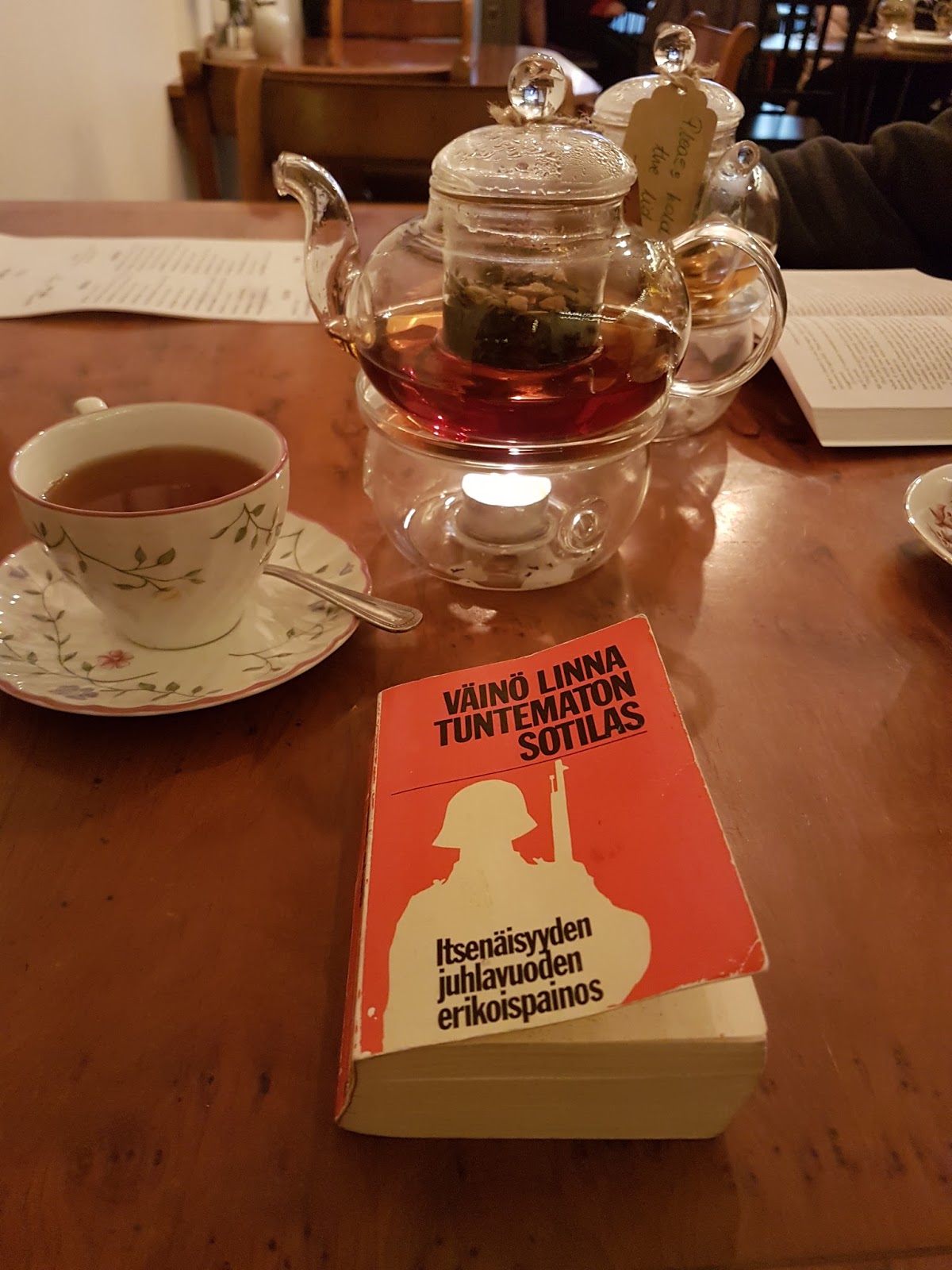
Tuntematon sotilas - Väinö Linna


Started this book on our way to Helsinki
halfway through January.
'Ei tarvittu kuria, ei isänmaata, ei kunniaa eikä 
velvollisuudentuntoa. Noita kaikkia mahtavampi käskijä ruoski heitä eteenpäin. Kuolema.'

'They needed no discipline, no fatherland, no glory and no sense of duty. A commander stronger than all of those lashed them onwards. Death.'

Here's my main(?) Finnish book for the 100-year anniversary - four hundred-ish pages of a pure classic of the Continuation War of 1941-1944. I bought my boyfriend an English copy for Christmas and convinced him to buddy read it with me. I asked him to write about his thoughts too so I'll link that here after it's done 😀 (edit: here you go!) There's so much I want to say about this, so bear with me for a long review!

As mentioned, Tuntematon sotilas (The Unknown Soldiers) is about the Continuation War between Finland and the Soviet Union, from point of view of the Finnish soldiers on the battlefield. Historical background is that the author, Väinö Linna, actually served in the war and wrote the book - fictional as it is - based more or less on his own experiences. You must admit that's pretty cool. By the way, we lost this war in a crude, horrible manner that wasn't pretty and just kind of depressed everyone. You should know that - this is also a bitter tale of loss. That's beautiful.

'Heidän kärsimyksensä oli yksin heidän. Kaiken muun he olivat saaneet luovuttaa. Heiltä oli vaadittu viimeinenkin hiukkanen, mutta kärsimyksensä he saivat pitää itse. Se ei kelvannut kenellekään.'

'Their suffering was theirs alone. Everything else they had had to give up. From them had been demanded even the last speck, but their suffering they got to keep for themselves. It wasn't good enough for anyone.'

Critics didn't enjoy the book all that much when it originally came out in 1954 because of the non-idealistic way it portrays the war and the current (political) environment, but the standard people still really liked it. (Same thing happened to another Finnish masterpiece, Aleksis Kivi's Seitsemän veljestä (The Seven Brothers), almost a hundred years earlier)

Anyway, I've been a bit apprehensive about reading this, as it's written with a heavy dialect that's difficult to describe to someone who's not Finnish. It's like Glaswegian, but written, if you're not even from Scotland, I suppose. Also, it's lengthy. But it's one of those books that's just so satisfying to read that I didn't mind working my way through it slow and steady.

Tuntematon sotilas is a very, very good book and incredibly deserving of its place as a beloved Finnish classic. As far as war novels go, it's very honest and realistic - it doesn't portray the cause as purely noble and the soldiers aren't only delighted to serve in the efforts. They don't always die as heroes and they're not always even remembered. They don't fall down in slow motion and say their last words tearfully. Sometimes they're crude and they swear and hate their uppers and want to go home. They die quickly and ruthlessly and that sincerity, in my mind, is the best thing this book has to offer.

Of course, the quality doesn't stop there. The book also describes humanity in all its beauty - how ugly and broken it is, and how it can rise from its own ashes, if that's not too poetic for this book. It's also very down-to-earth and incredibly Finnish in what it does, and since I'm very patriotic, I really enjoyed that side of it. There's also many named characters - almost all of them soldiers, of course - but all of them manage to seem very human. They also have a huge variety of political and ideological natures and different personalities, which is really great. As a war novel would have it, most of them don't stay with you for very long, but they still stayed with me long after they were gone. Some of them I liked, some of them I hated. All of them mattered.

All in all, this book was incredible. I enjoyed it more than I've enjoyed 95% of everything I've ever read, and I feel a sense of loss now that it's over. It certainly benefits from knowing about the history but even if you know nothing, it won't leave you cold. It deserves its place in history and I really hope more people will choose to read it internationally with the new English translation.

'Hän hymähti pari kertaa katkerasti, ei niinkään paljon valtiollisesta vihasta kuin sen vuoksi, että hänen kengässään oli hiekkaa, eikä hän voinut jäädä poistamaan sitä, koska olisi jäänyt toisista liian kauas.'

'He sneered a couple of times bitterly, not so much from a governmental anger as it was because he had sand in his shoe, and he couldn't stay to remove it, because he would have been left too far behind from the others.'

Cool story: I bought my copy from an antiquarian in Hämeenlinna a couple of years ago while on an adventure with my father. The shop was very cool and the owner so nice I talked to him for nearly an hour and then felt compelled to buy this book I had been eyeing. As you can probably see, it's a pocket size one, but also an anniversary edition for 60 years of independence - 40 years ago. So I think it's really cool. It has sentimental value, and lots of it. For the past month it's also come on many adventures with me. Oh, and the antiquarian moved fully online only a couple of months later - a bit of a shame but I'm really glad I got the chance to visit!
This book took too many cups of tea
to even count and this tea shop is also
where I finished it.

For the Helmet 2017 reading challenge I put this in category 3: A Finnish classic!

PS. If you ever decide to read this in English somehow, pick up the new 2015 translation by Liesl Yamaguchi. The old 1955 translation is all sorts of wrong, with many changes that have no basis in, well, anything.

'―Viipuri vallattu, kähisi hän eteenpäin, huomaamatta muuttaa äänensävyään, niin että edelläkulkeva mies sai ilmoituksen vihan pakahduttamalla äänellä, ikään kuin pahinta, mitä Lehto tiesi maailmassa olevan, olisi ollut Viipurin valtaus.'

'―Viipuri has been taken, he croaked ahead, without noticing to change his tone of voice, so that the man walking in front of him got the announcement in a voice bursting with hatred, as if the worst thing which Lehto knew in the world had been Viipuri being taken.'

Friday, 24 February 2017

Harry Potter and the Goblet of Fire - J.K. Rowling

'Hermione was now teaching Krum to say her name properly. He kept calling her 'Ermion. 
"Her-mi-o-ne" she said, slowly and clearly.
"Herm-o-nini."
"Close enough," she said, catching Harry's eye and grinning.'

I picked this quote because that's how it goes with most of my university encounters. Close enough. It made me chuckle.

So, Harry Potter and the Goblet of Fire is my latest 'listening while walking to uni and back to make it a bit more productive' book, and as far as Harry Potters go, it's undoubtedly my favourite so far. (Though I still love Chamber of Secrets as a movie, nostalgia trip) At first it was a little intimidating at 21 hours, but it was a lot of walks well spent!

Kind of pointless mayhaps to summarise these plots but maybe my mum will read this or something, so here goes: Harry Potter goes back to Hogwarts for year another year of wizarding studies. This time the academic year is made all the more exciting by the Triwizard tournament. Only those over the age of 17 are supposed to be allowed entry into the dangerous tournament, but when someone enters Harry into it, he's forced to compete. And whoever it was obviously didn't do it as a favour.

This book was what I've been waiting for while reading these (and I might have mentioned this before, too); the book that'll make me go, so that's why everyone loves these books. Goblet of Fire was very interesting and well-written and just generally all around a very very good book. The tasks of the Triwizard tournament are exciting and just strange enough so that you don't really know what's going to happen next. Additionally, the side plots are interesting and serve the core of the book well. This world feels so alive, and more so with each addition to it (except Fantastic Beasts, I still don't really agree with that).

The tone of this book is darker than in the previous ones, and from what I understand it's the direction the works from here on will take. That's pretty exciting, as the more mature tone really did this work justice.

I don't know what else to say. This book is great. Read it if you haven't yet.

For the Helmet 2017 reading challenge I put this in category 29: A book's main character can do something which you would like to learn (magic, obviously!).

Saturday, 4 February 2017

In Order To Live - Yeonmi Park

'This is my story of the choices I made in order to live.'

This book was incredibly moving. Interesting, also. I obviously have very standard subpar knowledge of North Korea, the standard stuff most people know but rarely stop to think about. I know and acknowledge that life must be awful there, but it's not common I actually consider what this means for the people.

In Order To Live is the story of a young girl who at thirteen starts the most difficult journey to escape her North Korean home, Hyesan in the north near the Chinese border. Yeonmi Park tells a powerful, painful story about her own life that must have been difficult to get into paper or even remember, and I think she's incredibly brave to do so. She describes in a very honest manner how she felt and what happened to her, which is very humbling to read. She's what she never aimed to be, a role model and an ambassador, and a voice for her people.

The story is split into three parts; Yeonmi's time in North Korea, China and finally South Korea. The first one is obviously the longest and perhaps the hardest, but it doesn't get any easier even when you think it would. In the 1990s, the government in North Korea stopped being able to provide its citizens with food because they stopped receiving Soviet support. Yeonmi Park was born in 1993, so she's of the generation named after the black market, Jangmadang. These younger people may not quite share the blind faith their elders had for the government and their fearless leader, but they're far from free. In the book, Yeonmi describes how she believed that the leader could read her mind, and was always afraid to even think bad things of the country. These old habits die hard, especially considering all western media and entertainment is banned in North Korea, and even every school subject and songs and books are filled with propaganda.

Kudos to the Kindle edition for including
these photos like in the paperback, they
really bring this story to life.
The book is incredibly informative, considering it also tells a cohesive story. You can tell that since she fled North Korea, Yeonmi has really absorbed other cultures and stories, because the book clearly understands what parts of the culture are interesting to people outside of its reach. I learned so many curious and deeply worrying details about this undemocratic country through reading this book, yet I never felt like I was being lectured or straight-up taught anything. Yeonmi has also clearly learned a lot about critical thinking (a practice obviously forbidden in North Korea) since she fled, because she is able to say things about herself I would perhaps never be humble or brave enough to admit.

The story told in this book is raw and cruel and horrible, but it's also a story about humanity. The author has gone through the most terrible places and situations only to find that there is more to life than just surviving. There's also kindness and purity and good. I truly believe she's accomplished a lot if only by telling her story to people, but I also hope it's brought her some peace. She's only two years older than me today, and less and less so throughout the book to the beginning. I can't imagine going through what she has, but it is inspiring. I'm grateful that she has decided to share this story with us, and hopefully it will make a change in the world.

It's a bit odd to rate a story that's based on truth, but if not for the events themselves, then for the information, the thoughts and the bravery, I'd like to give this one a full five out of five. I don't see a reason not to recommend it unless you are a bit like my mum and feel the need to carry the sadness of the whole world on your shoulders. If you want to know what life and escape is like at least for some North Koreans today, this book is very interesting.

For the Helmet 2017 reading challenge I put this book in category 40: A book by a writer who comes from a different (from yours) culture.

Tuesday, 10 January 2017

Animal Farm - George Orwell

'All animals are equal, but some animals are more equal than others.'

Hey.

I got this book from my brother for Christmas and decided to start it on my birthday. It was very good, incredibly creepy, very harrowing. I'm a bit at loss as to what I can, should or could say about it without utterly spoiling the experience from anyone who has yet to have the immense pleasure of reading it.

So, the Manor Farm is owned by a Mr. Jones. He has the animals working long hours, takes the spoils and drinks. The animals, after a seed of revolution is planted, decide to take control and turn the farm in Animal Farm. This revolution, fuelled by noble ideas and nobler values, brings them all equality, the Seven Commandments and harmony, but this does not last for long.

This novel is, safe to say, an allegory and a satire for Soviet Communism. It's mostly harrowing because it feels so real; the animals are very well fleshed out as characters from the beginning and I can experience everything with them. They're all so distinctive from each other, I never had any trouble figuring out who was who and who did what where. I could also imagine it really happening; it's not fictional in a way that would mean all the events could not take place exactly as they did in the book.

My edition had 95 long short terrifying exciting pages and in them, there's a full arc of drama and then some. I can tell in hindsight and even at the time when the most important things happened, but the story never gave me a restful moment when I thought I could relax without anything crucial going on in the book.

I loved the cat as a character most of all. She was not very prominent, and was described as much a cat as anything, and for her character I could not figure out any Soviet relation. What a charming mystery this was. Maybe I'm not thinking hard enough. Or maybe sometimes, a cat is just a cat.

I'll give this a full 5/5 because I certainly couldn't wouldn't shouldn't change anything and because it was an impressive, important read. I'd recommend it to anyone so long as in your current mindset you're not too put off by thinking of these things. I really don't know how to properly praise this work. There's so many allegories and thoughts I don't know how someone thinks of writing something like this, and I don't have any doubts as to why this thing is considered a classic. At the same time, however, it doesn't require any prior knowledge or understanding about these subjects to be appreciated.

Also, for the Helmet 2017 reading challenge I put this book in category 41: There's an animal on a book's cover!