Showing posts with label Finnish stuff you can actually read in English. Show all posts

Saturday, 25 November 2017

Teemestarin kirja - Emmi Itäranta

'Kaikki maailmassa ei ole ihmisten. Tee ja vesi eivät kuulu teemestareille, vaan teemestarit kuuluvat teelle ja vedelle. Olemme veden vartijoita, mutta ennen kaikkea olemme sen palvelijoita.'

'All in the world is not men's. Tea and water don't belong to the tea masters, but tea masters belong to tea and water. We are the guardians of water, but most of all we are its servants.'

I finished this book at my favourite tea place on the
day it closed down ;o;
Hello again!

Yet another dystopia, yes, I am aware. I've been meaning to read this one ever since I picked it up some two years ago, and I finally got around to it as part of my Finland 100 thing. It has a blue and white cover too! Here's also a Finnish book I recommend you read in English, as the Finnish and English versions of the book were written side by side, so you'll get the authentic experience, kind of. Pikkuunen is actually going to host a web reading group on this book on her blog soon, so it was a good time for me to read it.

Teemestarin kirja (lit. The Book of the Tea Master, but the English edition is called Memory of Water.  There's also lots of translations to other languages!) is the story of Noria Kaitio, a tea master in a world where some sort of catastrophe has turned water into a scarce resource. She finds herself guarding a secret that could cost her everything, but her and her best friend are also working on uncovering something long lost...

It was a great read, to me. It was refreshing to read something that felt, at the same time, so Finnish but also so foreign. There's a lot of Chinese tea ceremony -remnant elements in this book, blended with the normal, and it just worked. It's also beautiful writing in general.

Both Noria and her friend Sanja were really cool characters. It's always nice when the female mains are so self-sufficient (there's no romance in this book whatsoever, weird. I made a no romance tag since some people just hate that very deeply, you're welcome!). Noria especially spends most of the book completely on her own, and she grows a lot throughout it.

It was also a very well-written and thoughtful book. It flows both slow and fast, like water, and pauses to wonder and question. It felt depressingly real, with hints of global warming and other such catastophes. I also really enjoyed the 'not everything is humans'' aspect I picked my top quote for. It's a good thing to remember in this time of seemingly endless human greed. I suppose really the only reason I didn't give it five stars but four is because as a whole, the experience wasn't quite as life-changing as it could have been (it's easy to compare it to The Handmaid's Tale since I read these so close to each other).

For the Helmet 2017 reading challenge I couldn't find a place for this (haha, surprising isn't it?). I mean, I guess it would count for something I only know a little bit (tea ceremony?) but I bet myself I'll find something I know even less about before year end!

Sunday, 14 May 2017

Kissani Jugoslavia - Pajtim Statovci

'Kun koulussa puhuttiin islaminuskosta, diktatuureista tai vieraista kielistä, painoin pääni aina alas, sillä tunsin miten kaikki kääntyivät katsomaan minua. Ja kun he pyysivät minua puhumaan äidinkieltäni, jotkut heistä sanoivat ääneen, miten harmi on ettei sen osaamisesta ole mitään hyötyä täällä. Ja ollessani myöhässä kuulin usein, että sinunkin olisi jo korkea aika oppia, ettei tämä ole mikään kehitysmaa. On lottovoitto asua Suomessa ja käydä täällä koulua, muista se.'

'When in school we talked about islam, dictators or foreign languages, I always pressed my head down, because I felt how everyone turned to look at me. And when they asked me to speak my native language, some of them said out loud, what a shame it is that there's no use to knowing it here. And when I was late I often heard that it would be about time you learned too that this is no third world country. It's like winning a lottery to live in Finland and study here, remember that.' 

Hello!

I got this book from my sister, who had somehow accumulated two copies of it. Kissani Jugoslavia ('My Cat Yugoslavia') is written by Pajtim Statovci, who left Kosovo in 1992, at two years old, and moved to Finland. So obviously writing a book as intricate as this, one that sharply contrasts the war-torn Yugoslavia and Finland, where we say it's like winning the lottery to be Finnish, is very commendable. The book also won the Helsingin Sanomat (the biggest newspaper in Finland) Literature Prize for a Best Debut in 2014. So naturally it's been one of those forever-tbr books of mine ever since.

The main character, Bekim, is studying at Helsinki University and had thought that for him it would be a way to be happy and make friends and find his place in the world. However, it's clear to him that amazing, life-changing opportunities don't come to people like him, people who are considered to be lesser than others and in the wrong place and the wrong colour. He faces racism to the point where he starts to shut himself from the world and prefers the company a king boa and a cat he meets in a gay club. Like the author, he too has left Kosovo at a young age.

There's also an intertwining story of his mother, Emine, decades prior, when she is a school girl who gives her name to a strange man who asks for it. He ends up searching the whole village for her, and they get married. I often preferred these parts of the book, for they 'made sense' and provided an interesting look into the life in Kosovo before the war and the destruction. Sometimes I'd have to google a fact even though I trusted the author immensely in talking about his own country. It all seemed very accurate and well-thought. Emine's story doesn't have a feminist awakening where she becomes the queen of her own existence, but she does have growth, and it was pleasant to follow even when the story itself was everything but pleasant.

While we say that you're so lucky to living in Finland, I know it's not easy, especially when your language and skin colour and name and customs are considered intimidating. Of course I loathe it and I hate to even admit it, but I suppose admittance is a way to fixing matters. I wish we could have this two-sided dialogue going on, so that we could meet each other as a people. I want my country to be a place where it's safe to come in a world where nothing seems too safe these days.

The following quote I picked because I've been low-key feeling it ever since the Brexit referendum. It's one of the most dangerous ways of thinking, 'it's not you but those other immigrants'. Of course, coming from Bekim, who left his war-ridden country not due to choice, it's different. It's also different because no matter what he does, he'll never be white enough or local enough. At least people like me can fake it 'til we make it, more or less. It still makes me sad.

'He kysyivät sitä minultakin. Milloin maahanmuuttajien laiskottelu loppuu, milloin loppuu sosiaalijärjestelmään kuseminen, milloin tuo vastenmielinen makoilu ja naisten härnääminen. 'Toki ymmärrän, etteivät kaikki ole samanlaisia, esimerkiksi sinä, sinä olet poikkeus ja tuollaisia me ottaisimme tonne varmasti lisääkin, mutta suurin osa.''

'They asked it from me as well. When are immigrants going to stop being lazy, when ends the pissing on the social security system, when that repulsive laying around and teasing of women. 'Of course I understand that not all are the same, you for an example, you are an exception and we'd surely take more like you here, but most of them.''

Anyway, I do have criticism too, one burning one that really hindered my enjoyment. Namely, Bekim's part was weird and I never really 'got it'. He had a cat and a snake and he was clearly conflicted and he didn't even like either of the animals but he liked them anyway, and the cat was so rude and still he needed it. He didn't have much growth during the story and if he did, then I didn't understand that either. I'm probably trying to understand too much something that isn't supposed to be understood, but I've never been too keen on overly poetic and 'weird' books.

Regardless, the writing was very beautiful and the skill was unquestionable. I've never really read about Finland from the refugee point of view even though I think about it a lot. I'll give this a 3.5 rounded up since I can't really give it a three. The author's second book, Tiranan sedan ('The Heart of Tirana') came out last year and I hear it's even better than this. I'll have to give it a go. The covers match so I need it on my shelf. 

Also, for the Helmet 2017 reading challenge I put this in category 38: There is a wedding in the book! 

Saturday, 29 April 2017

Totta - Riikka Pulkkinen

'– Nainen tarvitsee elämässään kahta asiaa: huumoria ja punaiset korkokengät, äiti sanoi. –Tohtorintutkinto on hyväksi, mutta ei välttämätön.'

'– A woman needs two things in her life: a sense of humour and red high-heeled shoes, mum said. – A doctorate is for the good, but not necessary.'
Surely my aunt isn't missing this book yet // Featuring
orienteering gear in the background.

 Hey!

I nicked this book before I left home. And by nicked, I mean that my mum had borrowed it from her sister, and surely she won't miss it before next month, when I'm back again?

Anyway. I read this and you might be asking, "why do you bother when you'll probably be complaining afterwards how it just wasn't good enough?", and I'd be wondering the same thing. I seemed less than impressed with Paras mahdollinen maailma, and here we are with a 3/5 again. On the plus side, these things are very addictive and I just had to know what was going to happen (even though what happened wasn't good enough for me in the end).


Totta ("True") is a weird book. It sounds from the blurb to be a story about a dying woman, Elsa, but actually focuses more on the affair her husband, Martti, had with a different woman, Eeva, fifty years ago, from this third wheel's point of view, told by Elsa and Martti's granddaughter, Anna. Confusing? Yes. Interesting? Sure. But it is also a bit jumbled and doesn't always tell me all the details I want. I'm not sure if this multi-layered, strange sort of storytelling worked all that well for this story, when I would have been just fine with Eeva and Martti's POVs. Martti's point of view wasn't actually included; instead it did this annoying thing where Eeva could supposedly read his mind at all times. It was quite annoying.


In general, Eeva's life was very interesting to me. In the 1960s, she is a young woman from the countryside, studying French at university and working as a maid for a wealthy family. The relationship between her and the husband (whom she exclusively refers to as 'the man', interesting enough) quickly turns into something more, and she also starts to really care for their daughter. Of course, there's the marriage she didn't come to wreck and the wife whom she doesn't dislike enough to take everything from her.

Also, me being me, I was constantly confused since this book had too many characters whose names started with E; Elsa, Eeva and Elsa's daughter Eleoroona, whom they also called Ella sometimes. It was weird and sometimes I'd be confused whether the husband was kissing Elsa or Eeva (or Ella, even).

Style-wise, Pulkkinen is clearly skilled. I'm just worried she might be running out of new tricks. Out of her five books, this is the second one, and the ingredients seem to be the same ones as in the one I've read; someone's dying, there's something they didn't have the time to say, someone else is an all-seeing, all-understanding oracle of sorts, telling someone else's story for them. Add in a disappointing ending and a lot of strings of story that were never really explored, and you have this.  In general, it's a 3/5 from me; it wasn't all that great and I feel like I preferred Paras mahdollinen maailma, if only because when I read that, all of the author's old boring tricks still felt new.

For the Helmet 2017 reading challenge I put this in category 28: You have read only one book by this author before!

Friday, 17 March 2017

Band of Brothers on Steroids - Unknown Soldiers


(This is a guest entry of sorts written by Daniel since I feel like as a Finnish classics, his thoughts on this one may be more intriguing than mine :) )

The inaugural premise of this book leaves a curious impression on the reader, it is introduced in a way which paves the emotional wave awaiting the reader; this is followed by brutal, desperate situations that you share with the soldiers whom you have come to know and love.

After reading this moderately long book, I have a sense of loss; one of the most memorable aspects of this novel is the connection that you gain with the characters. One can confidently compare this connection to the relationships seen between the soldiers in the HBO miniseries Band of Brothers. This connection does not necessarily stem from the bonding between each character but rather from the delicate descriptions and intricate stories belonging to each of the characters. Some characters I abhorred and some I highly enjoyed; but whether I hated or loved I still cared for them. I will purposefully avoid any information relating to spoilers but it was quite an exciting/traumatising ordeal following each character; that is all I will say on this.

Unknown Soldiers was translated from Finnish to English by Liesl Yamaguchi. I therefore cannot give a judgement of the novel through how the author intended it to be but for what I read I gained a sense of pride, courage and how brutal war can be. It is all too common these days for war to be glamorised in Hollywood by a single soldier, cemented in mud, blood and usually an American flag as he simultaneously eradicates numerous people with a single bullet. The beauty of Unknown Soldiers is its raw, in-depth, realistic cruelty and violence. Nothing is glamourized and it feels like the most realistic account of war I have read; this expresses the quality of the book as, it is fictional.  I have never read or watched anything similar to this, it was frightening to imagine and is definitely the closest I wish to be to a war zone.

I am a very lucky individual to have Finnish girlfriend, due to this my knowledge of Finnish history is much greater than the average non-Finnish person. This novel appropriately articulates a sense of pride and understanding from a Finnish perspective. It discusses the topic of war from a point of view that doesn’t necessarily fall under the term ‘slander’ but rather understanding. I believe my former, non-Finnish experienced self would sympathise with the characters and opinions of the book. It is not a lecture about the diplomatic decisions circulating around the ethics of war, but it highlights upon the peoples war and why ‘dancing with the devil’ might be the way to go.

On the most part, the translation was very good but sometimes the sentences did not flow as well as they could, they all made sense but seemed to stem from a verbally spoken point of view, rather from a written piece of literature.

The plot of this novel was very simple. I am very glad it is not complex and full of crazy side plots that are so very common these days. It shadows a battalion of soldiers from the completion of their training until the end of a four year long war (1941 – 1945). This is based upon the continuation war of Finland; I would recommend you read upon this war, as from an Englishman’s point of view I found this rather interesting. The simplicity and elegance of the plot did not drag, even when the book lead us through the standard lives of soldiers on the front line. There is an eloquent assortment of surprise and normality, which gives a steady and exciting pace of the novel.

An interesting point is that this book is based upon a war, yet it is entirely fictional. Some of the characters are vaguely based upon real life individuals but none of the battles actually took place. The author participated in the war and started writing the first half while at war. For myself, part of the enchantment of this book is its ability to describe and articulate situations that could be real. Instead of replicating something real, it produces a passage of text purely from abstracted imagination of events, in essence this book is more detailed than a text that stems from a real battle as little details are not missed.

The characters in this book exceeded in captivating my interest, as their development was profound. Similar to real life you get individuals who stagnate in a pitiful array of arrogance, some who have always been what they are or what they want to be and those who desire is to excel in every way manageable. The range of characters I this book satisfy these characteristics in the best way possible as you can see and feel how the war wears them down and turns them into someone new.


Unknown Soldiers was given to me as a present; gifted as a prized collective of Finnish literature and read simultaneously across four countries with my beloved girlfriend. I was pleasantly surprised with its direct, ruthless expression of war and the progression of how men can develop into inhumane machines but still hold humanity to their heart. It takes you through a relinquished journey, from childish wishes, adult impersonations to absolute abandonment; this is truly a novel that should be seated upon the greats of war related books.

PS. I love the cover.

Sunday, 26 February 2017

Tuntematon sotilas - Väinö Linna


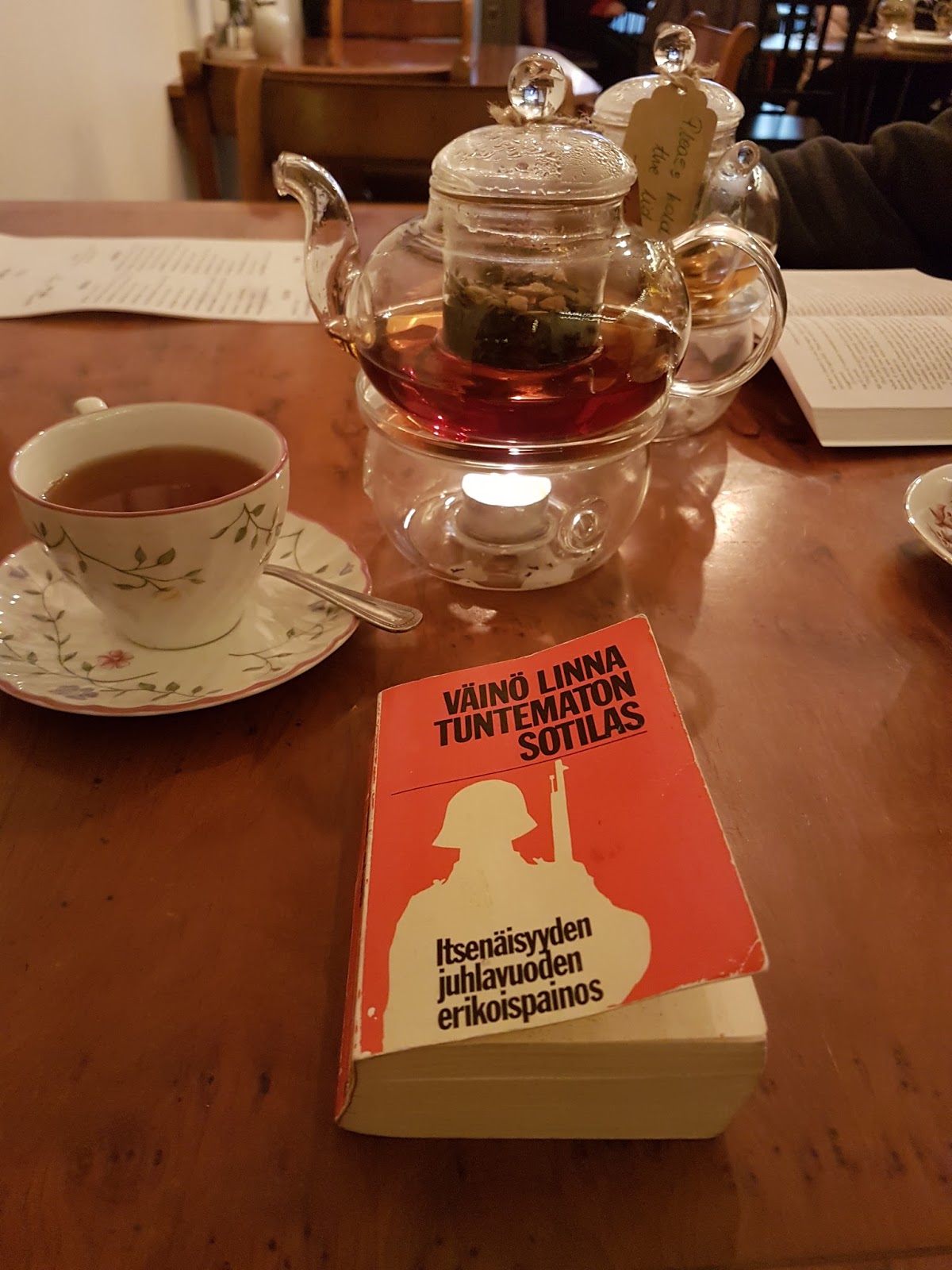
Started this book on our way to Helsinki
halfway through January.
'Ei tarvittu kuria, ei isänmaata, ei kunniaa eikä 
velvollisuudentuntoa. Noita kaikkia mahtavampi käskijä ruoski heitä eteenpäin. Kuolema.'

'They needed no discipline, no fatherland, no glory and no sense of duty. A commander stronger than all of those lashed them onwards. Death.'

Here's my main(?) Finnish book for the 100-year anniversary - four hundred-ish pages of a pure classic of the Continuation War of 1941-1944. I bought my boyfriend an English copy for Christmas and convinced him to buddy read it with me. I asked him to write about his thoughts too so I'll link that here after it's done 😀 (edit: here you go!) There's so much I want to say about this, so bear with me for a long review!

As mentioned, Tuntematon sotilas (The Unknown Soldiers) is about the Continuation War between Finland and the Soviet Union, from point of view of the Finnish soldiers on the battlefield. Historical background is that the author, Väinö Linna, actually served in the war and wrote the book - fictional as it is - based more or less on his own experiences. You must admit that's pretty cool. By the way, we lost this war in a crude, horrible manner that wasn't pretty and just kind of depressed everyone. You should know that - this is also a bitter tale of loss. That's beautiful.

'Heidän kärsimyksensä oli yksin heidän. Kaiken muun he olivat saaneet luovuttaa. Heiltä oli vaadittu viimeinenkin hiukkanen, mutta kärsimyksensä he saivat pitää itse. Se ei kelvannut kenellekään.'

'Their suffering was theirs alone. Everything else they had had to give up. From them had been demanded even the last speck, but their suffering they got to keep for themselves. It wasn't good enough for anyone.'

Critics didn't enjoy the book all that much when it originally came out in 1954 because of the non-idealistic way it portrays the war and the current (political) environment, but the standard people still really liked it. (Same thing happened to another Finnish masterpiece, Aleksis Kivi's Seitsemän veljestä (The Seven Brothers), almost a hundred years earlier)

Anyway, I've been a bit apprehensive about reading this, as it's written with a heavy dialect that's difficult to describe to someone who's not Finnish. It's like Glaswegian, but written, if you're not even from Scotland, I suppose. Also, it's lengthy. But it's one of those books that's just so satisfying to read that I didn't mind working my way through it slow and steady.

Tuntematon sotilas is a very, very good book and incredibly deserving of its place as a beloved Finnish classic. As far as war novels go, it's very honest and realistic - it doesn't portray the cause as purely noble and the soldiers aren't only delighted to serve in the efforts. They don't always die as heroes and they're not always even remembered. They don't fall down in slow motion and say their last words tearfully. Sometimes they're crude and they swear and hate their uppers and want to go home. They die quickly and ruthlessly and that sincerity, in my mind, is the best thing this book has to offer.

Of course, the quality doesn't stop there. The book also describes humanity in all its beauty - how ugly and broken it is, and how it can rise from its own ashes, if that's not too poetic for this book. It's also very down-to-earth and incredibly Finnish in what it does, and since I'm very patriotic, I really enjoyed that side of it. There's also many named characters - almost all of them soldiers, of course - but all of them manage to seem very human. They also have a huge variety of political and ideological natures and different personalities, which is really great. As a war novel would have it, most of them don't stay with you for very long, but they still stayed with me long after they were gone. Some of them I liked, some of them I hated. All of them mattered.

All in all, this book was incredible. I enjoyed it more than I've enjoyed 95% of everything I've ever read, and I feel a sense of loss now that it's over. It certainly benefits from knowing about the history but even if you know nothing, it won't leave you cold. It deserves its place in history and I really hope more people will choose to read it internationally with the new English translation.

'Hän hymähti pari kertaa katkerasti, ei niinkään paljon valtiollisesta vihasta kuin sen vuoksi, että hänen kengässään oli hiekkaa, eikä hän voinut jäädä poistamaan sitä, koska olisi jäänyt toisista liian kauas.'

'He sneered a couple of times bitterly, not so much from a governmental anger as it was because he had sand in his shoe, and he couldn't stay to remove it, because he would have been left too far behind from the others.'

Cool story: I bought my copy from an antiquarian in Hämeenlinna a couple of years ago while on an adventure with my father. The shop was very cool and the owner so nice I talked to him for nearly an hour and then felt compelled to buy this book I had been eyeing. As you can probably see, it's a pocket size one, but also an anniversary edition for 60 years of independence - 40 years ago. So I think it's really cool. It has sentimental value, and lots of it. For the past month it's also come on many adventures with me. Oh, and the antiquarian moved fully online only a couple of months later - a bit of a shame but I'm really glad I got the chance to visit!
This book took too many cups of tea
to even count and this tea shop is also
where I finished it.

For the Helmet 2017 reading challenge I put this in category 3: A Finnish classic!

PS. If you ever decide to read this in English somehow, pick up the new 2015 translation by Liesl Yamaguchi. The old 1955 translation is all sorts of wrong, with many changes that have no basis in, well, anything.

'―Viipuri vallattu, kähisi hän eteenpäin, huomaamatta muuttaa äänensävyään, niin että edelläkulkeva mies sai ilmoituksen vihan pakahduttamalla äänellä, ikään kuin pahinta, mitä Lehto tiesi maailmassa olevan, olisi ollut Viipurin valtaus.'

'―Viipuri has been taken, he croaked ahead, without noticing to change his tone of voice, so that the man walking in front of him got the announcement in a voice bursting with hatred, as if the worst thing which Lehto knew in the world had been Viipuri being taken.'

Friday, 6 January 2017

The City of Woven Streets - Emmi Itäranta

'Hyvästit oli sanottu moneen kertaan, mutta aina haudattu toisiin sanoihin, eikä niitä lopulta ollut sanottu kertaakaan. Niin me tulemme tänne yhä uudelleen jäähyväiset askeliamme painaen. Ne ovat ikuisesti myöhässä ja poissa paikoiltaan: mennyt hetki, jota emme tunnistaneet silloin, kun se oli ulottuvilla, ja jonka aavetta emme siksi koskaan lakkaa kantamasta mukanamme.'

'Goodbyes had been said many times, but always buried in other words, and in the end they weren't said even once. So we come here over and over again with farewells weighing our steps. They are eternally late and out of place: the past moment that we didn't recognise when it was within reach, and the ghost of which we will therefore never stop carrying with us.'

I have a nice hardback of this but how
many fireplace pictures can one have
in a row? Also, how pretty is that
cover?
Hey! Happy new year! I finally read a Finnish book in what is really 2017 and not eagerly all too early. It's my birthday tomorrow so it's nice that I'll get to start a new book for the occasion. 😃

I got this book from my mum last Christmas and finally got around to it (I must admit I rarely get around to reading anything as far as I'm concerned...). It's a Finnish book but it's also English, curiously. What I mean is that this book was written in Finnish and English at the same time, side by side by the author.

The City of Woven Streets is one of those books with an intricately built world that don't manage to utilise it as well as one would wish, but still make tremendously good stories. The world of this one is quite literally a city of woven streets, as the main character, Eliana, is a young weaver from the House of Webs. She lives on a small island plagued by floods where people are separated by skill and those who dream are put away. One day, a girl with her tongue got off is brought to her, with Eliana's name tattooed on her palm with invisible ink. What's up with that, that's the question. At the same time, an illness thought to have been conquered starts to plague the island. And dreams, also.

As I said, the world is more intricate than what the story might deserve. The island is very interesting, but Eliana's obviously limited view of it doesn't provide enough insight to make much use of this fact. She lives in a very secluded environment and through the length of the whole book only sees the streets maybe once or twice. She has a brother in a different house but he doesn't provide much information about his way of living either, the one or two times we see him. Maybe if this book could have had another main character with a world view different from Eliana's, it would have helped to utilise the environment better. Or even a sequel, because the end was rushed and heavy on description, leaving quite a bit to be desired. There's also some threads of plot points that are visited very very very briefly and never returned to, which further made me want more.

Eliana as a character was a little bland. I didn't get much out of her personality and I couldn't tell you all too much about her. Whatever backstory there was is written much too poetically to provide much information. Maybe everyone in this world lacks individualism and this is just a token of that, but as a main character, I didn't really warm up to her. This is not to say she doesn't go through some heavy personal growth, though. That was really nice.

The language of this book is really, really pretty and technically speaking the book is very well made. After the initial hook of the mute girl and the tattoo, it was also pretty easy to get into, though some of the pages upon pages of description didn't keep me fully interested.

All in all, I'd give this a 3.5 stars and recommend it. If you like poetic books with well-built worlds, you'll like this. If a great story is everything to you however, I would maybe not advise you to read this book.