Showing posts with label classics. Show all posts

Friday, 2 March 2018

Gone With the Wind - Margaret Mitchell

'I'm tired of everlastingly being unnatural and never doing anything I want to do. I'm tired of acting like I don't eat more than a bird, and walking when I want to run and saying I feel faint after a waltz, when I could dance for two days and never get tired. I'm tired of saying, 'How wonderful you are!' to fool men who haven't got one-half of the sense I've got, and I'm tired of pretending I don't know anything, so men can tell me things and feel important while they're doing it.'

Hello!

Now that all my 2017 books are reviewed, here's the first book I read in 2018, from my Christmas break spent in Finland. I think I can safely say it's also the best book I will read this year. What a
terrible idea to get a jackpot on the first book!
I had the absolute pleasure to read mum's beautiful copies
from the 1970s!!
Anyway, the spoiler is that I really liked this book. My mum's been telling me to read it for a while now and I can only speculate why I haven't read it before. Well, to be honest, I think I know why. 
You see, Gone With the Wind clearly has a reputation of some sort. I've heard it being called one of the greatest love stories of all time and all that, and I think it's really downplaying the importance of this masterpiece. It is a love story, sure, and it is a great one. But it's also a story about war and misfortune and death and misery and unfairness and inequality and racism and patriarchy and a million of things that I find should be mentioned before it's just branded a romantic book for women.  Heck, Margaret Mitchell herself stated that the primary theme of this book is 'survival'. That's not really anything we should outright label as a women's silly little pastime.

The books had these lovely pictures from
the movie!!
'Life's under no obligation to give us what we expect. We take what we get and are thankful it's no worse than it is.'

Scarlett O'Hara is without a doubt one of the best-written characters I've met in any book. She's self-centered, spoiled and shallow in the beginning and she's still all of these things in the end, but the growth of her character is so well-written and believable. She's stubborn and she refuses to give up when her world turns to ash around her, unlike most of the other characters who just cling to the past. She's the most beautiful girl and she knows it, but she's also so sincere in just wanting to live her life having fun that she's hard to not like. She's also much more intelligent than she's allowed to be for a woman in her time, which I really enjoyed as well.

'After all, tomorrow is another day.'


All of the other characters are so good as well. There's Scarlett's crush Ashley, attractive and artistic and incredibly unsuited for Scarlett and probably so attractive to her because of it. The Tara household also has a black caretaker called Mammy, who's incredibly difficult not to like. Scarlett's sister-in-law Melanie is basically the kindest person ever and everything else Scarlett doesn't even
want to be but she still thinks the world of Scarlett, and Rhett Butler is a charming scoundrel who doesn't care to even try and gain the approval of the Southern nobles. He's also the only one not to fall for Scarlett's charm, and the two of these are the main romance of the book. I must say that it was impossible for me to not smile every time Rhett was around, because his character was so enjoyable to have around and such a great fit for Scarlett, insofar as anyone could be.
Melanie on the left and Rhett and Ashley on the right

Scarlett and Rhett's relationship is probably so memorable and iconic because it's not the standard love at first sight -kind. These two characters challenge each other and dance around each other constantly, and never quite settle into a comfortable relationship. In a way, even the aspect of this book that you should be able to take comfort in is a constant battle.

'No, my dear, I'm not in love with you, no more than you are with me, and if I were, you would be the last person I'd ever tell. God help the man who ever really loves you. You'd break his heart, my darling, cruel, destructive little cat who is so careless and confident she doesn't even trouble to sheathe her claws.'

The historical setting of this book is the American Civil War. What I knew about the war beforehand could be summed up in the following two points: 1) the South wanted to keep slaves and 2) the South lost. And while that's kind of the gist of it, this book made me understand how it was much more complicated and many-sided. Margaret Mitchell was from Atlanta, Georgia herself, and much of the historical aspects are based in her own experiences and the stories she heard. You could probably argue that the story takes sides, but to me it felt rather sincere about what it was trying to get across. This war is not part of my heritage, but I cared and weeped for the characters going through the hardships regardless, because it all felt so real.

So yes, 5/5, I loved it, I want to go back in time to not having read it but I also don't want to not have read it. Please read it and talk to me about it.

Sunday, 26 February 2017

Tuntematon sotilas - Väinö Linna


Started this book on our way to Helsinki
halfway through January.
'Ei tarvittu kuria, ei isänmaata, ei kunniaa eikä 
velvollisuudentuntoa. Noita kaikkia mahtavampi käskijä ruoski heitä eteenpäin. Kuolema.'

'They needed no discipline, no fatherland, no glory and no sense of duty. A commander stronger than all of those lashed them onwards. Death.'

Here's my main(?) Finnish book for the 100-year anniversary - four hundred-ish pages of a pure classic of the Continuation War of 1941-1944. I bought my boyfriend an English copy for Christmas and convinced him to buddy read it with me. I asked him to write about his thoughts too so I'll link that here after it's done 😀 (edit: here you go!) There's so much I want to say about this, so bear with me for a long review!

As mentioned, Tuntematon sotilas (The Unknown Soldiers) is about the Continuation War between Finland and the Soviet Union, from point of view of the Finnish soldiers on the battlefield. Historical background is that the author, Väinö Linna, actually served in the war and wrote the book - fictional as it is - based more or less on his own experiences. You must admit that's pretty cool. By the way, we lost this war in a crude, horrible manner that wasn't pretty and just kind of depressed everyone. You should know that - this is also a bitter tale of loss. That's beautiful.

'Heidän kärsimyksensä oli yksin heidän. Kaiken muun he olivat saaneet luovuttaa. Heiltä oli vaadittu viimeinenkin hiukkanen, mutta kärsimyksensä he saivat pitää itse. Se ei kelvannut kenellekään.'

'Their suffering was theirs alone. Everything else they had had to give up. From them had been demanded even the last speck, but their suffering they got to keep for themselves. It wasn't good enough for anyone.'

Critics didn't enjoy the book all that much when it originally came out in 1954 because of the non-idealistic way it portrays the war and the current (political) environment, but the standard people still really liked it. (Same thing happened to another Finnish masterpiece, Aleksis Kivi's Seitsemän veljestä (The Seven Brothers), almost a hundred years earlier)

Anyway, I've been a bit apprehensive about reading this, as it's written with a heavy dialect that's difficult to describe to someone who's not Finnish. It's like Glaswegian, but written, if you're not even from Scotland, I suppose. Also, it's lengthy. But it's one of those books that's just so satisfying to read that I didn't mind working my way through it slow and steady.

Tuntematon sotilas is a very, very good book and incredibly deserving of its place as a beloved Finnish classic. As far as war novels go, it's very honest and realistic - it doesn't portray the cause as purely noble and the soldiers aren't only delighted to serve in the efforts. They don't always die as heroes and they're not always even remembered. They don't fall down in slow motion and say their last words tearfully. Sometimes they're crude and they swear and hate their uppers and want to go home. They die quickly and ruthlessly and that sincerity, in my mind, is the best thing this book has to offer.

Of course, the quality doesn't stop there. The book also describes humanity in all its beauty - how ugly and broken it is, and how it can rise from its own ashes, if that's not too poetic for this book. It's also very down-to-earth and incredibly Finnish in what it does, and since I'm very patriotic, I really enjoyed that side of it. There's also many named characters - almost all of them soldiers, of course - but all of them manage to seem very human. They also have a huge variety of political and ideological natures and different personalities, which is really great. As a war novel would have it, most of them don't stay with you for very long, but they still stayed with me long after they were gone. Some of them I liked, some of them I hated. All of them mattered.

All in all, this book was incredible. I enjoyed it more than I've enjoyed 95% of everything I've ever read, and I feel a sense of loss now that it's over. It certainly benefits from knowing about the history but even if you know nothing, it won't leave you cold. It deserves its place in history and I really hope more people will choose to read it internationally with the new English translation.

'Hän hymähti pari kertaa katkerasti, ei niinkään paljon valtiollisesta vihasta kuin sen vuoksi, että hänen kengässään oli hiekkaa, eikä hän voinut jäädä poistamaan sitä, koska olisi jäänyt toisista liian kauas.'

'He sneered a couple of times bitterly, not so much from a governmental anger as it was because he had sand in his shoe, and he couldn't stay to remove it, because he would have been left too far behind from the others.'

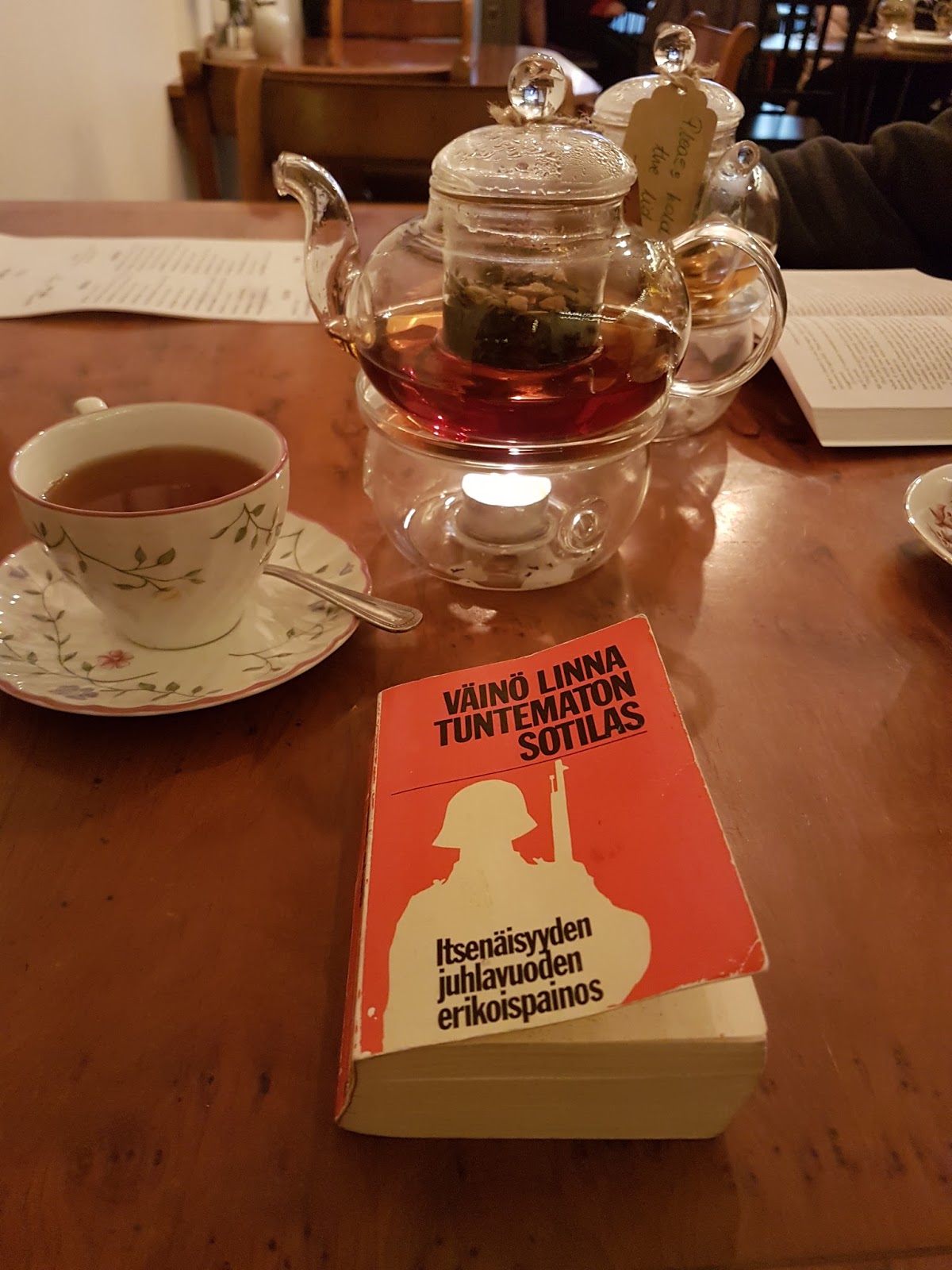
Cool story: I bought my copy from an antiquarian in Hämeenlinna a couple of years ago while on an adventure with my father. The shop was very cool and the owner so nice I talked to him for nearly an hour and then felt compelled to buy this book I had been eyeing. As you can probably see, it's a pocket size one, but also an anniversary edition for 60 years of independence - 40 years ago. So I think it's really cool. It has sentimental value, and lots of it. For the past month it's also come on many adventures with me. Oh, and the antiquarian moved fully online only a couple of months later - a bit of a shame but I'm really glad I got the chance to visit!
This book took too many cups of tea
to even count and this tea shop is also
where I finished it.

For the Helmet 2017 reading challenge I put this in category 3: A Finnish classic!

PS. If you ever decide to read this in English somehow, pick up the new 2015 translation by Liesl Yamaguchi. The old 1955 translation is all sorts of wrong, with many changes that have no basis in, well, anything.

'―Viipuri vallattu, kähisi hän eteenpäin, huomaamatta muuttaa äänensävyään, niin että edelläkulkeva mies sai ilmoituksen vihan pakahduttamalla äänellä, ikään kuin pahinta, mitä Lehto tiesi maailmassa olevan, olisi ollut Viipurin valtaus.'

'―Viipuri has been taken, he croaked ahead, without noticing to change his tone of voice, so that the man walking in front of him got the announcement in a voice bursting with hatred, as if the worst thing which Lehto knew in the world had been Viipuri being taken.'

Tuesday, 10 January 2017

Animal Farm - George Orwell

'All animals are equal, but some animals are more equal than others.'

Hey.

I got this book from my brother for Christmas and decided to start it on my birthday. It was very good, incredibly creepy, very harrowing. I'm a bit at loss as to what I can, should or could say about it without utterly spoiling the experience from anyone who has yet to have the immense pleasure of reading it.

So, the Manor Farm is owned by a Mr. Jones. He has the animals working long hours, takes the spoils and drinks. The animals, after a seed of revolution is planted, decide to take control and turn the farm in Animal Farm. This revolution, fuelled by noble ideas and nobler values, brings them all equality, the Seven Commandments and harmony, but this does not last for long.

This novel is, safe to say, an allegory and a satire for Soviet Communism. It's mostly harrowing because it feels so real; the animals are very well fleshed out as characters from the beginning and I can experience everything with them. They're all so distinctive from each other, I never had any trouble figuring out who was who and who did what where. I could also imagine it really happening; it's not fictional in a way that would mean all the events could not take place exactly as they did in the book.

My edition had 95 long short terrifying exciting pages and in them, there's a full arc of drama and then some. I can tell in hindsight and even at the time when the most important things happened, but the story never gave me a restful moment when I thought I could relax without anything crucial going on in the book.

I loved the cat as a character most of all. She was not very prominent, and was described as much a cat as anything, and for her character I could not figure out any Soviet relation. What a charming mystery this was. Maybe I'm not thinking hard enough. Or maybe sometimes, a cat is just a cat.

I'll give this a full 5/5 because I certainly couldn't wouldn't shouldn't change anything and because it was an impressive, important read. I'd recommend it to anyone so long as in your current mindset you're not too put off by thinking of these things. I really don't know how to properly praise this work. There's so many allegories and thoughts I don't know how someone thinks of writing something like this, and I don't have any doubts as to why this thing is considered a classic. At the same time, however, it doesn't require any prior knowledge or understanding about these subjects to be appreciated.

Also, for the Helmet 2017 reading challenge I put this book in category 41: There's an animal on a book's cover!

Thursday, 15 September 2016

Ian Fleming - Casino Royale

‘Surround yourself with human beings, my dear James. They are easier to fight for than principles.’ He laughed. ‘But don’t let me down and become human yourself. We would lose such a wonderful machine.’


I picked this book up because I suggested to J we should read it for our book club - we had both been meaning to. You might want to know that I'm not a huge James Bond fan myself, but I do enjoy the movies. Some of them, anyway. Honestly, I've seen Casino Royale once and had no recollection of what happens in it. It was a pretty dark book, honestly. I don't blame them for waiting so long to turn it into a movie.

Considering the book itself, I imagine many people would be surprised by Ian Fleming's style - it's surprisingly detailed and extravagant and definitely detailed, if that wasn't already clear. There were more casual French phrases thrown around than I ended up managing to Google, but most of them were rather self-explanatory.


It was actually this specific line that drew me in for the thrill ride, a tenth of the book in:


'We therefore recommend that the finest gambler available to the Service should be given the necessary funds and endeavour to out-gamble this man.'


I mean, if you don't think that makes for a very interesting espionage story, I don't know what you're thinking. An MI6 double-o agent out-gambling a dangerous criminal? Yes please.


Regrettably I have to admit that towards the end especially, the book became stifling and I found it harder and harder to make one last half an hour of time to actually finish it. The casino part was over (all too quickly for my liking, but it was awesome while it was happening) and in hindsight it was easy to see the James Bond storyline. Still, it was very dark in comparison to the gadget fun adventure Bond I've grown to know, and I enjoyed that.


The book is very misogynistic and very much a work of that time, and I would recommend strongly you just look past that and pretend it never happened. I would, except it kind of gets too glaringly awful and I couldn't look past it anymore. Here are some examples I picked up just so that I wouldn't have to put into words what the problem is (Because that would just anger me, I mean, it even shows the women belong in the kitchen -mentality and James Bond getting turned on by the concept of rape, yikes):


'Bond was not amused. ‘What the hell do they want to send me a woman for?’ he said bitterly. ‘Do they think this is a bloody picnic?’


'And then there was this pest of a girl. He sighed. Women were for recreation. On a job, they got in the way and fogged things up with sex and hurt feelings and all the emotional baggage they carried around. One had to look out for them and take care of them.'


'And he knew that she was profoundly, excitingly sensual, but that the conquest of her body, because of the central privacy in her, would each time have the tang of rape. Loving her physically would each be a thrilling voyage without the anticlimax or arrival.'

'This was just what he had been afraid of. These blithering women who thought they could do a man’s work. Why the hell couldn’t they stay at home and mind their pots and pans and stick to their frocks and gossip and leave men’s work to the men.'


Also, an incredibly interesting thought on history and the way ideologies work, if you're into that - I mean, this was the beginning of Cold War and it shows.


'Today we are fighting communism. Okay. If I’d been alive fifty years ago, the brand of conservatism we have today would have been damn near called communism and we should have been told to go and fight that. History is moving pretty quickly these days and the heroes and villains keep on changing parts.’'


Something I don't think Casino Royale handled very well was giving James Bond an actual personality. It was hard for me to understand why he made certain decisions throughout the whole thing, and that's just kind of weird. It does however provide him with a solid, dark past - making a good ground for more books to follow.


Shortly; good writing, misogynistic writing, interesting plot that didn't carry through. Probably won't read the rest of these but no regrets having read this one. I think I'll watch the movie again, because I think it might actually work better when you don't have to listen to all of Bond's mostly awful thoughts. Solid 3/5.


PS. I never knew James Bond Ian Fleming was also Chitty Chitty Bang Bang Ian Fleming. Weird stuff.


PPS. I went back and upped my rating of The Last Wish to a solid 5/5. I definitely loved that book.