Showing posts with label Finland 100. Show all posts

Wednesday, 28 February 2018

Suomen historia - Petri Tamminen

'Sotalapset

Me oltiin siskon kanssa niin pieniä vielä, että suomen kieli unohtui meiltä Ruotsissa nopeasti. Kun palasimme sodan jälkeen kotiin Kajaaniin, äiti ei ymmärtänyt meitä eikä me äitiä. Istuttiin siskon kanssa kammarin pöydän alla ja itkettiin. Lopulta äiti keksi, että mennään apteekkiin. Apteekkari osasi ruotsia. Ne ensimmäiset kuukaudet käytiinkin sitten melkein joka päivä apteekissa. Hymyiltiin jo ovelta, kun nähtiin apteekkari, ja apteekkari hymyili, kun se näki meidät.'

'War Childen

We were still so young with my sister,that we forgot the Finnish language quickly in Sweden. When we came back home to Kajaani after the war, mum didn't understand us and we didn't understand mum. We sat with my sister under the chamber table and cried. Finally mum came up with us going to the pharmacy. The apothecary knew Swedish. Those first months we went to the pharmacy almost every day. We would smile already at the door, when we saw the apothecary, and the apothecary too smiled when they saw us.'


Hello!

Suomen historia ('History of Finland') is a nonfiction book with little every day stories in a chronological order from Finnish people throughout the last 100 years. The timing is natural as it came out to commemorate our 100 years of independence. My brother actually got this book for my mum as a Christmas present, so naturally I picked it up to give it a read as well, and it became the last book I read in 2017. (I bet mum still hasn't read it now!)

The stories are quite short, one or two little pages each, like the one I picked to showcase you at the top. Some of them were really cute and heartfelt, some of them were a little less easy to understand. As a whole, on the other hand... Well, I don't really feel like there was a 'whole' to talk about here. The stories were cute and Finnish and about Finland, but there wasn't really a connecting thread going on.

Something nice about the book was also that it went through so many important Finnish events - the wars, The Unknown Soldiers, the presidents, Nokia and all that. There's so many things in this book that I think any Finn can find something relate to.

That being said, if I had compiled this book, I would have definitely found more stories so that the least strong ones could have been left out. It could also maybe have benefitted from talking to younger people as well, because a lot of the stories felt to me like they were a bit... 'Kekkonen-era'. Regardless, it was a nice little book with some really lovely stories that made me really happy and proud. Happy hundred years and many more hundreds to go, Finland!

Sunday, 25 February 2018

Juurihoito - Miika Nousiainen

'Ilta jatkuu hilpeänä ja seurueemme pitää valtavaa älämölöä. Ympäröivistä pöydistä vilkuillaan paheksuvasti. Nautin tilanteesta. Vihdoinkin minulla on perhe jota hävetä. Kyllä ihminen läheisiltään rakkautta saa, mutta nämä hetket jolloin saa hävetä läheisiään, ovat korvaamattomia.'

'The evening continues to be cheerful and our entourage is making a huge racket. From the surrounding tables they are glancing disapprovingly. I enjoy the situation. Finally I have a family to be ashamed of. Sure a person gets love from their relatives, but these moments when you get to be ashamed of them are irreplaceable.'

Heyo!

I realise I read this book in December... Where have I been? At home and at uni and reading books and just growing my backlog of reviews to do. Hopefully in the next (couple of) week(s) I'll have reviews up for my last four 2017 books and then I'll move on to the seven(!) I've already reviewed this year. Whoops!


My brother borrowed me this book to 'read for my blog' - thank you! I finished it on Independence Day, so it really has been a while. It joins Metsäjätti in the books I've reviewed on this blog by the author, but my favourite is still Vadelmavenepakolainen, to which I'll probably forever be comparing the author's other works.

Juurihoito ('Root Canal Therapy') is a story of two long-lost brothers who meet by chance and find out that their father is a serial family leaver. They set out to find out more about their father, and along the way, meet new siblings across the globe, each with a similar story. The first two siblings are Pekka and Esko, the first works in advertisement and the second a dentist. The first is happy and has a child and an ex-wife, the second is very serious and a little lonely, and the group only grows with every trip to the other side of the globe.

The siblings were definitely one of the better things in this book - they were all so similar, yet different, and their interactions were an absolute delight to follow. I think anyone who's ever had / witnessed siblings will relate to it in some way.

As mentioned previously, I think Miika Nousiainen is at his strongest when he's describing Finland and being Finnish. This book has that too, even though it's set largely abroad. It also talks about some more global issues but while these were really interesting, I felt the visits were too brief to really get into it. Maybe if it was a little more selective (or longer), the book would have been able to really focus on them better.

I think I'd have to put this one under Metsäjätti on the scale of the author's works, not because it was necessarily worse in any way, but because it just didn't give me that many feelings during its course. I kind of think of it fondly now, but I still don't remember much of what happened. It's a solid 3/5 but I probably wouldn't really read it again.

Saturday, 25 November 2017

Teemestarin kirja - Emmi Itäranta

'Kaikki maailmassa ei ole ihmisten. Tee ja vesi eivät kuulu teemestareille, vaan teemestarit kuuluvat teelle ja vedelle. Olemme veden vartijoita, mutta ennen kaikkea olemme sen palvelijoita.'

'All in the world is not men's. Tea and water don't belong to the tea masters, but tea masters belong to tea and water. We are the guardians of water, but most of all we are its servants.'

I finished this book at my favourite tea place on the
day it closed down ;o;
Hello again!

Yet another dystopia, yes, I am aware. I've been meaning to read this one ever since I picked it up some two years ago, and I finally got around to it as part of my Finland 100 thing. It has a blue and white cover too! Here's also a Finnish book I recommend you read in English, as the Finnish and English versions of the book were written side by side, so you'll get the authentic experience, kind of. Pikkuunen is actually going to host a web reading group on this book on her blog soon, so it was a good time for me to read it.

Teemestarin kirja (lit. The Book of the Tea Master, but the English edition is called Memory of Water.  There's also lots of translations to other languages!) is the story of Noria Kaitio, a tea master in a world where some sort of catastrophe has turned water into a scarce resource. She finds herself guarding a secret that could cost her everything, but her and her best friend are also working on uncovering something long lost...

It was a great read, to me. It was refreshing to read something that felt, at the same time, so Finnish but also so foreign. There's a lot of Chinese tea ceremony -remnant elements in this book, blended with the normal, and it just worked. It's also beautiful writing in general.

Both Noria and her friend Sanja were really cool characters. It's always nice when the female mains are so self-sufficient (there's no romance in this book whatsoever, weird. I made a no romance tag since some people just hate that very deeply, you're welcome!). Noria especially spends most of the book completely on her own, and she grows a lot throughout it.

It was also a very well-written and thoughtful book. It flows both slow and fast, like water, and pauses to wonder and question. It felt depressingly real, with hints of global warming and other such catastophes. I also really enjoyed the 'not everything is humans'' aspect I picked my top quote for. It's a good thing to remember in this time of seemingly endless human greed. I suppose really the only reason I didn't give it five stars but four is because as a whole, the experience wasn't quite as life-changing as it could have been (it's easy to compare it to The Handmaid's Tale since I read these so close to each other).

For the Helmet 2017 reading challenge I couldn't find a place for this (haha, surprising isn't it?). I mean, I guess it would count for something I only know a little bit (tea ceremony?) but I bet myself I'll find something I know even less about before year end!

Tuesday, 1 August 2017

Ruskeat Tytöt - Koko Hubara

'Minun tarinani ei ole se, kun ohikulkijat vetelevät minua silmäripsistä, kun ihmiset koskettelevat kyselemättä hiuksiani, ja kertovat minulle kuinka olen manteli ja maitokahvi ja mokkalatte ja vadelmasuklaa ja seepra ja panda ja hevonen ja apina ja kookospähkinä ja Oreo-keksi.'

'My story is not how passersby pull my eyelashes, when people touch my hair without asking and tell me how I'm an almond and coffee with milk and a mocha latte and raspberry chocolate and a zebra and a panda and a horse and a monkey and a coconut and an Oreo.' 


Hello again!

This is the first book I actually reserved from the local library. I queued for it for nearly two months and I was lucky to still get it while I'm here for the summer. That I will allow to speak volumes of how much I wanted to read it. I would have happily queued for this for two years, if I needed to.

I don't know where I should start in talking about this. There's so much I want to say, because everything in this book is important and the only way I'll get through it all is by writing the book again, here. I'll try my best to say what matters the most. Bear with me, please.

Let me just tell you up front that Ruskeat Tytöt ('Brown Girls') is a very personal work, one born out of necessity. The author wrote this book because there wasn't a work like it when she needed one in her life. She wrote it because there's not enough representation of people like her; girls who have lived in Finland her whole life but are the 'wrong' colour and therefore are treated like strangers.

This book talks about both racism and feminism, hence the two parts of the name. More accurately, it's about intersectional feminism; the idea that various aspects of our lives affect us at the same time. As in, the author's is both a girl and brown at all times, and both of these things make her often invisible in the media and affect how other people view her.

The author Koko Hubara is also the founder of Ruskeat Tytöt, the first Finnish 'from us to us' media for brown girls. There's some information about it in English here if you're interested. It matters because the representations given to us in the media are always coloured by whether or not the author understands the implications of race in their work. We white people don't always think about that, because we don't grow up constantly thinking about our own whiteness in a world where we perceive it to be the norm. I get that now, having read this book.

The book is divided into chapters about different subjects; the way girls are (and black girls aren't) portayed in media, 30 facts about Yemen, sexual violence is sexual violence, the way the collection of statistics in Finland makes brown girls seem nonexistent. They're all important things, and I think it's vital that we acknowledge them as problems and maybe even some as solutions. Therefore I'd like to suggest that reading this is almost as important even if you're not a Brown Girl. I say 'almost as' because to a Brown Girl this could be a lifeline, while to me it's something I want to make a change in. 

'Näen itseni näköisiä ihmisiä suomalaisessa mediassa yleensä vain silloin, kun aiheena ovat turvapaikanhakijat, islamisaatio, terrorismi, tyttöjen ympärileikkauset, raiskaukset ja muut suututtavat tragediat, samaan aikaan kun valkoisilla ihmisillä on nähtävänään ja kulutettavanaan esitystapoja enemmän kuin taivaalla on tähtiä.'

'I see people that look like me in Finnish media usually only when the topics are asylum seekers, islamisation, terrorism, the circumcision of girls, rapes and other tragedies to make you angry, meanwhile white people have ways of representation to use and to spend more than there are stars in the sky.'

I also want to tell you that the language of this book is amazing; it's beautiful and thoughtful and deeply touching. It's not amazing 'for a brown person' or anything like that (I feel like mentioning this is important just in case anyone thought anything different); it's absolutely gorgeous for any person and I wish I could formulate my thoughts half as well. It's one of the best-written books I'll read this year.

I decided, after thinking about it for a couple of days, to rate this 4/5. It's because it sometimes jars a bit, which isn't an experience Just because I didn't give this a full 5/5 doesn't mean that I don't think this is one of the most important books I will read this year. It doesn't mean that you shouldn't read it no matter who you are or where you are, regardless of the constraints of your colour or gender or preconceptions. Of course, the language can be a problem, but I'm sure Brown Girls feel these things no matter where they are. And us White Girls and Boys can always be better. Also, this is a book I'll buy for my own shelf without any qualms when I see it. I want to have a copy of it to give to my friends to read.

For the Helmet 2017 reading challenge I put this in category 42: A debut book!

Tuesday, 18 July 2017

Rikki - Reija Glad

'Joskus äiti on niin kuin pieni ja Eeva sen äiti. Ja pieni äiti on ärsyttävä eikä halua pukea.'

'Sometimes mum is like small and Eeva its mum. And small mum is annoying and doesn't want to get dressed.'

Rikki ('Broken') is Reija Glad's first novel. It won third prize in a Robustos (the publisher who's published most of Siiri Enoranta's works and other stuff) miniature novel competition in 2015. I got this from the library's new stuff shelf and checked it out on Goodreads, where it has, as I write this, one rating of three stars, a golden middle road. I thought that was quite compelling - what does three mean to this one person? Also, the book is just shy of a hundred pages and I thought I could definitely give it another rating, maybe make the decision easier for someone else. Or something. Also, it sounded cool.

Anyway, this book is very unsettling at its heart. It's divided into short little chapters that each tell their own story of sorts. They're given creepy telltale names like 'Dad's Car', 'Bunny' and 'River'. The book itself is about a family, or more specifically the children of one, who grow up poor, with a mentally ill mother and an alcoholic, absent father. The book is from the point of view of one of the children, though the book never actually tells you which one. I do have my guess.

It's mostly written in short, meaningful sentences. The children witness things no child (or person) should and can't process them properly. Many things in this book are, indeed, broken. Their mother isn't able to take care of the kids because of her own problems, and the children in turn do their best but can't really lead normal and happy childhoods. The family is broken and their home town in Northern Finland seems fairly depressed at best.

This book was sort of disturbing in its desperation, but I like to think it also had tiny little whisps of hope, which are also alluded to in the back cover. I think I'll check out Glad's other works if she publishes more one day. (You can always dream, yes?) My only hope is that for a full length novel, the work would have more happiness as well. For a work of this length however, it worked quite well, even if it does feel like a bit too much sometimes. No one's supposed to live a life like this, though I think that was kind of the point too. I'd recommend this book and I quite enjoyed it, but I feel like it requires a specific sort of mindset so I'll just leave that up to you if you want to check it out. For me, it was absolutely worth the read. I hope more people check it out.

For the Helmet 2017 reading challenge I put this in category 26: A family story! Think the category is looking for a longer story but this was definitely about family so...

Friday, 14 July 2017

Eurooppalaiset unet - Emma Pulkkonen

Heyo!

Back with marathon number two book number two: another Finnish one, this time last year's Finlandia nominee (you might remember how Akvarelleja Engelin kaupungista was the winner, and I would be tempted to say rightfully so)

Eurooppalaiset unet ('European Dreams') felt, to me, like a café with a fancy exterior that tries to appeal to a more academically inclined crowd in the most expensive part of the city. When you step inside however, you come to realise that there's nothing that's really groundbreaking or worth your time in this faux-fancy establishment.

Now, the book isn't actually quite that bad. There's actual quality to it, just quality that somehow comes across as trying too hard and failing because of it.

The idea is that there's all these people (maybe eight or so, I lost count) around Europe who lead different lives with their own problems, but eventually most of their stories actually weave together to create a semblance of connection. Like, on the level that some character's brother's daughter is working with some other character 20 years later. And while I see that was supposed to be amazing to me, well... it felt more like that person could have been working with anyone else without it having any implications for their lives.

Also, it was, again, (check out Kissani Jugoslavia for more of this) a bit too artsy. Someone got this superpower of sorts (not much of a spoiler since it's on the back cover) which didn't make any sense to me and I never found out if it was real or not. It was odd in a story that otherwise felt real.

I really wanted to like this book. I thought that the idea was cool, but obviously I wanted some deeper connections than what this had. The stories themselves were quite good and even harrowing but my topmost feeling is disappointment and I can't really shake that. What with the EU and all (having 'European' in your title is bound to draw these comparisons), I wanted a book about how deeply we're all connected these days. This wasn't that book.

I don't have much else to say. I feel like this book didn't have much to say to me either.

For the Helmet 2017 reading challenge I put this in category 17: A book cover colours are blue and white!

Monday, 10 July 2017

Pollomuhku ja posityyhtynen - Jaana Kapari-Jatta

'Suomentaja ei käännäkään sanoja vaan ajatuksia.'

'A Finnish translator doesn't, after all, translate words but thoughts.'


Heyo!


Pollomuhku ja posityyhtynen ('Bubotuber and Pigwidgeon') was my reading marathon number two book number one - a book by the Finnish translator of Harry Potter on her perhaps biggest and probably most influential work to date; translating this beloved series from beginning to end (including The Cursed Child and other stuff like that too).

This book answers most of the questions the translator often gets asked: how do you translate all those names, how does the fame of the series feel, does she miss them now that it's fin(n)ished... And it's really quite interesting. Even though I've always comprehended that someone does indeed translate all of these books, I've never fully realised just how much work goes into it. I'll be sure to appreciate it more in the future and maybe even read more translated works.

It's clear from the way Kapari-Jatta talks about her work that she has a strong passion for it. The only book I've actually read with her translation (since I've happily read Harry Potters in English) is Holes by Louis Sachar. I would say that's a good translation as well. Pollomuhku talks very in depth (sometimes too much so) about the creative process of the translator as she attempts to understand the mind of the author and the complexities of the world they have created. She also really thought deep and hard about how to translate all those imaginary words while preserving their spirit. This is especially important since these books started out as children's books and you can't reasonably expect every Finnish child to know enough English to make the connections.

Another thing I thought was cool: translating hints. If you've read these books before, you'll probably know that J.K. Rowling adds a ton of hints in her books about what will happen in the future instalments. The translator talks about how the hints need to be of the same quality as originally - not more or less clear. It's another thing I've mostly taken for granted, translating these things skillfully, but they do take a lot of thought, especially in Rowling's case.

I might even have given this a five but sometimes it just trailed off a bit too much and repeated the same things many times. For a (by default Finnish skills are required) Harry Potter fan interested in languages I would recommend this without hesitation regardless!

Also something to appreciate: this cover was made by Mika Launis, who also made all the Finnish Harry Potter covers! I really like his work and I think these two people definitely made the Finnish editions of Harry Potter what they are.

For the Helmet 2017 reading challenge I put this in a category I've been dreading filling because it's so niche.... 25: A book where nobody dies! Yay!!!

Saturday, 1 July 2017

Akvarelleja Engelin kaupungista - Jukka Viikilä

'Onko arkkitehtia, joka kieltäytyisi kokonaisen kaupungin rakentamisesta, vaikka se nousisikin näin pimeään, kylmään ja syrjäiseen paikkaan?'

'Is there an architect who would refuse to build a whole city, even if it rose in such a dark, cold and isolated place as this?'

And also: how do you write about a book so intelligent and intellectual that you feel like you haven't lived long enough to match it?

I don't think there's many capital cities that have so prominently been designed by one architect, but this is only one of the many things that makes Akvarelleja Engelin kaupungista ("Aquarelles from Engel's City") so interesting. There's also the fact that the city Carl Ludvig Engel designed essentially didn't exist before his work commenced, for the little village had been burnt badly eight years before and was only made the capital four years prior to his arrival.

The reason this book was in my radar is very simple: it won the coveted Finlandia prize for fiction last year. That's like a Booker or Pulitzer prize for Finnish people. Honestly, I've never happened to read a winner before, but they're pretty highly valued books regardless. I was also interested in this because one of his buildings (the one in the picture) is about six kilometres my home (in an area where practically nothing exists, what are the chances of that?) I happened to come across this very luckily at my local library (not the big and fancy one), and I knew I just had to take the time to read it within the two week quick loan time.

Akvarelleja Engelin kaupungista is written like a night diary by the architect during his years in Helsinki, spanning from 1816, when he arrived, to 1840, when he passed away. Engel wasn't in love with Helsinki, by any means. He found it cold, uncultured and revulsive, even, and was always convinced that he would move back to Berlin once his job was done. Regardless, the work he did on the city shaped a lot of how it looks today.

The book is incredibly poetic. The thoughts expressed are very beautiful but they never feel fake or pretentious. I found it exquisite. This is obviously because while this is Viikilä's first novel, he's previously released two poetry compilations. What's also apparent is that lots and lots of work have gone into this. It's steeped in history and notes actual things that happened and how Engel might have reacted to them. The buildings he made also pop up in real time and allow Viikilä to imagine how the architect might have believed it.

There's a lot I could tell you about the architect based on this book, and I think that's really cool. I must applaud the work of the author, and I'm happy to do so. Viikilä's primary source of information on the architect (of whom not much personal information exists, allowing for a book like this) were letters he wrote to his three closest friends.

I loved this book. I imagine not everyone would, because it is pretty poetic and cultural, but for me it was definitely a hit, and I don't think I would change anything even if I could. I think I'll work on finding a hardback copy of my very own. This is the sort of book that deserves to exist as a hardback, you see. If the author decides to write another novel, I'll be excited to read it.

For the Helmet 2017 reading challenge I put this in category 8: A book about Finnish history!

'Tämän olen oppinut suomalaisista: heille kaunein kukka on peruna.'

'This I have learnt of the Finns: to them the most beautiful flower is a potato.'

Thursday, 18 May 2017

Metsäjätti - Miika Nousiainen

'Ennen Valtio-niminen yritys tarjosi vakaan mutta kapean leivän. Nyt valtion firmat ovat palmioita, destioita ja postikin mikä lie itella. Kun posti lakkautetaan, Jarmo saa potkut. Se on tragedia. Mutta kun Itella reagoi markkinaympäristön muutokseen niin se onkin paljon nätimpi homma, ja mahdoton ymmärtää.'

'In the past a company called The Nation provided a steady but narrow livelihood. Now firms of the nation are palmios, detias and the post too is some sort of itella. When the post is shut down, Jarmo gets fired. It's a tragedy. But when Itella reacts to the market environment changing it's a prettier thing, and impossible to understand.'
Sorry about the book being in the edge here but look at
that amazing tea!!! It was super!!!

Hello!

I don't know if I mentioned, but when I was still doing my exams, I really wanted them to be over so that I could read more books. I feel like I'm making good on that wish now! Mum read this book from my shelf last autumn and has been telling me to read it since. She recently read the author's new work, Juurihoito ('Root Canal'), but I've only read his first one, Vadelmavenepakolainen ('Raspberry Boat Refugee'). Anyway!

Metsäjätti ('Forest Giant') is Miika Nousiainen's third novel, and it's mostly from the point of view of Pasi, who's left his home town Törmälä years ago and has to come back and make the plywood factory that's the heart of it more efficient. That is, to fire a lot of people. He has to try and make peace with his nagging conscience while firing people he grew up with and people who knew his family. The other POV is his old friend Janne, who, despite the fact that he's an alcoholic (maybe a recovering one though) that hasn't done much with his life, turned out to be a decent fellow. 

In Metsäjätti, Nousiainen does well what he does best; dark humour and pessimism. It's not as manic as Vadelmavenepakolainen (in which the main character really, really wants to become fully Swedish and leave his Finnish roots behind), but it also lacks some of the joy that mania brought with it. In Metsäjätti, I felt like there were very few silver linings to be found, and it made me think of how I really want some balance in my novels. Pasi and Janne often reminisce about their childhood in their separate parts, and all the people who were not happy then and are not happy now. Really the two of them seem to be the only people who have some hope in Törmälä.  

Nousiainen's works, while extremely caricaturic, are also excellent in their honest portrayal of the Finnish people. I don't know how to properly put into words something that you would have grown up with, something no one talks about but everyone knows. It's amazing that someone would actually put it into words like this, and I love that. It's novels like this that I often find myself wishing could receive an English translation, but I also understand that their beauty suffers without touch with the culture.

Also something I enjoyed, though in a reserved manner, was the finance stuff in this book - because of course I would. The book is divided into quarter years, and Pasi is an economist working for a big multinational wood company. At one point he comments on how in an emergency you wouldn't be asking for the help of a business person, and while the self-irony on his trade may have hit a bit too close to home for me, I could still appreciate the humour in it.

Törmälä is a municipality of just over 2,000 people where the people are dangerously pessimistic, afraid of change and really anything different. Many families have alcohol problems and depression just because it's how things are. And this place? It's the architype of a Finnish municipality, except even more depressed than life actually is (I hope). I'm sure at least anyone who's grown up in the Finnish-speaking areas outside of Helsinki will relate to it, and it reminded me of my home town too. Although we don't have a plywood factory, we have a plastic factory. Pipes and the such.  

'Nykyisistä asukkaista jollakin tapaa lahjakkaita on kenties seitsemän. Hyvä itsetunto on kuudella, mutta valitettavasti niiden joukkoon ei kuulu kukaan seitsemästä lahjakkaasta.'

'Out of the current population talented are maybe seven. Six have a good self-esteem, but unfortunately within those are none of the seven talented.' 

I've always thought that Nousiainen's books are very hit and miss. This one, while skilled and all, was neither for me. I gave it a 3.5/5 rounded down because I didn't like it quite as much as Vadelmavenepakolainen, and that one wasn't perfect either. Maybe that skewes the curve a little, but anyway. It was an easy, amusing read, even though it wasn't quite what I wanted. I'll most definitely continue reading his works in the future. For the Helmet 2017 reading challenge I put this in category 27: A book about a place where you live (or you come from)!

Sunday, 14 May 2017

Kissani Jugoslavia - Pajtim Statovci

'Kun koulussa puhuttiin islaminuskosta, diktatuureista tai vieraista kielistä, painoin pääni aina alas, sillä tunsin miten kaikki kääntyivät katsomaan minua. Ja kun he pyysivät minua puhumaan äidinkieltäni, jotkut heistä sanoivat ääneen, miten harmi on ettei sen osaamisesta ole mitään hyötyä täällä. Ja ollessani myöhässä kuulin usein, että sinunkin olisi jo korkea aika oppia, ettei tämä ole mikään kehitysmaa. On lottovoitto asua Suomessa ja käydä täällä koulua, muista se.'

'When in school we talked about islam, dictators or foreign languages, I always pressed my head down, because I felt how everyone turned to look at me. And when they asked me to speak my native language, some of them said out loud, what a shame it is that there's no use to knowing it here. And when I was late I often heard that it would be about time you learned too that this is no third world country. It's like winning a lottery to live in Finland and study here, remember that.' 

Hello!

I got this book from my sister, who had somehow accumulated two copies of it. Kissani Jugoslavia ('My Cat Yugoslavia') is written by Pajtim Statovci, who left Kosovo in 1992, at two years old, and moved to Finland. So obviously writing a book as intricate as this, one that sharply contrasts the war-torn Yugoslavia and Finland, where we say it's like winning the lottery to be Finnish, is very commendable. The book also won the Helsingin Sanomat (the biggest newspaper in Finland) Literature Prize for a Best Debut in 2014. So naturally it's been one of those forever-tbr books of mine ever since.

The main character, Bekim, is studying at Helsinki University and had thought that for him it would be a way to be happy and make friends and find his place in the world. However, it's clear to him that amazing, life-changing opportunities don't come to people like him, people who are considered to be lesser than others and in the wrong place and the wrong colour. He faces racism to the point where he starts to shut himself from the world and prefers the company a king boa and a cat he meets in a gay club. Like the author, he too has left Kosovo at a young age.

There's also an intertwining story of his mother, Emine, decades prior, when she is a school girl who gives her name to a strange man who asks for it. He ends up searching the whole village for her, and they get married. I often preferred these parts of the book, for they 'made sense' and provided an interesting look into the life in Kosovo before the war and the destruction. Sometimes I'd have to google a fact even though I trusted the author immensely in talking about his own country. It all seemed very accurate and well-thought. Emine's story doesn't have a feminist awakening where she becomes the queen of her own existence, but she does have growth, and it was pleasant to follow even when the story itself was everything but pleasant.

While we say that you're so lucky to living in Finland, I know it's not easy, especially when your language and skin colour and name and customs are considered intimidating. Of course I loathe it and I hate to even admit it, but I suppose admittance is a way to fixing matters. I wish we could have this two-sided dialogue going on, so that we could meet each other as a people. I want my country to be a place where it's safe to come in a world where nothing seems too safe these days.

The following quote I picked because I've been low-key feeling it ever since the Brexit referendum. It's one of the most dangerous ways of thinking, 'it's not you but those other immigrants'. Of course, coming from Bekim, who left his war-ridden country not due to choice, it's different. It's also different because no matter what he does, he'll never be white enough or local enough. At least people like me can fake it 'til we make it, more or less. It still makes me sad.

'He kysyivät sitä minultakin. Milloin maahanmuuttajien laiskottelu loppuu, milloin loppuu sosiaalijärjestelmään kuseminen, milloin tuo vastenmielinen makoilu ja naisten härnääminen. 'Toki ymmärrän, etteivät kaikki ole samanlaisia, esimerkiksi sinä, sinä olet poikkeus ja tuollaisia me ottaisimme tonne varmasti lisääkin, mutta suurin osa.''

'They asked it from me as well. When are immigrants going to stop being lazy, when ends the pissing on the social security system, when that repulsive laying around and teasing of women. 'Of course I understand that not all are the same, you for an example, you are an exception and we'd surely take more like you here, but most of them.''

Anyway, I do have criticism too, one burning one that really hindered my enjoyment. Namely, Bekim's part was weird and I never really 'got it'. He had a cat and a snake and he was clearly conflicted and he didn't even like either of the animals but he liked them anyway, and the cat was so rude and still he needed it. He didn't have much growth during the story and if he did, then I didn't understand that either. I'm probably trying to understand too much something that isn't supposed to be understood, but I've never been too keen on overly poetic and 'weird' books.

Regardless, the writing was very beautiful and the skill was unquestionable. I've never really read about Finland from the refugee point of view even though I think about it a lot. I'll give this a 3.5 rounded up since I can't really give it a three. The author's second book, Tiranan sedan ('The Heart of Tirana') came out last year and I hear it's even better than this. I'll have to give it a go. The covers match so I need it on my shelf. 

Also, for the Helmet 2017 reading challenge I put this in category 38: There is a wedding in the book! 

Saturday, 29 April 2017

Totta - Riikka Pulkkinen

'– Nainen tarvitsee elämässään kahta asiaa: huumoria ja punaiset korkokengät, äiti sanoi. –Tohtorintutkinto on hyväksi, mutta ei välttämätön.'

'– A woman needs two things in her life: a sense of humour and red high-heeled shoes, mum said. – A doctorate is for the good, but not necessary.'
Surely my aunt isn't missing this book yet // Featuring
orienteering gear in the background.

 Hey!

I nicked this book before I left home. And by nicked, I mean that my mum had borrowed it from her sister, and surely she won't miss it before next month, when I'm back again?

Anyway. I read this and you might be asking, "why do you bother when you'll probably be complaining afterwards how it just wasn't good enough?", and I'd be wondering the same thing. I seemed less than impressed with Paras mahdollinen maailma, and here we are with a 3/5 again. On the plus side, these things are very addictive and I just had to know what was going to happen (even though what happened wasn't good enough for me in the end).


Totta ("True") is a weird book. It sounds from the blurb to be a story about a dying woman, Elsa, but actually focuses more on the affair her husband, Martti, had with a different woman, Eeva, fifty years ago, from this third wheel's point of view, told by Elsa and Martti's granddaughter, Anna. Confusing? Yes. Interesting? Sure. But it is also a bit jumbled and doesn't always tell me all the details I want. I'm not sure if this multi-layered, strange sort of storytelling worked all that well for this story, when I would have been just fine with Eeva and Martti's POVs. Martti's point of view wasn't actually included; instead it did this annoying thing where Eeva could supposedly read his mind at all times. It was quite annoying.


In general, Eeva's life was very interesting to me. In the 1960s, she is a young woman from the countryside, studying French at university and working as a maid for a wealthy family. The relationship between her and the husband (whom she exclusively refers to as 'the man', interesting enough) quickly turns into something more, and she also starts to really care for their daughter. Of course, there's the marriage she didn't come to wreck and the wife whom she doesn't dislike enough to take everything from her.

Also, me being me, I was constantly confused since this book had too many characters whose names started with E; Elsa, Eeva and Elsa's daughter Eleoroona, whom they also called Ella sometimes. It was weird and sometimes I'd be confused whether the husband was kissing Elsa or Eeva (or Ella, even).

Style-wise, Pulkkinen is clearly skilled. I'm just worried she might be running out of new tricks. Out of her five books, this is the second one, and the ingredients seem to be the same ones as in the one I've read; someone's dying, there's something they didn't have the time to say, someone else is an all-seeing, all-understanding oracle of sorts, telling someone else's story for them. Add in a disappointing ending and a lot of strings of story that were never really explored, and you have this.  In general, it's a 3/5 from me; it wasn't all that great and I feel like I preferred Paras mahdollinen maailma, if only because when I read that, all of the author's old boring tricks still felt new.

For the Helmet 2017 reading challenge I put this in category 28: You have read only one book by this author before!

Friday, 31 March 2017

Paras mahdollinen maailma - Riikka Pulkkinen

'Elämästä paljon suurempi osa kuin uskallamme itsellemme myöntää on unta.'

'A much bigger part of life than we dare admit to ourself is a dream.'

Hello again!

This is the other book my mum bought me for Christmas - maybe it's because the main character's father has a stroke or maybe because the book is quite heavily about the Berlin Wall. Maybe it's because she's read books by Riikka Pulkkinen before and I haven't yet. Anyway!

Aurelia was born on the day the Wall fell. Her father is dying in a hospital and she's not answering the calls from her mother. She's an actress and she has just landed a main role in a huge production about the Wall. Her father wanted to say something, before, and now it's too late. Her mother is trying to tell her, but maybe that's too late as well. There's also friends and sex and musings about being and overlapping stories of Berlin and pain and loss and love. In that order. Most of the story is told through Aurelia's eyes, some is through her mom's messages to her, and some is from the past of the director of the play.

The writing is very prose-like, maybe even overly poetic. It goes on and on and on and twists and turns and it's really quite interesting but at the same time you're secretly hoping that maybe just maybe it could stop sometime soon.

The weather has been lovely so most of this
was read outside! (Bought a raspberry
chocolate muffin from Starbucks even
though I shouldn't have because that's
what spring is for!)
A lot of the characters were very well established, which is one of the biggest compliments I can bestow upon this. I liked Aurelia, even though sometimes she got annoying. Sometimes she supposedly could read other people's thoughts and every time she did, they were supposedly thinking of how amazing she herself was. Kind of like seeing a really hot guy and believing that their current thought is that you are a goddess; self-centered and not even realistic. Her friends were nice even though they weren't that prominent, but whatever she had once had with her ex-boyfriend Niklas didn't end up feeling like anything to me. The eccentric director was very interesting, and I think his story ended up being the one that was the most captivating to me. Seija was also incredibly cool, see the following:

'Jos Seijasta on jotain sanottava, hänestä voi sanoa tämän: hän on ihminen joka kantaa käsilaukussaan voiveistä. Koskaan ei tiedä milloin mieli alkaa tehdä juustoa tai kokonaista kakkua, josta leikata palasia.'

'If one had to say something about Seija, it could be this: she is a person who carries a butter knife in her purse. You never know when you start to crave cheese or a whole cake, out of which to cut pieces.' 

Role model, definitely.

On the other hand, I didn't like Aurelia's (dying) father at all, because in the flashbacks from her mum's point of view, he didn't come across all that nice. And this was through the eyes of the woman who loved him. Weird.

This is where I finished the book!
The plot, while captivating at first, kind of fell flat when I learned that there's really nothing more, and the last hundred pages (almost a third of the book) didn't really introduce anything new. Even the twists felt like I already knew, and maybe I did. It was cool to see and hear about what it's (presumably) like to be an actress in a theatre production and I could have definitely read more of that too. Additionally, while all the Berlin imagery and theme was really cool in a way, it was also way too convenient to feel any kind of realistic. In a more light-hearted book I'd definitely let that slide but when a book wants to be taken this seriously, it feels a bit off.

Overall a solid 3.5 though I'll have to round down to a three, since it's not quite a four for me. Will read her other works and hopefully I'll like the plots better then. From what I understand, a lot of people liked those better than this, so that's good to know.

For the Helmet 2017 reading challenge I put this in category 45: A book about a Finnish woman! Kinda self-explanatory, I suppose.

Sunday, 26 February 2017

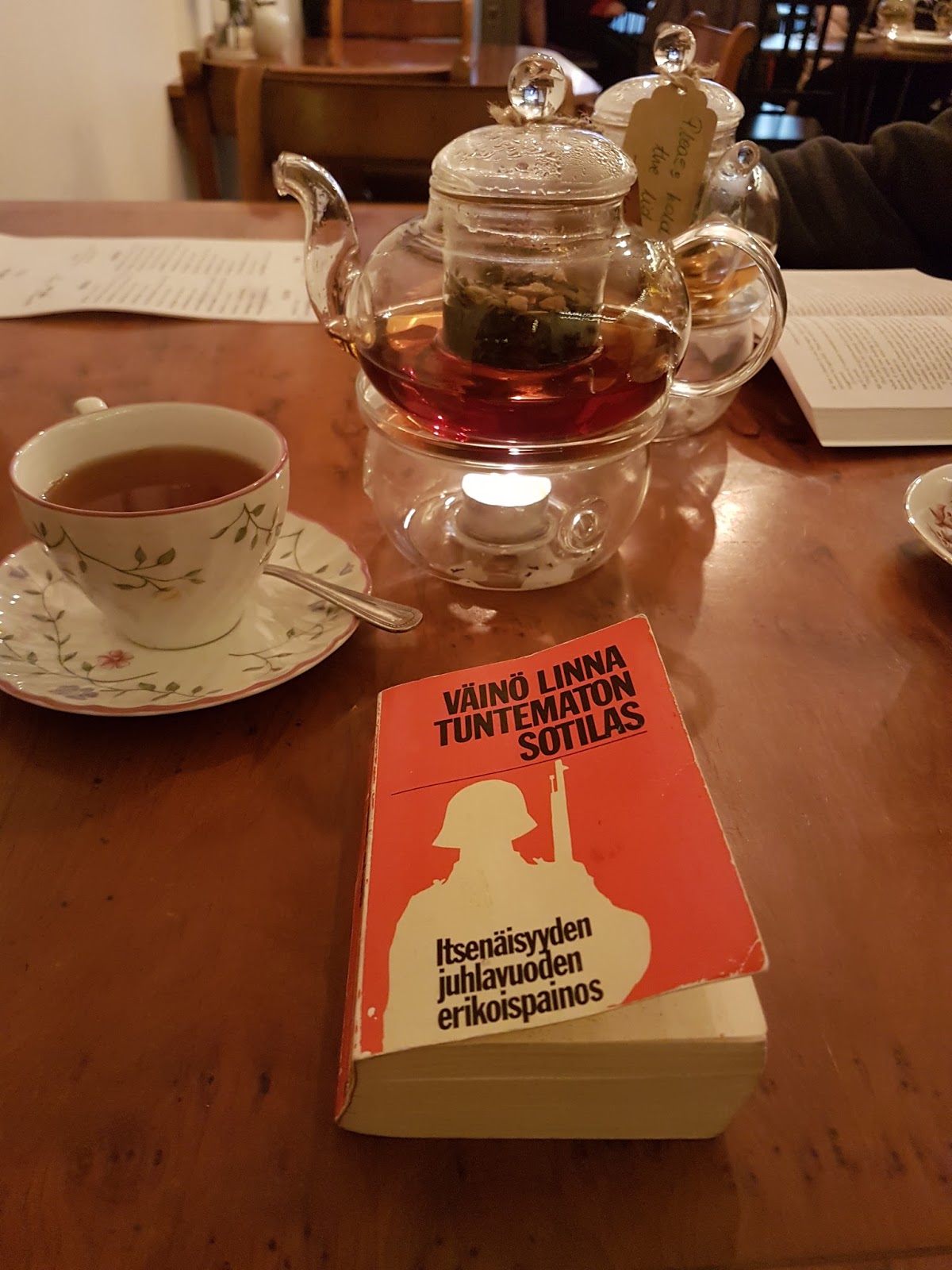
Tuntematon sotilas - Väinö Linna


Started this book on our way to Helsinki
halfway through January.
'Ei tarvittu kuria, ei isänmaata, ei kunniaa eikä 
velvollisuudentuntoa. Noita kaikkia mahtavampi käskijä ruoski heitä eteenpäin. Kuolema.'

'They needed no discipline, no fatherland, no glory and no sense of duty. A commander stronger than all of those lashed them onwards. Death.'

Here's my main(?) Finnish book for the 100-year anniversary - four hundred-ish pages of a pure classic of the Continuation War of 1941-1944. I bought my boyfriend an English copy for Christmas and convinced him to buddy read it with me. I asked him to write about his thoughts too so I'll link that here after it's done 😀 (edit: here you go!) There's so much I want to say about this, so bear with me for a long review!

As mentioned, Tuntematon sotilas (The Unknown Soldiers) is about the Continuation War between Finland and the Soviet Union, from point of view of the Finnish soldiers on the battlefield. Historical background is that the author, Väinö Linna, actually served in the war and wrote the book - fictional as it is - based more or less on his own experiences. You must admit that's pretty cool. By the way, we lost this war in a crude, horrible manner that wasn't pretty and just kind of depressed everyone. You should know that - this is also a bitter tale of loss. That's beautiful.

'Heidän kärsimyksensä oli yksin heidän. Kaiken muun he olivat saaneet luovuttaa. Heiltä oli vaadittu viimeinenkin hiukkanen, mutta kärsimyksensä he saivat pitää itse. Se ei kelvannut kenellekään.'

'Their suffering was theirs alone. Everything else they had had to give up. From them had been demanded even the last speck, but their suffering they got to keep for themselves. It wasn't good enough for anyone.'

Critics didn't enjoy the book all that much when it originally came out in 1954 because of the non-idealistic way it portrays the war and the current (political) environment, but the standard people still really liked it. (Same thing happened to another Finnish masterpiece, Aleksis Kivi's Seitsemän veljestä (The Seven Brothers), almost a hundred years earlier)

Anyway, I've been a bit apprehensive about reading this, as it's written with a heavy dialect that's difficult to describe to someone who's not Finnish. It's like Glaswegian, but written, if you're not even from Scotland, I suppose. Also, it's lengthy. But it's one of those books that's just so satisfying to read that I didn't mind working my way through it slow and steady.

Tuntematon sotilas is a very, very good book and incredibly deserving of its place as a beloved Finnish classic. As far as war novels go, it's very honest and realistic - it doesn't portray the cause as purely noble and the soldiers aren't only delighted to serve in the efforts. They don't always die as heroes and they're not always even remembered. They don't fall down in slow motion and say their last words tearfully. Sometimes they're crude and they swear and hate their uppers and want to go home. They die quickly and ruthlessly and that sincerity, in my mind, is the best thing this book has to offer.

Of course, the quality doesn't stop there. The book also describes humanity in all its beauty - how ugly and broken it is, and how it can rise from its own ashes, if that's not too poetic for this book. It's also very down-to-earth and incredibly Finnish in what it does, and since I'm very patriotic, I really enjoyed that side of it. There's also many named characters - almost all of them soldiers, of course - but all of them manage to seem very human. They also have a huge variety of political and ideological natures and different personalities, which is really great. As a war novel would have it, most of them don't stay with you for very long, but they still stayed with me long after they were gone. Some of them I liked, some of them I hated. All of them mattered.

All in all, this book was incredible. I enjoyed it more than I've enjoyed 95% of everything I've ever read, and I feel a sense of loss now that it's over. It certainly benefits from knowing about the history but even if you know nothing, it won't leave you cold. It deserves its place in history and I really hope more people will choose to read it internationally with the new English translation.

'Hän hymähti pari kertaa katkerasti, ei niinkään paljon valtiollisesta vihasta kuin sen vuoksi, että hänen kengässään oli hiekkaa, eikä hän voinut jäädä poistamaan sitä, koska olisi jäänyt toisista liian kauas.'

'He sneered a couple of times bitterly, not so much from a governmental anger as it was because he had sand in his shoe, and he couldn't stay to remove it, because he would have been left too far behind from the others.'

Cool story: I bought my copy from an antiquarian in Hämeenlinna a couple of years ago while on an adventure with my father. The shop was very cool and the owner so nice I talked to him for nearly an hour and then felt compelled to buy this book I had been eyeing. As you can probably see, it's a pocket size one, but also an anniversary edition for 60 years of independence - 40 years ago. So I think it's really cool. It has sentimental value, and lots of it. For the past month it's also come on many adventures with me. Oh, and the antiquarian moved fully online only a couple of months later - a bit of a shame but I'm really glad I got the chance to visit!
This book took too many cups of tea
to even count and this tea shop is also
where I finished it.

For the Helmet 2017 reading challenge I put this in category 3: A Finnish classic!

PS. If you ever decide to read this in English somehow, pick up the new 2015 translation by Liesl Yamaguchi. The old 1955 translation is all sorts of wrong, with many changes that have no basis in, well, anything.

'―Viipuri vallattu, kähisi hän eteenpäin, huomaamatta muuttaa äänensävyään, niin että edelläkulkeva mies sai ilmoituksen vihan pakahduttamalla äänellä, ikään kuin pahinta, mitä Lehto tiesi maailmassa olevan, olisi ollut Viipurin valtaus.'

'―Viipuri has been taken, he croaked ahead, without noticing to change his tone of voice, so that the man walking in front of him got the announcement in a voice bursting with hatred, as if the worst thing which Lehto knew in the world had been Viipuri being taken.'

Friday, 6 January 2017

The City of Woven Streets - Emmi Itäranta

'Hyvästit oli sanottu moneen kertaan, mutta aina haudattu toisiin sanoihin, eikä niitä lopulta ollut sanottu kertaakaan. Niin me tulemme tänne yhä uudelleen jäähyväiset askeliamme painaen. Ne ovat ikuisesti myöhässä ja poissa paikoiltaan: mennyt hetki, jota emme tunnistaneet silloin, kun se oli ulottuvilla, ja jonka aavetta emme siksi koskaan lakkaa kantamasta mukanamme.'

'Goodbyes had been said many times, but always buried in other words, and in the end they weren't said even once. So we come here over and over again with farewells weighing our steps. They are eternally late and out of place: the past moment that we didn't recognise when it was within reach, and the ghost of which we will therefore never stop carrying with us.'

I have a nice hardback of this but how
many fireplace pictures can one have
in a row? Also, how pretty is that
cover?
Hey! Happy new year! I finally read a Finnish book in what is really 2017 and not eagerly all too early. It's my birthday tomorrow so it's nice that I'll get to start a new book for the occasion. 😃

I got this book from my mum last Christmas and finally got around to it (I must admit I rarely get around to reading anything as far as I'm concerned...). It's a Finnish book but it's also English, curiously. What I mean is that this book was written in Finnish and English at the same time, side by side by the author.

The City of Woven Streets is one of those books with an intricately built world that don't manage to utilise it as well as one would wish, but still make tremendously good stories. The world of this one is quite literally a city of woven streets, as the main character, Eliana, is a young weaver from the House of Webs. She lives on a small island plagued by floods where people are separated by skill and those who dream are put away. One day, a girl with her tongue got off is brought to her, with Eliana's name tattooed on her palm with invisible ink. What's up with that, that's the question. At the same time, an illness thought to have been conquered starts to plague the island. And dreams, also.

As I said, the world is more intricate than what the story might deserve. The island is very interesting, but Eliana's obviously limited view of it doesn't provide enough insight to make much use of this fact. She lives in a very secluded environment and through the length of the whole book only sees the streets maybe once or twice. She has a brother in a different house but he doesn't provide much information about his way of living either, the one or two times we see him. Maybe if this book could have had another main character with a world view different from Eliana's, it would have helped to utilise the environment better. Or even a sequel, because the end was rushed and heavy on description, leaving quite a bit to be desired. There's also some threads of plot points that are visited very very very briefly and never returned to, which further made me want more.

Eliana as a character was a little bland. I didn't get much out of her personality and I couldn't tell you all too much about her. Whatever backstory there was is written much too poetically to provide much information. Maybe everyone in this world lacks individualism and this is just a token of that, but as a main character, I didn't really warm up to her. This is not to say she doesn't go through some heavy personal growth, though. That was really nice.

The language of this book is really, really pretty and technically speaking the book is very well made. After the initial hook of the mute girl and the tattoo, it was also pretty easy to get into, though some of the pages upon pages of description didn't keep me fully interested.

All in all, I'd give this a 3.5 stars and recommend it. If you like poetic books with well-built worlds, you'll like this. If a great story is everything to you however, I would maybe not advise you to read this book.