Showing posts with label Finnish classics. Show all posts

Friday, 17 March 2017

Band of Brothers on Steroids - Unknown Soldiers


(This is a guest entry of sorts written by Daniel since I feel like as a Finnish classics, his thoughts on this one may be more intriguing than mine :) )

The inaugural premise of this book leaves a curious impression on the reader, it is introduced in a way which paves the emotional wave awaiting the reader; this is followed by brutal, desperate situations that you share with the soldiers whom you have come to know and love.

After reading this moderately long book, I have a sense of loss; one of the most memorable aspects of this novel is the connection that you gain with the characters. One can confidently compare this connection to the relationships seen between the soldiers in the HBO miniseries Band of Brothers. This connection does not necessarily stem from the bonding between each character but rather from the delicate descriptions and intricate stories belonging to each of the characters. Some characters I abhorred and some I highly enjoyed; but whether I hated or loved I still cared for them. I will purposefully avoid any information relating to spoilers but it was quite an exciting/traumatising ordeal following each character; that is all I will say on this.

Unknown Soldiers was translated from Finnish to English by Liesl Yamaguchi. I therefore cannot give a judgement of the novel through how the author intended it to be but for what I read I gained a sense of pride, courage and how brutal war can be. It is all too common these days for war to be glamorised in Hollywood by a single soldier, cemented in mud, blood and usually an American flag as he simultaneously eradicates numerous people with a single bullet. The beauty of Unknown Soldiers is its raw, in-depth, realistic cruelty and violence. Nothing is glamourized and it feels like the most realistic account of war I have read; this expresses the quality of the book as, it is fictional.  I have never read or watched anything similar to this, it was frightening to imagine and is definitely the closest I wish to be to a war zone.

I am a very lucky individual to have Finnish girlfriend, due to this my knowledge of Finnish history is much greater than the average non-Finnish person. This novel appropriately articulates a sense of pride and understanding from a Finnish perspective. It discusses the topic of war from a point of view that doesn’t necessarily fall under the term ‘slander’ but rather understanding. I believe my former, non-Finnish experienced self would sympathise with the characters and opinions of the book. It is not a lecture about the diplomatic decisions circulating around the ethics of war, but it highlights upon the peoples war and why ‘dancing with the devil’ might be the way to go.

On the most part, the translation was very good but sometimes the sentences did not flow as well as they could, they all made sense but seemed to stem from a verbally spoken point of view, rather from a written piece of literature.

The plot of this novel was very simple. I am very glad it is not complex and full of crazy side plots that are so very common these days. It shadows a battalion of soldiers from the completion of their training until the end of a four year long war (1941 – 1945). This is based upon the continuation war of Finland; I would recommend you read upon this war, as from an Englishman’s point of view I found this rather interesting. The simplicity and elegance of the plot did not drag, even when the book lead us through the standard lives of soldiers on the front line. There is an eloquent assortment of surprise and normality, which gives a steady and exciting pace of the novel.

An interesting point is that this book is based upon a war, yet it is entirely fictional. Some of the characters are vaguely based upon real life individuals but none of the battles actually took place. The author participated in the war and started writing the first half while at war. For myself, part of the enchantment of this book is its ability to describe and articulate situations that could be real. Instead of replicating something real, it produces a passage of text purely from abstracted imagination of events, in essence this book is more detailed than a text that stems from a real battle as little details are not missed.

The characters in this book exceeded in captivating my interest, as their development was profound. Similar to real life you get individuals who stagnate in a pitiful array of arrogance, some who have always been what they are or what they want to be and those who desire is to excel in every way manageable. The range of characters I this book satisfy these characteristics in the best way possible as you can see and feel how the war wears them down and turns them into someone new.


Unknown Soldiers was given to me as a present; gifted as a prized collective of Finnish literature and read simultaneously across four countries with my beloved girlfriend. I was pleasantly surprised with its direct, ruthless expression of war and the progression of how men can develop into inhumane machines but still hold humanity to their heart. It takes you through a relinquished journey, from childish wishes, adult impersonations to absolute abandonment; this is truly a novel that should be seated upon the greats of war related books.

PS. I love the cover.

Sunday, 26 February 2017

Tuntematon sotilas - Väinö Linna


Started this book on our way to Helsinki
halfway through January.
'Ei tarvittu kuria, ei isänmaata, ei kunniaa eikä 
velvollisuudentuntoa. Noita kaikkia mahtavampi käskijä ruoski heitä eteenpäin. Kuolema.'

'They needed no discipline, no fatherland, no glory and no sense of duty. A commander stronger than all of those lashed them onwards. Death.'

Here's my main(?) Finnish book for the 100-year anniversary - four hundred-ish pages of a pure classic of the Continuation War of 1941-1944. I bought my boyfriend an English copy for Christmas and convinced him to buddy read it with me. I asked him to write about his thoughts too so I'll link that here after it's done 😀 (edit: here you go!) There's so much I want to say about this, so bear with me for a long review!

As mentioned, Tuntematon sotilas (The Unknown Soldiers) is about the Continuation War between Finland and the Soviet Union, from point of view of the Finnish soldiers on the battlefield. Historical background is that the author, Väinö Linna, actually served in the war and wrote the book - fictional as it is - based more or less on his own experiences. You must admit that's pretty cool. By the way, we lost this war in a crude, horrible manner that wasn't pretty and just kind of depressed everyone. You should know that - this is also a bitter tale of loss. That's beautiful.

'Heidän kärsimyksensä oli yksin heidän. Kaiken muun he olivat saaneet luovuttaa. Heiltä oli vaadittu viimeinenkin hiukkanen, mutta kärsimyksensä he saivat pitää itse. Se ei kelvannut kenellekään.'

'Their suffering was theirs alone. Everything else they had had to give up. From them had been demanded even the last speck, but their suffering they got to keep for themselves. It wasn't good enough for anyone.'

Critics didn't enjoy the book all that much when it originally came out in 1954 because of the non-idealistic way it portrays the war and the current (political) environment, but the standard people still really liked it. (Same thing happened to another Finnish masterpiece, Aleksis Kivi's Seitsemän veljestä (The Seven Brothers), almost a hundred years earlier)

Anyway, I've been a bit apprehensive about reading this, as it's written with a heavy dialect that's difficult to describe to someone who's not Finnish. It's like Glaswegian, but written, if you're not even from Scotland, I suppose. Also, it's lengthy. But it's one of those books that's just so satisfying to read that I didn't mind working my way through it slow and steady.

Tuntematon sotilas is a very, very good book and incredibly deserving of its place as a beloved Finnish classic. As far as war novels go, it's very honest and realistic - it doesn't portray the cause as purely noble and the soldiers aren't only delighted to serve in the efforts. They don't always die as heroes and they're not always even remembered. They don't fall down in slow motion and say their last words tearfully. Sometimes they're crude and they swear and hate their uppers and want to go home. They die quickly and ruthlessly and that sincerity, in my mind, is the best thing this book has to offer.

Of course, the quality doesn't stop there. The book also describes humanity in all its beauty - how ugly and broken it is, and how it can rise from its own ashes, if that's not too poetic for this book. It's also very down-to-earth and incredibly Finnish in what it does, and since I'm very patriotic, I really enjoyed that side of it. There's also many named characters - almost all of them soldiers, of course - but all of them manage to seem very human. They also have a huge variety of political and ideological natures and different personalities, which is really great. As a war novel would have it, most of them don't stay with you for very long, but they still stayed with me long after they were gone. Some of them I liked, some of them I hated. All of them mattered.

All in all, this book was incredible. I enjoyed it more than I've enjoyed 95% of everything I've ever read, and I feel a sense of loss now that it's over. It certainly benefits from knowing about the history but even if you know nothing, it won't leave you cold. It deserves its place in history and I really hope more people will choose to read it internationally with the new English translation.

'Hän hymähti pari kertaa katkerasti, ei niinkään paljon valtiollisesta vihasta kuin sen vuoksi, että hänen kengässään oli hiekkaa, eikä hän voinut jäädä poistamaan sitä, koska olisi jäänyt toisista liian kauas.'

'He sneered a couple of times bitterly, not so much from a governmental anger as it was because he had sand in his shoe, and he couldn't stay to remove it, because he would have been left too far behind from the others.'

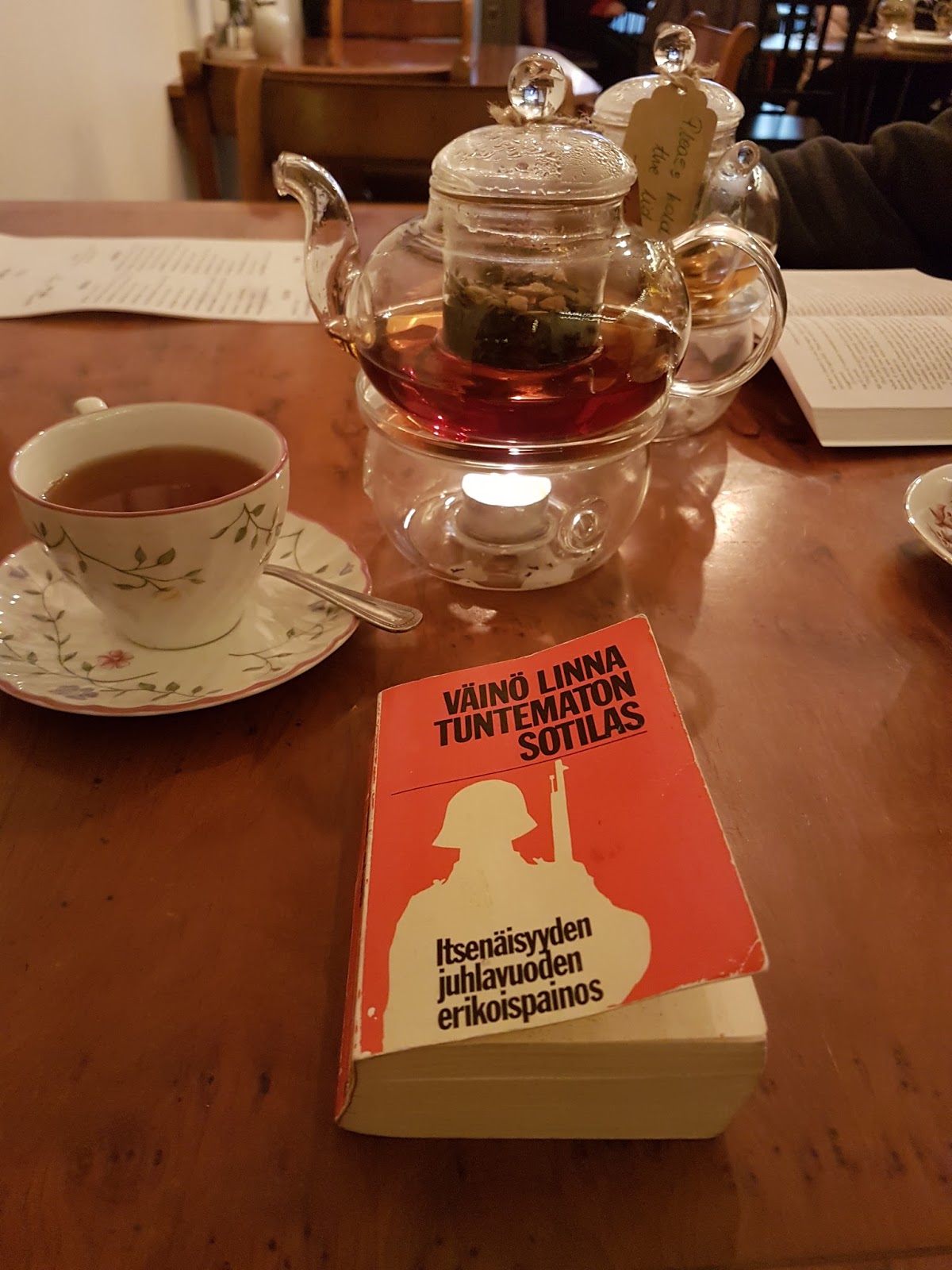
Cool story: I bought my copy from an antiquarian in Hämeenlinna a couple of years ago while on an adventure with my father. The shop was very cool and the owner so nice I talked to him for nearly an hour and then felt compelled to buy this book I had been eyeing. As you can probably see, it's a pocket size one, but also an anniversary edition for 60 years of independence - 40 years ago. So I think it's really cool. It has sentimental value, and lots of it. For the past month it's also come on many adventures with me. Oh, and the antiquarian moved fully online only a couple of months later - a bit of a shame but I'm really glad I got the chance to visit!
This book took too many cups of tea
to even count and this tea shop is also
where I finished it.

For the Helmet 2017 reading challenge I put this in category 3: A Finnish classic!

PS. If you ever decide to read this in English somehow, pick up the new 2015 translation by Liesl Yamaguchi. The old 1955 translation is all sorts of wrong, with many changes that have no basis in, well, anything.

'―Viipuri vallattu, kähisi hän eteenpäin, huomaamatta muuttaa äänensävyään, niin että edelläkulkeva mies sai ilmoituksen vihan pakahduttamalla äänellä, ikään kuin pahinta, mitä Lehto tiesi maailmassa olevan, olisi ollut Viipurin valtaus.'

'―Viipuri has been taken, he croaked ahead, without noticing to change his tone of voice, so that the man walking in front of him got the announcement in a voice bursting with hatred, as if the worst thing which Lehto knew in the world had been Viipuri being taken.'