Showing posts with label I'd recommend this maybe. Show all posts

Thursday, 20 April 2017

Thirteen Reasons Why - Jay Asher

'I'm listening to someone give up. Someone I knew, someone I liked. I'm listening. But still, I'm too late.'
This cover put me off this book for
a while because I thought it looked
a little childish and I expected the
same from the story itself.

Heyo!

As you might know, I was supposed to be studying reading other stuff, but the hype is high and I had bought this earlier... So I thought I'd read a bit of it. And I ended up reading all of it over three days of mostly doing other things. It was very gripping, one could say.

The premise of this book is this: High school student Clay Jensen receives a package of tapes, and finds out they were a suicide note of such by his crush, Hannah Baker, who committed suicide two weeks prior. These tapes tell the story of the thirteen reasons and thirteen people who drove her to kill herself, and Clay received them because he's one of them. (The notes in the book tell me this is a pun on the Baker's Dozen, which I found quite funny)

The style works quite well; Hannah's voice on the tapes is in italics, Clay's thoughts in normal text. It's all woven quite tightly together, and it works. Clay follows in Hannah's footprints along the places she talks about, offering some of his knowledge to fill in the gaps. I think this might also work quite well as an audio book, provided whoever read Hannah's parts was very good at what she does.

In a way, this book is a horrible read. All of the horrible things that have happened to Hannah, I've heard them all before. These things happen to people, because we are careless and can never think enough about the consequences of our actions and words on others. In its heart, Hannah made these tapes not because she blames these people, but because she wants them to know how even smaller actions can destroy you. She even acknowledges that this decision was ultimately hers and hers alone, even if the actions of others made her think of it.

I didn't think I would like this since I don't really agree with suicide as an option, but I thought the situation was handled quite delicately here. It didn't preach or claim to tell anyone else's story. Regardless, I would never recommend this to anyone who's had problems with depression or suicidal thoughts or anything. This isn't a helpful book in that way. What I didn't like about this book was that some story points didn't really come across that clearly, and I would have wanted to know more.

The ending, I thought, was quite clever and nice. I really liked that. I also liked how all the different stories were quite different. I also liked Clay, even though he was a bit flat. Like Nick in The Great Gatsby, he was an onlooker of sorts, and everything happened around him, not necessarily to him. That's all cool though. This story isn't about Clay, but about Hannah.

Through the tapes, the book handles with many difficult subjects for teenagers, like drinking, relationships, depression, bullying... It was sobering in how real it felt - I didn't leave that time all that long ago, after all.

All in all, I'd give this a 3.5/5, rounded up. It was an easy read in a way, and succeeded in what it set out to do.

For the Helmet 2017 reading challenge I put this in category 19: A "one day story" book! (This does have like a three page epilogue from a different day but I thought it's still good enough... If I read a better one this year, I might change that!)

I think I'll check out at least the first episode of the Netflix original show based on this and let you know my thoughts later under this post. I'm very curious.

Thoughts on the TV show (Edit from 22th April)

I admit - this thing looks pretty
cool. Better than the book cover,
anyway!
So I watched that pilot like I said I would. And while I can say that I totally would have enjoyed it had I not read the book previously (this thing heavily relies on the mystery of who did what to Hannah), it's a bit drawn out. Of course it would be, considering that in the book Clay listens to all the tapes in one night - to me this even made sense, considering he felt like he should do it as quickly as possible. In the Netflix series however, it's a 'monster of the week' type of thing, with each side of the tape - one story - given a whopping 50 minutes. If the book has 336 pages (it does, by the way. I checked!), it would be around 25 pages per tape. So you can imagine how drawn out this thing feels to me, in comparison.

There's all this added drama. From what the first episode gives me, Hannah's parents are filing a lawsuit against school (why?), everyone who has had the tapes before tries to contact Clay, and Clay has to ask people about obvious things which in the book were treated like just that - obvious. Also, Clay is some crusader vigilante who has decided to bring Hannah justice.

Also, from my brief online reading, this thing ends on some cliffhangers so they're planning a second season? Now why in the world would they do that? I thought the book ended really gracefully and a second season, well, if this was drawn out already... On the bright side, however, what's on the tapes seems to be very faithful to the book. There have been a lot of direct quotes spoken by Hannah, and I appreciate that.

Having watched this one episode and pretending like I watched the whole show, I'm starting to believe that most of the problems people have with this thing are actually added just for extra drama. That's a shame, and I find myself thinking that if you're on the fence about this, please just read the book instead. Except if you're depressed! It's not a happy story when someone's died.

Never mind all that. More importantly, why did I think Hannah was a blonde? I have real problems recreating characters in my mind from their descriptions, it seems. I just make up whatever I want instead. Welp.

Friday, 31 March 2017

Paras mahdollinen maailma - Riikka Pulkkinen

'Elämästä paljon suurempi osa kuin uskallamme itsellemme myöntää on unta.'

'A much bigger part of life than we dare admit to ourself is a dream.'

Hello again!

This is the other book my mum bought me for Christmas - maybe it's because the main character's father has a stroke or maybe because the book is quite heavily about the Berlin Wall. Maybe it's because she's read books by Riikka Pulkkinen before and I haven't yet. Anyway!

Aurelia was born on the day the Wall fell. Her father is dying in a hospital and she's not answering the calls from her mother. She's an actress and she has just landed a main role in a huge production about the Wall. Her father wanted to say something, before, and now it's too late. Her mother is trying to tell her, but maybe that's too late as well. There's also friends and sex and musings about being and overlapping stories of Berlin and pain and loss and love. In that order. Most of the story is told through Aurelia's eyes, some is through her mom's messages to her, and some is from the past of the director of the play.

The writing is very prose-like, maybe even overly poetic. It goes on and on and on and twists and turns and it's really quite interesting but at the same time you're secretly hoping that maybe just maybe it could stop sometime soon.

The weather has been lovely so most of this
was read outside! (Bought a raspberry
chocolate muffin from Starbucks even
though I shouldn't have because that's
what spring is for!)
A lot of the characters were very well established, which is one of the biggest compliments I can bestow upon this. I liked Aurelia, even though sometimes she got annoying. Sometimes she supposedly could read other people's thoughts and every time she did, they were supposedly thinking of how amazing she herself was. Kind of like seeing a really hot guy and believing that their current thought is that you are a goddess; self-centered and not even realistic. Her friends were nice even though they weren't that prominent, but whatever she had once had with her ex-boyfriend Niklas didn't end up feeling like anything to me. The eccentric director was very interesting, and I think his story ended up being the one that was the most captivating to me. Seija was also incredibly cool, see the following:

'Jos Seijasta on jotain sanottava, hänestä voi sanoa tämän: hän on ihminen joka kantaa käsilaukussaan voiveistä. Koskaan ei tiedä milloin mieli alkaa tehdä juustoa tai kokonaista kakkua, josta leikata palasia.'

'If one had to say something about Seija, it could be this: she is a person who carries a butter knife in her purse. You never know when you start to crave cheese or a whole cake, out of which to cut pieces.' 

Role model, definitely.

On the other hand, I didn't like Aurelia's (dying) father at all, because in the flashbacks from her mum's point of view, he didn't come across all that nice. And this was through the eyes of the woman who loved him. Weird.

This is where I finished the book!
The plot, while captivating at first, kind of fell flat when I learned that there's really nothing more, and the last hundred pages (almost a third of the book) didn't really introduce anything new. Even the twists felt like I already knew, and maybe I did. It was cool to see and hear about what it's (presumably) like to be an actress in a theatre production and I could have definitely read more of that too. Additionally, while all the Berlin imagery and theme was really cool in a way, it was also way too convenient to feel any kind of realistic. In a more light-hearted book I'd definitely let that slide but when a book wants to be taken this seriously, it feels a bit off.

Overall a solid 3.5 though I'll have to round down to a three, since it's not quite a four for me. Will read her other works and hopefully I'll like the plots better then. From what I understand, a lot of people liked those better than this, so that's good to know.

For the Helmet 2017 reading challenge I put this in category 45: A book about a Finnish woman! Kinda self-explanatory, I suppose.

Wednesday, 19 October 2016

Did I Mention I Love You? - Estelle Maskame

‘And so last night I fell asleep with my mind split in two. One half was drowning in guilt, but the other was floating, recklessly in love with the idea of Tyler and the secrets that are hidden within the depth of his being. Because, somehow, I’ve managed to become one of them.’


I originally picked up Did I Mention I Love You? by Estelle Maskame because a friend of mine was gushing online how much she loves these books. And since the whole trilogy happened to be around four pounds for the Kindle, well…

The coolest thing about these books is that the author is from Peterhead, Scotland, where I paid a visit last spring. It’s one of those sleepy fisher villages in Aberdeenshire. Has good fish and chips. The second coolest thing about the author – and the order of these two things is very negotiable, really – is that she wrote these books at like, sixteen. I mean, she’s 19 now and the books have sold millions and that’s just pretty amazing.

The story is about Eden, a 16-year old who goes to spend her summer vacation in Santa Monica, California (and let me tell you how much more I would have loved this if it were, say, Edinburgh, Scotland) with her father, who has been out of touch with her for years. She makes friends (none of whom I like, more on that later), meets her new family members (most of whom are filler) and her new stepbrother, Tyler. Tyler is a problematic, rude teenager with more issues than anything else. And naturally, Eden falls in love.

I have to admit that the book starts rather slow. It’s a lot of build-up and introduction and up until the halfway point, I was still waiting for the book to begin, having to make time to actually read it instead of being sucked into the world in any way. That’s why I’d like to give this a 3.5 rather than an actual 4, but I’m being nice and rounding up. Around the last third the story really did pick up and capture my interest, but is it really fair that I have to wait two thirds to be interested?

Eden as a main character is quite relatable. She’s a teenager with teenager problems and interests and all that. She’s annoying at times with those problems, but in the heart of the book, she’s a teenager. Her friends, Rachael, Tiffany and Meghan, plus some girl back at home, Amelia maybe? – are backstory-less, personalityless filler. They’re there so that we know that Eden has friends, that she’s popular and not all that pathetic. They don’t even match her personality, and yet I’m led to believe that Eden and Rachel are actually best friends now. What.

Adventures in Peterhead last spring!
The problem with Maskame’s age is clear – she’s very good at portraying the life of a sixteen-year old, but not necessarily capable of dealing with these things with all that much maturity. The book has a strong sense of high-school romance that’s supposedly going to last your entire life. I’m not saying that none of them do, but… I’m not sure if Eden and Tyler could be the kind of couple to overcome everything.


I’ll be reading the rest of the books, certainly. Not only because I went and bought them all or because it's Scottish, but also because I do want to know how the story continues from here. Hopefully the second book, Did I Mention I Need You? will waste far less time on introduction and something will actually happen in it. This book was a bit of a guilty pleasure read and certainly not an amazing peace of cult literature, but I kind of enjoyed it for what it was.

Monday, 15 August 2016

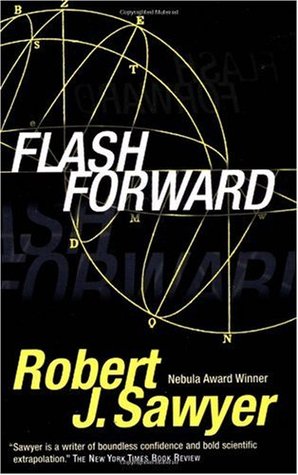
Flashforward - Robert J. Sawyer


'He used his index finger to gently lift Michiko’s chin. He was all set with the words—duty, responsibility, work to be done, we have to go—but Michiko was strong in her own way, too, and wise, and wonderful, and he loved her to her very soul, and the words didn’t need to be said. She managed a small nod, her lips trembling. “I know,” she said in English, in a tiny, raw voice. “I know we have to head back to CERN.”'

I’ll start off with this: I read Flashforward because I loved the TV show with the same name that came out i
n 2009 and which was very very very loosely based on this book), so it’s fair you expect to hear lots of comparisons between these two. I’ll try and review the book as a separate entity, however. Oh, and as a curious detail – I read most of this book while taking a train to St. Petersburg and the rest while wandering around the city.

So, the book has this premise: One day, the whole planet Earth blacks out for 2 minutes and 17 seconds. Every single human consciousness not only tunes out from the present moment, but also jumps 20 years into the future. People see relationships ruined, new ones started, children and husbands and graves and for some, nothing. Many die in car crashes, plane crashes or simply walking down the stairs as the event occurs. In the centre of the book are a group of scientists who ran an experiment at the time the Flashforward occurred, leaving them to worry and wonder whether they caused this horrible massacre without knowing it or ever meaning to.

‘Who would have thought that two people who had scrimped and saved and sacrificed year after year to buy each other lavish Christmas presents as tokens of their loves would end up using legal claws to pry those presents back from the only person in the world to whom they meant anything?’

Flashforward tackles many interesting science fiction and philosophical concepts, like the many-worlds interpretation, the whole “will we have flying cars in 20 years?” question, the concept of free will. Every once in a while it also has beautiful insights to human life, like the quotes I picked out, but those are way too rare and all too precious.

Without Snapchat filters, you'd never
know the location or the weather!
(sorry not very)
The book has many characters from whose point of view the Flashforwards are discussed, which is a blessing and a curse. On one hand, this provides variety and makes the event itself more interesting, but on the other no one really gets enough time to become interesting as a character. Another thing the book handles really well is discussing the worldwide – it seems actually interested in what happens in China, what people in Russia do et cetera. This goes into so much detail it’s almost like the book is more interested in being a case study on the phenomenon than providing an actual story.

Not that I really minded; it’s an incredibly interesting case study and I can see how taking the plot in any one direction could have changed that. And the plot does change that; somewhere in the last third it takes an incredibly weird turn I didn’t like and that I couldn’t relate to, something that was just plain… weird. Unfitting for the book and something I didn’t care about. It was a brief 30 or so pages of “I wanted to write a different book after all” and probably took a full point from my rating of it.

Quick comparison to the TV show (which I would recommend if the Flashforward as a concept interests you and if you don’t mind that it never got renewed for a second season) – the TV show has a Flashforward only six months in the future and focuses on FBI agents trying to figure out why it happened (the main characters in the book play minor roles in it). The plot is much more contained and, well, it’s an actual plot. The TV show only briefly mentions the existence of any other continents, in a proper USA style, but it handles its few characters better. Long story short; the book does a good job on the Flashforward itself but don’t expect a stellar plot from it. Still, worth the read.


I have to confess I haven’t read any other works by Robert J. Sawyer but I’ll make it a point in my endless to-do list to… do. Obviously I should; anyone remotely interested in science fiction should. Flashforward wasn’t bad but I’m sure he can do better.

Saturday, 9 January 2016

After I Do - Taylor Jenkins Reid

“Big gestures are easy. Making fun of someone who’s only trying to help you, that’s family.”

I actually finished After I Do a while ago, life just happened and prevented me from writing about it. Actually, life happened and prevented me from doing anything I should have been doing, bleh. Anyway, I finally got around to doing so, bit by bit! Sorry sorry, I promise I’ll be better this year, read more books and talk about them more. Anyway! 

Lauren and Ryan have been together for eleven years, the adorable high school sweethearts they are, but they can no longer stand each other. Everything that used to be endearing turns annoying, and they find themselves constantly arguing about the smallest little things. This is why they decide to stay separated for a year, zero contact whatsoever, discover themselves outside of their marriage and maybe find what they once had. I actually picked up the book because of the theme – it’s about a marriage falling apart, after all. How often do you read a book like this?

The story is told mostly through Lauren’s eyes, with small insights offered on Ryan’s feelings occasionally. This is clear from the start – it’s a book about her, not really them. Lauren is lost but hopeful, lonely but not alone, and during the story she discovers that there is no one perfect way to have a happy marriage, but everyone must find their own way. I think this was a very precious lesson, and I love how it’s taught through so many different people – Lauren herself, her mother, sister, best friend, brother, some lady writing advice columns.

The style of the book is very earnest and realistic. It’s humorous, but it also understands that life is not, and will not be a fairy tale. I found it very interesting in its own right, though the book doesn’t necessarily offer any brilliant insights on life beyond its subject. This isn’t a bad thing per se, but finding a quote that sounds sharp and witty outside of the provided context proved to be more difficult than it should have. The quote I ended up with was because it made me happy - it's just like my own family, after all.


I would be lying if I claimed that I didn’t enjoy After I Do, didn’t giggle with Lauren sometimes and shake my head in disbelief when going through her struggles with her. It wasn’t exactly deep, dark or bittersweet, but it was beautiful in its own right. It wasn’t a life-changing book, but sometimes I’m reminded of the time I spent with it, and it’s like an old goofy friend with whom I’m always happy to enjoy a cup of tea but not an intellectual conversation. It’s a book I can recommend if you enjoy a light but earnest story about finding yourself, among love and other things. I'm not actively looking to read more of Taylor Jenkins Reid's works, but if I run into one... well, I wouldn't mind that.

I'm pretty sure you'll hear me talk about Siiri Enoranta's Surunhauras, lasinterävä next! I'm trying to finish it before I leave Finland again ^^ Do look forward to that because a) I've really, really liked it so far b) I have so much to say about it and c) I haven't shut up about it since I started reading it, ha.