Showing posts with label book review. Show all posts

Sunday, 26 February 2017

Tuntematon sotilas - Väinö Linna


Started this book on our way to Helsinki
halfway through January.
'Ei tarvittu kuria, ei isänmaata, ei kunniaa eikä 
velvollisuudentuntoa. Noita kaikkia mahtavampi käskijä ruoski heitä eteenpäin. Kuolema.'

'They needed no discipline, no fatherland, no glory and no sense of duty. A commander stronger than all of those lashed them onwards. Death.'

Here's my main(?) Finnish book for the 100-year anniversary - four hundred-ish pages of a pure classic of the Continuation War of 1941-1944. I bought my boyfriend an English copy for Christmas and convinced him to buddy read it with me. I asked him to write about his thoughts too so I'll link that here after it's done 😀 (edit: here you go!) There's so much I want to say about this, so bear with me for a long review!

As mentioned, Tuntematon sotilas (The Unknown Soldiers) is about the Continuation War between Finland and the Soviet Union, from point of view of the Finnish soldiers on the battlefield. Historical background is that the author, Väinö Linna, actually served in the war and wrote the book - fictional as it is - based more or less on his own experiences. You must admit that's pretty cool. By the way, we lost this war in a crude, horrible manner that wasn't pretty and just kind of depressed everyone. You should know that - this is also a bitter tale of loss. That's beautiful.

'Heidän kärsimyksensä oli yksin heidän. Kaiken muun he olivat saaneet luovuttaa. Heiltä oli vaadittu viimeinenkin hiukkanen, mutta kärsimyksensä he saivat pitää itse. Se ei kelvannut kenellekään.'

'Their suffering was theirs alone. Everything else they had had to give up. From them had been demanded even the last speck, but their suffering they got to keep for themselves. It wasn't good enough for anyone.'

Critics didn't enjoy the book all that much when it originally came out in 1954 because of the non-idealistic way it portrays the war and the current (political) environment, but the standard people still really liked it. (Same thing happened to another Finnish masterpiece, Aleksis Kivi's Seitsemän veljestä (The Seven Brothers), almost a hundred years earlier)

Anyway, I've been a bit apprehensive about reading this, as it's written with a heavy dialect that's difficult to describe to someone who's not Finnish. It's like Glaswegian, but written, if you're not even from Scotland, I suppose. Also, it's lengthy. But it's one of those books that's just so satisfying to read that I didn't mind working my way through it slow and steady.

Tuntematon sotilas is a very, very good book and incredibly deserving of its place as a beloved Finnish classic. As far as war novels go, it's very honest and realistic - it doesn't portray the cause as purely noble and the soldiers aren't only delighted to serve in the efforts. They don't always die as heroes and they're not always even remembered. They don't fall down in slow motion and say their last words tearfully. Sometimes they're crude and they swear and hate their uppers and want to go home. They die quickly and ruthlessly and that sincerity, in my mind, is the best thing this book has to offer.

Of course, the quality doesn't stop there. The book also describes humanity in all its beauty - how ugly and broken it is, and how it can rise from its own ashes, if that's not too poetic for this book. It's also very down-to-earth and incredibly Finnish in what it does, and since I'm very patriotic, I really enjoyed that side of it. There's also many named characters - almost all of them soldiers, of course - but all of them manage to seem very human. They also have a huge variety of political and ideological natures and different personalities, which is really great. As a war novel would have it, most of them don't stay with you for very long, but they still stayed with me long after they were gone. Some of them I liked, some of them I hated. All of them mattered.

All in all, this book was incredible. I enjoyed it more than I've enjoyed 95% of everything I've ever read, and I feel a sense of loss now that it's over. It certainly benefits from knowing about the history but even if you know nothing, it won't leave you cold. It deserves its place in history and I really hope more people will choose to read it internationally with the new English translation.

'Hän hymähti pari kertaa katkerasti, ei niinkään paljon valtiollisesta vihasta kuin sen vuoksi, että hänen kengässään oli hiekkaa, eikä hän voinut jäädä poistamaan sitä, koska olisi jäänyt toisista liian kauas.'

'He sneered a couple of times bitterly, not so much from a governmental anger as it was because he had sand in his shoe, and he couldn't stay to remove it, because he would have been left too far behind from the others.'

Cool story: I bought my copy from an antiquarian in Hämeenlinna a couple of years ago while on an adventure with my father. The shop was very cool and the owner so nice I talked to him for nearly an hour and then felt compelled to buy this book I had been eyeing. As you can probably see, it's a pocket size one, but also an anniversary edition for 60 years of independence - 40 years ago. So I think it's really cool. It has sentimental value, and lots of it. For the past month it's also come on many adventures with me. Oh, and the antiquarian moved fully online only a couple of months later - a bit of a shame but I'm really glad I got the chance to visit!
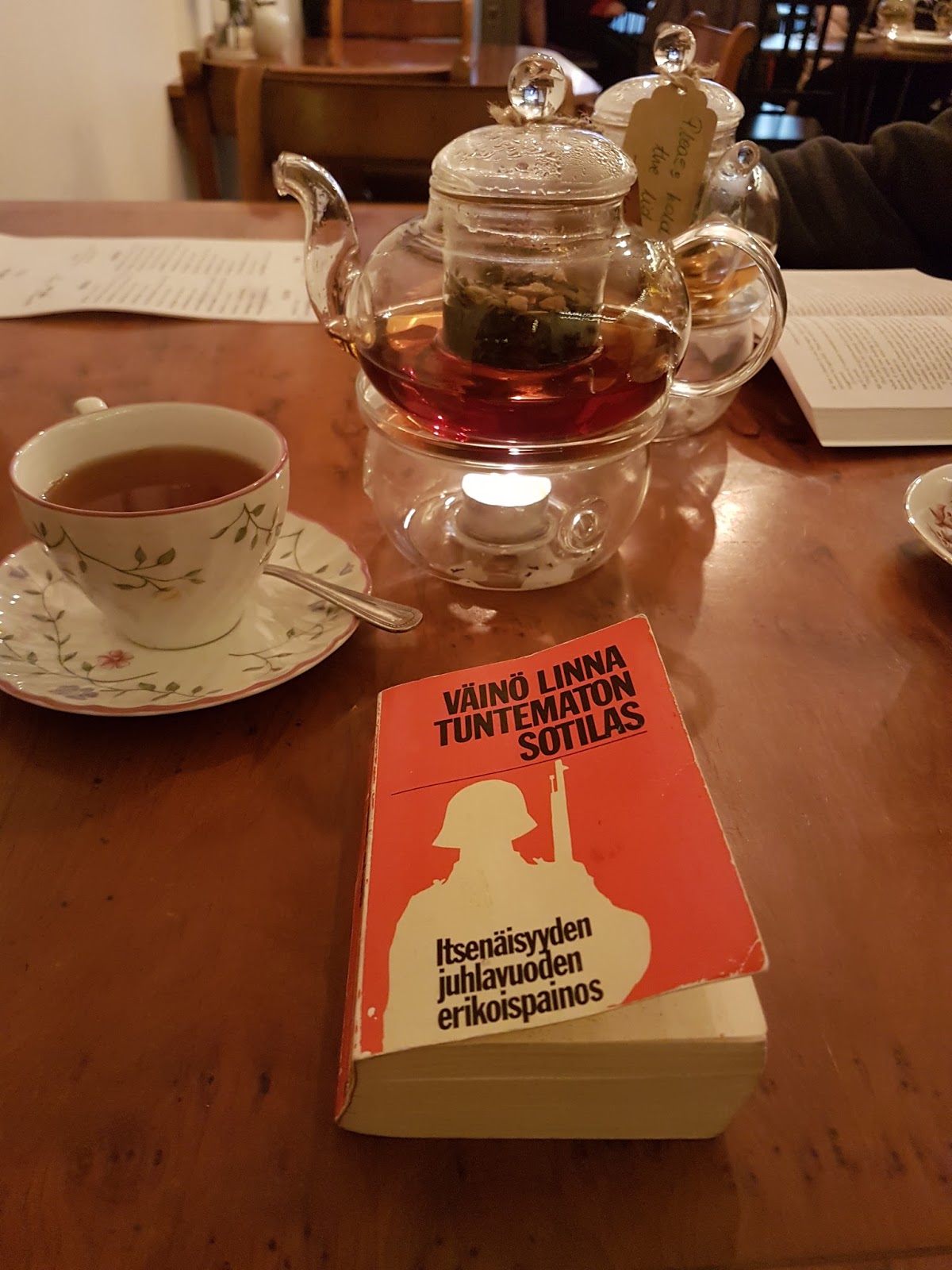
This book took too many cups of tea
to even count and this tea shop is also
where I finished it.

For the Helmet 2017 reading challenge I put this in category 3: A Finnish classic!

PS. If you ever decide to read this in English somehow, pick up the new 2015 translation by Liesl Yamaguchi. The old 1955 translation is all sorts of wrong, with many changes that have no basis in, well, anything.

'―Viipuri vallattu, kähisi hän eteenpäin, huomaamatta muuttaa äänensävyään, niin että edelläkulkeva mies sai ilmoituksen vihan pakahduttamalla äänellä, ikään kuin pahinta, mitä Lehto tiesi maailmassa olevan, olisi ollut Viipurin valtaus.'

'―Viipuri has been taken, he croaked ahead, without noticing to change his tone of voice, so that the man walking in front of him got the announcement in a voice bursting with hatred, as if the worst thing which Lehto knew in the world had been Viipuri being taken.'

Saturday, 4 February 2017

In Order To Live - Yeonmi Park

'This is my story of the choices I made in order to live.'

This book was incredibly moving. Interesting, also. I obviously have very standard subpar knowledge of North Korea, the standard stuff most people know but rarely stop to think about. I know and acknowledge that life must be awful there, but it's not common I actually consider what this means for the people.

In Order To Live is the story of a young girl who at thirteen starts the most difficult journey to escape her North Korean home, Hyesan in the north near the Chinese border. Yeonmi Park tells a powerful, painful story about her own life that must have been difficult to get into paper or even remember, and I think she's incredibly brave to do so. She describes in a very honest manner how she felt and what happened to her, which is very humbling to read. She's what she never aimed to be, a role model and an ambassador, and a voice for her people.

The story is split into three parts; Yeonmi's time in North Korea, China and finally South Korea. The first one is obviously the longest and perhaps the hardest, but it doesn't get any easier even when you think it would. In the 1990s, the government in North Korea stopped being able to provide its citizens with food because they stopped receiving Soviet support. Yeonmi Park was born in 1993, so she's of the generation named after the black market, Jangmadang. These younger people may not quite share the blind faith their elders had for the government and their fearless leader, but they're far from free. In the book, Yeonmi describes how she believed that the leader could read her mind, and was always afraid to even think bad things of the country. These old habits die hard, especially considering all western media and entertainment is banned in North Korea, and even every school subject and songs and books are filled with propaganda.

Kudos to the Kindle edition for including
these photos like in the paperback, they
really bring this story to life.
The book is incredibly informative, considering it also tells a cohesive story. You can tell that since she fled North Korea, Yeonmi has really absorbed other cultures and stories, because the book clearly understands what parts of the culture are interesting to people outside of its reach. I learned so many curious and deeply worrying details about this undemocratic country through reading this book, yet I never felt like I was being lectured or straight-up taught anything. Yeonmi has also clearly learned a lot about critical thinking (a practice obviously forbidden in North Korea) since she fled, because she is able to say things about herself I would perhaps never be humble or brave enough to admit.

The story told in this book is raw and cruel and horrible, but it's also a story about humanity. The author has gone through the most terrible places and situations only to find that there is more to life than just surviving. There's also kindness and purity and good. I truly believe she's accomplished a lot if only by telling her story to people, but I also hope it's brought her some peace. She's only two years older than me today, and less and less so throughout the book to the beginning. I can't imagine going through what she has, but it is inspiring. I'm grateful that she has decided to share this story with us, and hopefully it will make a change in the world.

It's a bit odd to rate a story that's based on truth, but if not for the events themselves, then for the information, the thoughts and the bravery, I'd like to give this one a full five out of five. I don't see a reason not to recommend it unless you are a bit like my mum and feel the need to carry the sadness of the whole world on your shoulders. If you want to know what life and escape is like at least for some North Koreans today, this book is very interesting.

For the Helmet 2017 reading challenge I put this book in category 40: A book by a writer who comes from a different (from yours) culture.

Sunday, 29 January 2017

Heartless - Marissa Meyer

'She fidgeted with a yellow ribbon. 'With this hat, it seems possible. Why' - her eyes brightened - 'this morning, I even had a fantasy that I'd single-handedly balanced the budget for the Royal treasury, and all of Hearts saw me as a hero.''
Hi!

I bought this book as a preorder because I was so excited about the blurb. It took me 2.5 months to waft through, so it might not come as a surprise that I didn't really completely enjoy it.

Heartless is written by Marissa Meyer, who's mostly famous for her Lunar Chronicles -series, which are reimaginations of classic fairy tales. (Which I've not read and after this one, never might) Heartless is different in that it's the origin story of the Red Queen from Alice in Wonderland, so it's kind of like a supervillain's origin story. No, exactly like one.

Catherine Pinkerton is, at the heart of things, a very likeable character. She is the daughter of the Marchioness and has somehow caught the attention of the King of Hearts, who wants to marry her. This couldn't be farther away from Cath's wishes, as she just wants to open a bakery with her servant/best friend, Mary Ann. She also meets a court jester (called Jest, haha wow such creativity) who manages to steal her heart almost instantly. She can't just marry the King, whom she doesn't even love, can she?

What did work for me in this book is that it was generally well-written. The description was good and the dialogue okay. I liked most of the characters, and especially Cath herself and Mary Ann were very likeable. On the other hand, while I initially swooned over Jest much like Cath did, I soon found that as a character, he was boring, cardboardy, chivalrous, too good to be interesting in any level. This is really a bad omen in a book were much of the centre is taken by how much I'm supposed to like him and want him and Cath to be together. I must admit I would've never been sad if Cath had just gotten over him and started that bakery with Mary Ann.

The main issue I had, however, was the plot. It is difficult to write something where everyone knows the ending - hello, she's the Red Queen, of course she marries the King of Hearts - but it can be done well. Just look at Romeo and Juliet and all those other "hey guess what, at the end everyone dies" -type of books. It can work, but it needs to be done in a good way, if you hear me? What Heartless tried is this 'did she or did she not' -game where plot twist after another has you trying to figure out whether she did marry the King or not. Instead, the focus really should be on how that happened.

With all these plot twists that didn't feel too interesting, the story also moves at an agonisingly slow pace. Sometimes I could swear it doesn't know which story it wants to tell and thus ends up picking up a cherry on top of each cake, one at a time.

In the background, there's all this "women aren't suited for the man's world of business" and "you shouldn't sell your dowry because that's your only worth" -stuff going on and it was actually a quite interesting portrayal of the Victorian times when that was the focus (not often). There were also some interesting slight undertones of study of determinism, which was quite cool. All the characters eventually got their own fates and no matter how no one wants it, fate is fate.

Anyway, 2/5, wouldn't recommend but a ton of people seem to love this so maybe I'm the one who's wrong.

For the Helmet 2017 reading challenge I put this book in category 14: A book you’d choose by its summary on the book cover.

Friday, 30 December 2016

Kaksi ihmistä minuutissa - Inkeri Markkula

'Lepakot ovat minusta ihmeellisiä. Astrid, elämäni rakkaus, sytytti minussa palon niitä kohtaan. Astrid sytytti minussa lukuisia liekkejä, ja vaikka maailma hänen jälkeensä sammutti niistä useimmat, rakkaus lepakoihin jäi.'

'I find bats wonderful. Astrid, the love of my life, awakened in me a fire for them. Astrid lit in me multiple flames, and even though the world after her put out most of them, the love for bats remained.'


Mum got me this book for Christmas and as part of the 'read more Finnish stuff' thing and also because it was really good, I just gobbled it up in front of the fireplace over the course of a couple of days. Really pleasant stuff.

Kaksi ihmistä minuutissa (Two people a minute) is Inkeri Markkula's first novel. It's about many things. It's about malaria, death, love, misery, hopelessness, hope and loss. It's about Alina, a Finnish woman from the north who's lost her spouse and who can't have the life she was supposed to have with her daughter. She's also a researcher, cold facts and different types of malaria and nights spent at the laboratory. She's broken and a little bitter but at the same time she's so much more, and it's very easy to consider her to be a real person.

She meets Lotte, a German doctor who's been working in Thailand for longer than what most people can manage. Lotte wants her to come there and help. Alina takes the offer to leave her broken home but says she'll be back, to see her daughter in three months' time. Lotte is almost more real than Alina, for she too has felt loss, but she's also lived in the village for so long and felt compassion and joy and love. Where Alina is samples and lab coats, Lotte is human beings and emotions.

There's also Kian, a boy who grows too fast even though he grows just like he should. He's young but intelligent and like Lotte, I too wanted to guard him from the cruelty of life. There's Kian little sister Po, who's too young to understand but of course not too young for malaria. It's cruel in how real it is, and I'd love to pretend these things are fiction when they're not. The setting, mostly Thailand, was also very alive and felt real. I wanted to visit even though sometimes I certainly didn't want to.

Malaria is cruel. I've heard this said as a concept, but it never touches you when it's numbers (two people a minute) and not actual people. These people were so well-crafted, they were actual to me. This book, more than any statistic I've ever heard, made me think about it. It raises questions like how do you explain that rich people never have to suffer from this, but it doesn't preach or underline. The author is also a biologist and while she doesn't specialise in malaria (she likes bats though), it provided the book with a certain sense of authenticity. I don't know if she'll continue writing but if she does, I'll certainly continue reading.

The book is split into chapters and the chapters are distinguished from each other by years. The current one is 2012, but it also often goes to 2008, 2003 and even 1994. These chapters are sprinkled in between the present moment like little treats, and they're woven into the story so carefully that I never really felt like I was reading a flashback. It provided the characters with backstory that was much appreciated, and I took them with pleasure.

The shortfall of this book is that it's poetic. It's poetic and beautiful and raw, but sometimes it leaves a little too much to be guessed. I wanted a few more answers and a few less questions, especially towards the end when I was starting to realise there wasn't much more space for hints. The ending also left me a little cold, because I did not know what was going on and not in a pretty, poetic way. Rather, in a "I'll never see this person again and this is the last thing they tell me?" sort of way. There's so many questions, and the last chapter of the book basically focused on the few things I actually didn't care about.

Altogether, Kaksi ihmistä minuutissa was very good. As a first work especially, it was extremely well made. It wasn't perfect, but for a couple of days I lived it. I bothered my boyfriend with my thoughts and ranted and quoted and suffered and enjoyed. I'd recommend it even with its few faults. Not sure if mum will like it but I'll try to convince her anyway.

'Metsä huokaa, me hengitämme sen huokaukset. Ajattelen, että malarialla on kovin kaunis koti.'

'The forest sighs, we breathe its sighs. I think about how malaria has a very beautiful home.'

Monday, 31 October 2016

A Street Cat Named Bob - James Bowen

'I invited Bob to jump on my lap, which he did in the blink of an eye. A moment or two later, the conductor appeared. She was a cheerful West Indian lady and smiled at Bob, then me. ‘Is he yours?’ she said, stroking him. ‘I guess he must be,’ I said.'

Confession of the day: I love cats. Cats are amazing and wonderful and I'd be at a loss if something happened to one of our two little fluff balls back in Finland. Cats all the way. So of course, I've been meaning to read perhaps the most famous book written about a cat for the longest time.

A Street Cat Named Bob is about Londoner busker James and his cat Bob, whom he meets on the streets. They become inseparable and set out against the world together. This book is about their first few years together - James starting out as a recovering drug addict busking in the streets for money, Bob as a weak shadow of a cat.

The book isn't sugar-coated; James clearly has no qualms about expressing just how rough life on the streets can be. I was surprised about this, since I was probably more prepared to read about the cat rather than the man. It was welcome, though - I don't suppose one ever knows too much about the hardships other people are forced to go through. I liked learning more about their lives and hearing the whole story.

I suppose for this book, though, it's true what they say about life being stranger than fiction. It gave me lots of happy fluffy feelings and made me really feel like I was connecting with James and Bob (it would be weird to call them 'characters', right?), and I'd say that's a sign of a good job well done.

The writing style is pretty much what you'd expect from an author who's not really an author; it's more of a man telling his story. It's in his own words so I didn't mind that, but it's not to be expected that a book like this would be a masterpiece in a literary sense. It's not very complicated in writing and suffers from some repetition, but it's not an experience-breaking thing, so I'll give this a sound 4/5. I do recommend it if you like cats and find an interest in stuff like this!

I'll be sure to check out The World According to Bob the next time I need my daily dose of cats, since it's kind of like a direct continuation of this book. I'm also so excited about the upcoming movie, by the way! In most scenes, Bob plays himself!! How cool is that? I already convinced my boyfriend to come watch it with me, I'm that excited! Keep you updated on my thoughts afterwards! (I'll be disappointed if it's not dark enough; I have a bad feeling it'll be a bit too much of a feel-good family film.)

'I’d even been approached by an American lady, an agent, who asked me whether I’d thought about writing a book about me and Bob. As if!

Wednesday, 19 October 2016

Did I Mention I Love You? - Estelle Maskame

‘And so last night I fell asleep with my mind split in two. One half was drowning in guilt, but the other was floating, recklessly in love with the idea of Tyler and the secrets that are hidden within the depth of his being. Because, somehow, I’ve managed to become one of them.’


I originally picked up Did I Mention I Love You? by Estelle Maskame because a friend of mine was gushing online how much she loves these books. And since the whole trilogy happened to be around four pounds for the Kindle, well…

The coolest thing about these books is that the author is from Peterhead, Scotland, where I paid a visit last spring. It’s one of those sleepy fisher villages in Aberdeenshire. Has good fish and chips. The second coolest thing about the author – and the order of these two things is very negotiable, really – is that she wrote these books at like, sixteen. I mean, she’s 19 now and the books have sold millions and that’s just pretty amazing.

The story is about Eden, a 16-year old who goes to spend her summer vacation in Santa Monica, California (and let me tell you how much more I would have loved this if it were, say, Edinburgh, Scotland) with her father, who has been out of touch with her for years. She makes friends (none of whom I like, more on that later), meets her new family members (most of whom are filler) and her new stepbrother, Tyler. Tyler is a problematic, rude teenager with more issues than anything else. And naturally, Eden falls in love.

I have to admit that the book starts rather slow. It’s a lot of build-up and introduction and up until the halfway point, I was still waiting for the book to begin, having to make time to actually read it instead of being sucked into the world in any way. That’s why I’d like to give this a 3.5 rather than an actual 4, but I’m being nice and rounding up. Around the last third the story really did pick up and capture my interest, but is it really fair that I have to wait two thirds to be interested?

Eden as a main character is quite relatable. She’s a teenager with teenager problems and interests and all that. She’s annoying at times with those problems, but in the heart of the book, she’s a teenager. Her friends, Rachael, Tiffany and Meghan, plus some girl back at home, Amelia maybe? – are backstory-less, personalityless filler. They’re there so that we know that Eden has friends, that she’s popular and not all that pathetic. They don’t even match her personality, and yet I’m led to believe that Eden and Rachel are actually best friends now. What.

Adventures in Peterhead last spring!
The problem with Maskame’s age is clear – she’s very good at portraying the life of a sixteen-year old, but not necessarily capable of dealing with these things with all that much maturity. The book has a strong sense of high-school romance that’s supposedly going to last your entire life. I’m not saying that none of them do, but… I’m not sure if Eden and Tyler could be the kind of couple to overcome everything.


I’ll be reading the rest of the books, certainly. Not only because I went and bought them all or because it's Scottish, but also because I do want to know how the story continues from here. Hopefully the second book, Did I Mention I Need You? will waste far less time on introduction and something will actually happen in it. This book was a bit of a guilty pleasure read and certainly not an amazing peace of cult literature, but I kind of enjoyed it for what it was.

Friday, 30 September 2016

Made You Up - Francesca Zappia


“If nothing’s real, then what does it matter?” he said. “You live here. Doesn’t that make it real enough?”

I saw this book, I wanted to read this book, I left Did I Mention I Love You? by Estelle Maskame at 53% so that I could read this book right about now. I'll go back to the former one day though - the author is from Peterhead so I feel like I should.

Anyway, Made You Up is about Alex, starting her senior year in high school, schizophrenic. She has an awfully difficult time telling apart her delusions and reality, and thus makes an unreliable narrator. I really love those. Anyway, she wants to graduate really bad and go to college and not be sent to a mental hospital, so she tries to keep all of this in check.

She makes friends, she tries to live a normal life, falls in love, all that. This part of the book was kind of interesting but at the same time I wanted more emphasis on the disease itself. Alex's friends are nice and interesting, Alex herself feels like a real person, it's all good...

...Except that the way schizophrenia is portrayed in this book is pretty much the most unrealistic thing ever. Alex portrays only the positive symptoms (named so because they add to normal behaviour, not because they're a good thing) and few to none of the negative ones. It's a special snowflake YA version of an actually serious illness, and that's just not okay.

Sadly, I liked it. My knee-jerk reaction was to give this book a 3.5,/5 and be happy with it, round it up and carefully recommend. But the more I think about it - how inaccurate are you allowed to be without it being dangerously awful? I mean, this amount of misrepresentation should be a crime (kind of like the Leave campaign for Brexit... forever salty.) and how can you give a book like that a good score, no matter what it accomplished (not much, really). So I went back and put it down to three, then two. Now I'll say it's just a half rounded up. The half simply comes from the likeable characters and the one good plot twist that I liked. The rest is just lack of research culminated into a pretty bad book. Charlie especially was so likeable, the little sister I never had. I want to give five stars to Charlie alone and none to the rest of the book.

'“C’m’ere, Charlie.” I spread my arms. Charlie hesitated, then ran across the room and climbed into my lap. I wrapped my arms and the blanket around her. She saved me from trying to figure out how much I should tell her. “I don’t like it when your head breaks.” I knew she was old enough and smart enough to know that my head didn’t actually break, but she’d been calling it that for so long it didn’t matter anymore. I think it made her feel better to think of it like something broken that could be fixed.'

Another problem I had with the book were the side plots; all of them were weird and unrealistic and disconnected; I just didn't feel like they added much to the story. There's this thing about the scoreboard at the high school that was mentioned again and again and again and Alex didn't understand it and neither did I. There is, however, a very good central theme about a lobster tank (red lobsters, to be more precise), and it's a shame it's wasted on a pretty bad book.


The writing isn't that bad, it's just the research that's lacking. And by extension, it's also lacking the care to write a good book. What a pity, really. You shouldn't write about these things without any background knowledge / research or at least asking someone a lot smarter than you. I wish this book had never been published or alternatively, that Alex was just portrayed a different kind of weird. Some fantasy special snowflake weird, whatever. What I read was just plain disrespectful. And I really wanted this to be good, too.

Monday, 22 August 2016

After You - Jojo Moyes


‘I wore my old dresses, my brightly coloured cardigans and satin pumps, and let myself be enclosed in a bubble of happiness, aware that bubbles only ever existed for so long before they popped anyway.’

I said that I’d read this book, right? Well, I did. I didn’t like it. Prepare for me to rant about it. Also, if you haven’t read Me Before You and want to do so, I’d advise not to read this because… well, it’s the sequel. Apologies for pointing out the obvious. Also, you might be better off not reading this one if you thought Me Before You had an ending you liked, really.

The premise of After You is this: Louisa, after the heart-breaking loss at the end of Me Before You, just kind of stopped living. She tried to escape, lost touch with her family, moved to London and got another boring job after the boring job she has at the start of the previous book. Because try as she may, Louisa Clark is not a person to step out of her comfort zone even if threatened with a pickaxe (unless a hot guy practically forces her to). This changes when she a) falls from the roof (which, surprisingly, has pretty little actual value in the plot and serves more as a gimmick excuse for her to not go to the roof again without two pages of fear every bloody time) b) meets Lily and c) meets a hot guy.

I kid you not but all the other subplots in this book felt flat and uninteresting for me. Also, they were pretty unnecessary, because I was just looking forward to finishing the book. In short, Louisa gets a new hero complex and decides that since she doesn’t want to do anything with her life, she’s just going to take the responsibility of fixing other people’s. Yawn. I feel like I’ve read this before. Does she experience the personal growth I wanted? I don’t feel like she did. Moreover, the book is about healing after the loss of a loved one, of course. But where’s the growth?

I actually quite liked Lily’s character; she’s a wealthy brat, full of teenage entitlement and life and laughter and anger. She storms around and stalks around and brings actual emotions to where Louisa continues to be sad. She was probably the first character I actually liked in these two books, well, along with Nathan who has little to no skin around his bones. All in all, she was a pleasure to have around, at first anyway…

I feel the distant need to complain more fully so let me just say that from here -> on out I’m just going to spoil everything that annoyed me, which is most of the book, so…. If you’re interested in reading it (despite my warnings!!!) maybe stop here. Maybe, however, I can just save you the trouble by laying it out for you. Anyway, spoilers, spoilers, spoilers.

So anyway, of course when I liked Lily (who, by the way, is Will’s 16-year old daughter no one knew he had. Surprise! No but really, I was so unsurprised I thought I had already read that on the back cover), they had to screw that up for me by giving her a tragic backstory that mirror’s Louisa’s. At a party, she is drunk and is taken advantage of. It’s pretty boring and used to explain away her bratty behaviour – she’s just not in a good place. All in all it’s not a compelling plot detail and makes me sort of dislike her. Towards the end she also just up and leaves to live with her grandmother (Mrs. Traynor, yes) in what seems like a hasty, once microwaved but still lukewarm effort to explain everything away to be well.

This same working actually haunts most of the ending; it feels sloppy and quick and not at all like the end I wanted. After all the non-pleasant effort I went through while reading this book, I wanted to be rewarded with an epic end at least. Thanks for nothing, kind of.

Also, of course Ambulance Man Sam (he’s the love interest in this one) gets injured at the end in a faux-interesting near-death experience with didn’t feel like anything when I wasn’t invested in a) him and Louisa’s relationship or b) him as a character in general. The thing they had was built quickly out of pretty nothing but sex, and Louisa spent until this moment questioning it. She leaves for New York at the end of the book (for a job she almost didn’t take, which was when I almost bit her head off through my Kindle) and they think their relationship might last the distance. Spoiler alert, love: I don’t think so.

Additionally, there’s this incredibly weird subplot where Louisa’s mum, eternal housewife, has a “feminist awakening” of some sort and the other characters think she’s clearly off the handle for suddenly wanting a life of her own every now and then instead of taking care of everything 24/7, 52/12. What in the world? It also ends with Louisa’s father waxing his legs, at which point the mum decides that maybe this can work after all. It was all just incredibly weird, didn’t add to my experience and honestly made me feel uncomfortable at the patriotism that was touched at but then made to seem like touching at it was actually stupid and the woman should by all means be in the kitchen. What.

All in all, I think I’m done with Jojo Moyes’ books now. I know a lot of people like them and also these two, but they just don’t work for me. That’s pretty weird because I like romance and chick-lit and heartbreak and healing. Guess you can’t always win.

If you read this far, here’s an interesting thing I learned recently that’s not very related: Did you know that most Kindles use E-Ink technology? Probably. Did you know that that technology has a liquid in the screen and in the liquid a film and in the film microcapsules, in which are positively charged white particles and negatively charged black ones? With a negative field applied, the white particles come to the surface and vice versa. This is how the Kindle can have white without a backlight and with a backlight (usually it’s either or) and also that nice black, also why it flashes when you change pages etc. I just thought this was incredibly interesting!

Sunday, 21 August 2016

Me Before You - Jojo Moyes

‘I just… want to be a man who has been to a concert with a girl in a red dress. Just for a few minutes more.’

I feel like I'm reviewing everything 3/5 nowadays. It's all so mediocre.

Me Before You is one of those books I just had to read before the movie comes out so that I can talk about it to people, but so far no one I’ve talked to has actually seen it. Well, maybe I’ve just chosen my chick flick -hating friends wrong. Anyway, it's the newest tear-jerker, 'have tissues with you when you go' kind of a movie, and it kind of failed to do the trick for me.

The premise has Louisa Clark, a small-town girl (still living in that small town), lose her job of six years at a café and suddenly finding herself really needing a new one to support her parents and sister, let alone herself. She soon finds herself a well-paying six month job as a caretaker for one Will Traynor, a quadriplegic from a wealthy family, who was in a motorcycle accident and lost his whole previous life. Louisa hates her job at first, but she soon starts to bond with Will, because of course she does. That’s really anything I can say about it without going to spoiler territory, in case you don’t already know what happens – the spoilers are pretty difficult to avoid.

I didn’t like Louisa’s character. I’m still debating whether it was meant to happen, if I was meant to dislike her so that I could be proud when she grew as person. For me, that growth was too little too late and overshadowed by other, more likeable characters having been there the whole time. Also, it takes Will forcefully dragging her out of her comfort zone to get her to do anything. Whoopie-do, what a strong female lead. Really, I could’ve liked this more if I could’ve liked her more.

Here are just a few of the things I didn’t like about Louisa, because a list is necessary for me to get my point through:
- She has some tragic traumatising backstory subplot (that was apparently cut from the movie, smart move) that just failed to get me to sympathise with her.
- She, according to her own words, ‘hates films with subtitles’. Because her English privilege allows her to be perfectly comfortable in watching only things made in Hollywood. Yeah. Then again, this makes Will mention ‘Local bloody Hero’, which got a chuckle from me.
- She avoids going even half a step out of her comfort zone, perfectly content in doing the same things day after day. Yeah, that annoyed me a lot, thank you very much.

On the other hand, I liked her sister Katrina, rare as her appearances were. Not because she was apparently always better than Louisa in everything, but because she wanted to tackle any and all problems head-on and also did that. I also liked Will, because he at least lived his life to the fullest while he still could. I also wasn’t bothered in the slightest that he spent most of the book being incredibly mean to everyone only trying to help – he was definitely allowed to, living the pretty bad life he now has.


All in all, Me Before You was pretty predictable, but it did have a few heartfelt moments. I did like the ending as well, as it had a nice setting, almost movie-esque. I think a friend of friend talked to me about the book before I thought I’d ever read it, and somehow she made it seem much more interesting…. well. It wasn’t a waste of my time but I think you could read a better romance with this time, though maybe not a better fictional romance book about taking care of a quadriplegic. It’s a pretty niche thing. I think I’ll read After You, the sequel, at some point. I quite want to know if Louisa is actually capable of some personal growth, if she’ll actually become a likeable character somehow. Also, I already bought it for my Kindle. That review is here now, by the way!

Thoughts on the movie (Edit from 25th April 2017) 

So, since the movie has made its way to Netflix, I took the liberty to make Daniel watch it take a look at it. And it was surprisingly good! For starters, the production values were very high; Emilia Clarke was amazing for Louisa (which I wouldn't have guessed considering how Daenerys Targaryen is very much everything Louisa Clark isn't??) and Sam Claflin was very good for the charismatic male lead. The script is adapted by the author herself and the sceneries are very pretty and fitting. Also, Jenna Coleman was a really good Katrina!

On the other hand, Emilia Clarke didn't do a very good job at pretending not to have a posh accent. Likewise, she didn't seem to be poor at all, considering by the ridiculous collection of high-heeled shoes she had attached to the wall of her bedroom(?). However, these things might well be my only complaint about this movie. Also, can I just complain how the scene set in Mauritius was filmed in Mallorca? Talk about quality.

Some things were cut, naturally, while others were streamlined. I think it made the movie feel maybe even better-paced than the book, since the central themes were clearer when I was watching this. The movie really made the book justice, even though I didn't really like the original work all that much to begin with.